Dog Brain Health
PupGrade Calming Chews for Dogs: Label Check


PupGrade calming chews for dogs sit in a crowded soft-chew aisle built around stress-support ingredient classes. Before you buy, read every printed milligram, ask whether the formula aims for daily brain support or a sedative feel, and loop in your veterinarian when the pattern is sudden, severe, or tied to pregnancy, meds, or pain.
You typed pupgrade calming chews for dogs because a bag showed up in search, a friend mentioned it, or a retailer page promised a calmer evening. That is a fair place to start.
Related: hemp calming chews for dogs
What the SERP rarely shows is how to judge any calming chew on the same rails: which actives are actually printed, what the evidence can honestly support, which dogs need a vet first, and when a brain-support chew like NeuroChew is a better fit than a sedation-leaning formula. This guide is the label checklist we wish every product page included, written without inventing a PupGrade SKU panel we have not dual-verified from manufacturer and retailer pages.
We sell NeuroChew, and we hold our own bag to the same printed-amount test.
AT A GLANCE
The pick: Our pick is NeuroChew, our own daily brain-health chew, held to the standard this guide teaches.
Reason one: Built for daily brain support, not sedation.
Reason two: Veterinarian-approved, with Dr. Ruth Roberts, DVM, CVFT as the named endorser.
Reason three: A 60-day guarantee, refunded even on an empty bottle.
Skip it if: Your dog has new, sudden, or severe symptoms, is pregnant, nursing, or a puppy, is on medication, or is managing an existing condition without your veterinarian's input.
Start with your veterinarian, not the product page
Always consult your veterinarian before introducing any new calming supplement to your dog's routine to evaluate safety and appropriate guidance. A retailer listing for pupgrade calming chews for dogs cannot see drug interactions, pain, or a behavior plan already in motion.
Complementary options can sit inside a behavior plan your clinician designs; they are adjuncts, not a substitute for exam findings.
Behavior shifts that arrive overnight, night confusion, or pain signals belong in the clinic before any soft chew joins the bowl.
Source: VCA Animal Hospitals
Bottom line: clinic first for meds, pregnancy, pain, and sudden behavior change.
A filled checklist row for any PupGrade-style bag

While some ingredients show promise, robust clinical research on the overall effectiveness of dietary calming supplements for dogs remains limited. That ceiling is why a PupGrade-style label must work harder than the front panel.
Fill this row for the exact bag in your hand: named actives, milligrams per serving, weight chart, proprietary-blend FAIL or PASS, sedative-leaning herbs present or absent, and the job you think the chew is doing (storm night versus daily edge).
If the label hides actives behind a proprietary blend, assume the worst. Fairy-dusting stacks impressive names under one combined figure so a shopper never learns how much is there.
Source: Animals (Basel) via PubMed Central
Bottom line: limited category research makes milligram honesty non-negotiable.
What L-theanine is doing in this category
L-theanine, an amino acid, may help support dogs experiencing environmental stress, fear, or anxiety-related behaviors. That sentence is ingredient-class context from veterinary consumer sources, not a claim about every bag that lists the word.
When you open a PupGrade-style label, look for the exact milligrams of L-theanine rather than a proprietary blend that only proves the name is present.
NeuroChew keeps L-theanine off the panel on purpose so daily brain support is not sold through a calming-chew active we do not use.
Bottom line: L-theanine is ingredient-class context until milligrams are printed.
Calm without heavy drowsiness as a sales pitch

L-theanine, an amino acid, may help support relaxation and manage situational anxiety in dogs without causing severe drowsiness. That contrast matters on an aisle that often sells sleepiness as peace.
Sedation is not calm.
When you read a PupGrade-style panel, ask whether the formula aims at a dog who is still herself, minus some edge. A non-drowsy framing is education about the ingredient class, not a promise about the bag you open, and it is not a claim about our chew.
Bottom line: non-drowsy framing is ingredient-class education, not a bag promise.
Alpha-casozepine and the milk-protein story
Alpha-casozepine, which is derived from milk protein, may help manage stress and anxiety in dogs, but individual responses can vary. That hedge is load-bearing.
If a PupGrade-style panel leads with a milk-protein story, treat the printed amount and the evidence tier as two separate questions.
NeuroChew does not list alpha-casozepine. Do not upgrade a may-help line into a sure fix just because the packaging sounds gentle.
Bottom line: milk-protein lines need printed amounts and modest expectations.
How strong is the alpha-casozepine evidence, really?
Scientific evidence regarding the efficacy of ingredients like alpha-casozepine is still emerging, meaning results may vary and further research is needed. Map that ceiling onto any PupGrade bag the same way you would map it onto any other calm chew: packaging is not a trial report.
Related: naturvet quiet moments calming chews
Keep a short log during a fair trial window so you are not reconstructing the story from memory.
If nothing measurable changes after the window your veterinarian set, stop stacking more pouches.
Bottom line: emerging evidence means results vary and more research is needed.
Side effects shoppers actually ask about
While L-theanine is generally well-tolerated, potential side effects are rare but may include mild digestive upset. Potential side effects of certain calming ingredients can include mild lethargy or gastrointestinal upset.
Build a week-one watch list for any PupGrade-style trial: stool quality, appetite, and evening energy.
Mild does not mean invisible, and well-tolerated does not mean right for every dog on every medication list.
Bottom line: rare digestive upset still deserves a first-week log.
Pregnancy, lactation, and meds raise the bar
L-theanine should be used with caution under veterinary supervision in pregnant or lactating dogs, as safety data for these groups is limited. It is critical to consult your veterinarian before administering any calming supplements, especially if your dog is taking other medications or has underlying health issues.
A PupGrade product page cannot clear those gates for you.
Bring the exact label photo and the full medication list so the conversation is about this dog, not a generic aisle claim.
Bottom line: limited safety data means clinic supervision, not aisle self-serve.
Response varies dog to dog
Response to dietary calming aids can vary widely among individual dogs, meaning a supplement that works for one dog might not have the same effect on another. That is why star ratings and friend recommendations are weak substitutes for a printed panel and a supervised trial.
Keep expectations modest on this brand's calming chews, change one variable at a time, and stop when the log shows no useful change.
Source: Animals (Basel) via PubMed Central and PetMD
Bottom line: one household success story is not a forecast for yours.
Training and environment still lead
Calming aids are typically most beneficial when combined with behavior modification training and environmental adjustments rather than relied upon alone. Budget departure practice, enrichment, and trigger management before you upgrade the pouch size.
If the only change you make is the bag, you stacked the trial against yourself.
Source: PetMD and VCA Animal Hospitals
Bottom line: chews are optional layers inside a behavior plan.
Timing the chew to the trigger
For situational stressors like thunderstorms or veterinary visits, certain calming supplements are most effective when given prior to the trigger event. Read the feeding directions on the exact PupGrade bag you buy and write the pre-event window next to the calendar entry for the storm, trip, or clinic visit.
A daily-edge problem and a fireworks problem are different jobs; do not force one timing story onto both.
Source: VCA Animal Hospitals and PetMD
Bottom line: situational stressors need a pre-event clock, not a random evening dose.
Pheromone tools when an edible is the wrong first move
Synthetic dog appeasing pheromones may help comfort stressed dogs by mimicking natural chemical signals. Synthetic canine appeasing pheromones can help promote a sense of security and reduce stress-related behaviors in anxious dogs.
That matters for PupGrade shoppers who assume a soft chew is the default.
Diffusers, collars, and sprays can fit a car ride or a boarding week without asking the dog to swallow another stack. A chew cannot stand in for a pheromone plan your clinician recommended, and a pheromone aid cannot stand in for printed actives on a daily brain-support label.
Bottom line: environmental signals can fit short stressors without another ingestible stack.
Where NeuroChew sits on the same label rails
It is critical to consult your veterinarian before administering any calming supplements, especially if your dog is taking other medications or has underlying health issues. After that gate is clear, compare jobs rather than brand noise.
Related: vetriscience composure calming chews for dogs
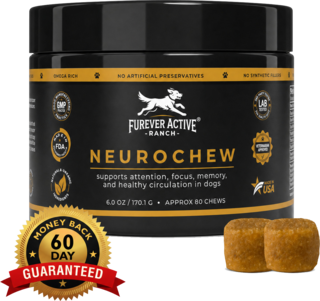
NeuroChew is built for daily brain support, not sedation.
The panel prints phosphatidylserine 5 mg, Huperzine-A 100 mcg, alpha lipoic acid 25 mg, Norwegian salmon oil 100 mg, and vitamin B1 15 mg per serving. Serving size is 2 soft chews (4 g); weight bands run from 2 chews under 30 lbs through 7 chews at 150-180 lbs.
Absent on purpose: melatonin, valerian, chamomile, L-theanine, tryptophan, hemp, and CBD.
Side-by-side honesty: if a PupGrade panel prints calming names with milligrams, it can pass the same printed-amount test we use on ourselves; if it hides doses, it fails the same way any fairy-dusted bag fails. The 60-day guarantee (not thrilled?
even the empty bottle gets a full refund) is a refund policy, not an efficacy promise.
Full retail panel: the official NeuroChew retail page from Furever Active
Bottom line: NeuroChew is a printed-amount daily brain chew, not a PupGrade clone.
So, where does NeuroChew fit into all this?
Full transparency: NeuroChew is ours. It's a veterinarian-approved daily soft chew that supports normal brain function and healthy circulation in dogs.
It's daily support, not medicine, designed to fit alongside your vet's plan rather than replace it. Dr.
Ruth Roberts, DVM, CVFT, puts it this way: "I support NeuroChew because it's the first dog chew that supports both brain function and healthy circulation!" If the signs above sound familiar, a daily brain-support routine is one of the simplest places to start.
Frequently asked questions
Are PUpgrade calming chews safe for dogs?
Safety is individual. Always consult your veterinarian before introducing any new calming supplement, especially with medications, pregnancy, lactation, or underlying disease. Read the exact bag for printed actives and stop if stool, appetite, or energy patterns worsen.
Do any dog calming chews actually work?
Some dogs respond to dietary calming aids and some do not; response varies widely. Robust clinical research on the overall effectiveness of dietary calming supplements remains limited, so treat any bag as an adjunct inside training and environmental management rather than a guaranteed fix.
What are the risks of calming chews for dogs?
Potential side effects of certain calming ingredients can include mild lethargy or gastrointestinal upset, and L-theanine may rarely cause mild digestive upset. Medication interactions and life-stage limits raise the stakes, which is why the clinic conversation comes first.
What are the most effective calming chews for dogs?
Effectiveness is not a universal ranking. Prefer bags that print milligrams, match the timing job (pre-event versus daily), and sit inside a behavior plan your veterinarian or trainer designed. Score PupGrade and NeuroChew on those rails instead of star ratings alone.
How should I read a PupGrade label before buying?
Circle every named active, write milligrams per serving, copy the weight chart, and mark FAIL if a proprietary blend hides doses. Note sedative-leaning herbs if present, then ask your veterinarian how that pouch fits beside current medications.
Does NeuroChew replace a PupGrade calming chew?
Not as a clone. NeuroChew is a daily brain-support chew with printed actives and no L-theanine, melatonin, hemp, or CBD on the label. Choose based on the job your clinician named and the printed panel you can defend, not on interchangeable aisle branding. this brand's calming chews can still be researched honestly if the bag prints amounts and your veterinarian stays in the loop for meds and red-flag signs. Pair any adjunct with a real behavior plan. If you want a non-sedation daily option with a printed panel, weight-based soft-chew chart, and a commercial 60-day guarantee, read NeuroChew the same way you would read any other bag: amounts first, promises last.
You can still research this brand honestly if the bag prints amounts and your veterinarian stays in the loop for meds and red-flag signs. Pair any adjunct with a real behavior plan.
Always consult your veterinarian before introducing any new calming supplement to your dog's routine to evaluate safety and appropriate guidance. If you want a non-sedation daily option with a printed panel, weight-based soft-chew chart, and a commercial 60-day guarantee, read NeuroChew the same way you would read any other bag: amounts first, promises last.
References
- Behavior Counseling - Complementary Medication, VCA Animal Hospitals. https://vcahospitals.com/know-your-pet/behavior-counseling---medication-complementary
- L-Theanine, VCA Animal Hospitals. https://vcahospitals.com/know-your-pet/l-theanine
- What to Know About Calming Aids for Dogs: Supplements, Toys, and More, PetMD. https://www.petmd.com/dog/behavior/dog-calming-products-help-ease-dog-anxiety
- L-Theanine, VCA Animal Hospitals. https://vcahospitals.com/know-your-pet/l-theanine
- Dietary Strategies for Relieving Stress in Pet Dogs and Cats, Animals (Basel) via PubMed Central. https://pmc.ncbi.nlm.nih.gov/articles/PMC10045725/
- Pheromones, VCA Animal Hospitals. https://vcahospitals.com/know-your-pet/pheromones
As of July 2026
Get practical dog wellness tips by email
Occasional, useful guidance on keeping your dog healthy and happy. Unsubscribe anytime.
No spam. We respect your inbox.
Support your dog's brain health with NeuroChew
NeuroChew is our daily soft chew for dogs, made fresh in the USA. See the ingredients and how it fits into a healthy daily routine.
Learn more about NeuroChew