Dog Brain Health
Dog Anti Anxiety Medication: Vet Options and Label Tests


Dog anti anxiety medication is a veterinary decision, not an aisle experiment. Clinics match support to the dog in front of them, including short pre-visit help and longer daily management when behavior work alone is not enough. Pair any product talk with training and environment changes, skip punishment for distress, and keep supplements in structure-function territory only.
If you typed dog anti anxiety medication into a search bar at 2 a.m., you are probably not shopping for a slogan. You want a plain map of what prescription support is for, what separation distress looks like at home, which behavior steps still matter, and how to read a daily brain-health chew without confusing it with a drug. We keep the frame inside source-backed education. The packet behind this page does not name individual drug classes or doses, so we will not invent them.
Related: can dogs get anxiety after pneumonia
AT A GLANCE
The pick: Our pick is NeuroChew, our own daily brain-health chew, held to the standard this guide teaches.
Reason one: Built for daily brain support, not sedation.
Reason two: Veterinarian-approved, with Dr. Ruth Roberts, DVM, CVFT as the named endorser.
Reason three: A 60-day guarantee, refunded even on an empty bottle.
Skip it if: Your dog has new, sudden, or severe symptoms, is pregnant, nursing, or a puppy, is on medication, or is managing an existing condition without your veterinarian's input.
What dog anti anxiety medication means at the clinic
Veterinarians may prescribe customized pre-visit or daily management plans depending on the dog's specific behavioral triggers and health profile. That is the honest starting line for dog anti anxiety medication: the plan is clinical, individualized, and not something you invent from a product page.
Think in two broad clinic jobs rather than one mystery bottle.
Pre-visit support is situational help for clinic fear, car rides to the exam, or other short high-stress events the veterinarian already knows about. Daily management is a longer plan for dogs whose triggers show up in ordinary life, and it still sits beside training and environment work.
VCA's pre-visit pharmaceutical guidance is useful as a contrast source for situational clinic fear, and Cornell's anxious-behavior guide steers owners toward a veterinarian or veterinary behaviorist when distress is stuck.
Keep prescription support and over-the-counter chews in separate mental buckets so you do not blur the two.
Source: VCA Animal Hospitals and Cornell Riney Canine Health Center
Bottom line: Hold to this limit: veterinarians may prescribe customized pre-visit or daily management plans depending on the dog's specific.
When the clinic visit itself is the trigger
If a dog exhibits intense fear or resistance during veterinary visits, owners may consult their veterinarian about pre-visit pharmaceuticals to help manage the situational stress. That conversation belongs with the clinic team that knows the dog's medical history, not with a late-night product page.
Ask about timing relative to the appointment, what monitoring the team wants, and what signs mean you should call back.
Do not blur prescription situational support with an everyday soft chew you bought for routine brain health. A daily structure-function chew and a pre-visit pharmaceutical answer different jobs on different clocks.
Source: VCA Animal Hospitals
Bottom line: Hold to this limit: if a dog exhibits intense fear or resistance during veterinary visits, owners may consult.
What separation distress can look like when you leave
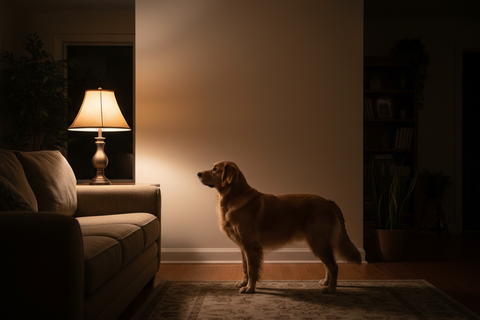
Dogs experiencing separation anxiety may exhibit severe, panic-like behaviors such as destructive escape attempts, persistent howling, or pacing when left alone. VCA's board-certified behaviorist guidance also flags house soiling when separated and destruction aimed at owner items or exit doors.
A cheap camera is often more honest than memory because it shows whether the spike starts right after departure.
This pattern is education about signs, not a checklist diagnosis, and it is not a cue to stack random products before a real plan exists. Bring video and a short timeline to the clinic so the medication conversation, if it happens, starts from facts rather than late guesses.
Bottom line: Hold to this limit: dogs experiencing separation anxiety may exhibit severe, panic-like behaviors such as destructive escape attempts.
Why dogs get anxious in the first place
A dog's anxiety may be influenced by genetics, environment, traumatic events, or biological factors involving the communication between the gut and the brain. Cornell's owner guidance covers causes, the value of a predictable routine, and clear escalation to professional help.
A 2024 Veterinary Medicine International review maps gut-brain pathways in dogs and still calls canine-specific evidence scarce and exploratory.
Use that framing for owner education only. It is not proof that any single product rewrites temperament on contact, and it is not a substitute for naming the actual trigger in front of you.
Source: Cornell Riney Canine Health Center and Veterinary Medicine International (Wiley, formerly Hindawi), via NCBI/PMC
Bottom line: Hold to this limit: a dog's anxiety may be influenced by genetics, environment, traumatic events, or biological factors.
Behavior work that still does the heavy lifting

Desensitization techniques, establishing predictable daily routines, and providing a secure environment may help lower a dog's overall stress levels. Short, boring practice departures beat heroic all-day absences you hope a dog will suddenly tolerate.
Food puzzles, dim light, a familiar bed, and a quiet landing zone are unglamorous infrastructure.
Cornell and ASPCA owner materials both keep the order honest: the retraining program drives lasting change, and products are optional adjuncts rather than the whole plan. If a medication conversation is on the table, bring this baseline with you so the clinic is not being asked to paper over a chaotic day.
Source: Cornell Riney Canine Health Center
Bottom line: Hold to this limit: desensitization techniques, establishing predictable daily routines, and providing a secure environment may help lower.
Skip the scolding loop when you walk back in

Pet owners should avoid scolding or punishing a dog for anxious behaviors, such as house-soiling or destructive chewing, as this may increase the dog's distress. A shredded pillow is information, not a moral failure.
ASPCA and Cornell materials both steer owners away from punishment for distress behaviors.
After a hard exit, protect the dog from rehearsing the same panic pattern, tidy the space, and put the energy into routine and professional guidance instead of a lecture once the damage is already done. Medication and training both fail faster when the home response is anger.
Bottom line: Hold to this limit: pet owners should avoid scolding or punishing a dog for anxious behaviors, such as.
Gut-brain science stays secondary on a medication page
Emerging science suggests a connection between the gut microbiome and canine behavior, though responses vary widely and further research is needed to fully understand these pathways. Keep this section short on purpose.
The primary job of a anti-anxiety medication page is clinic framing, trigger mapping, and behavior order of operations.
Gut-brain papers are interesting background, not a reason to demote the veterinarian or to handle a retail pouch like a prescription. The 2024 Animals review supports mechanism-level explanation only and still states that no study yet shows any intervention, including FMT, improves canine behavioral symptoms.
Mechanism talk is education, not a claim about our chew.
Source: Veterinary Medicine International (Wiley, formerly Hindawi), via NCBI/PMC
Bottom line: Hold to this limit: emerging science suggests a connection between the gut microbiome and canine behavior, though responses.
Association findings are not a leash you can yank
Variations in the composition of the gut microbiota have been associated with differences in anxiety and aggression levels in companion dogs. Keep that as a short sidebar on a medication-intent page, not the spine of the article.
Correlation can inform curiosity.
It cannot justify a causal medical claim or transfer a strain-specific probiotic trial onto a formula that does not contain that strain. After the clinic frame and behavior baseline are clear, some owners still want a printed-amount daily option for overall brain health.
NeuroChew is our own daily brain-support chew; the appended product note below carries the rest.
Source: Peer-reviewed article via PubMed Central
Bottom line: Hold to this limit: variations in the composition of the gut microbiota have been associated with differences in.
So, where does NeuroChew fit into all this?
Full transparency: NeuroChew is ours. It's a veterinarian-approved daily soft chew that supports normal brain function and healthy circulation in dogs.
It's daily support, not medicine, designed to fit alongside your vet's plan rather than replace it. Dr.
Ruth Roberts, DVM, CVFT, puts it this way: "I support NeuroChew because it's the first dog chew that supports both brain function and healthy circulation!" If the signs above sound familiar, a daily brain-support routine is one of the simplest places to start.
Frequently asked questions
What is the best medication to give a dog for anxiety?
There is no single best bottle for every dog. The clinic matches support to the dog's triggers, medical history, and whether the need is short situational help or longer daily management. This page cannot name drug classes or doses because those facts are not in the packet; ask your veterinarian for the options that fit your dog.
Can dogs have panic attacks?
Dogs can show intense, panic-like distress, especially around separation, with escape attempts, nonstop vocalizing, or restless pacing when left alone. Those signs need veterinary and behavior guidance, not a punishment loop or a random aisle experiment.
Why do dogs get anxious?
Causes can include genetics, environment, past trauma, and broader biology, including gut-brain research that is still early. Cornell's owner guidance is a solid starting map, and stuck or severe cases belong with a veterinarian rather than a product page.
How to help a dog not be stressed?
Build predictable routines, practice short desensitization reps, and make the landing zone feel secure. Skip scolding for distress behaviors, and ask your veterinarian before adding any medication or supplement so the tools do not fight each other.
Is dog anti anxiety medication the same as a calming chew?
No. Prescription medication is veterinarian-directed clinical care. A daily brain-support chew is structure-function support for overall brain health and cognitive function, with printed label amounts and no sedative herbs on the label. Keep those categories separate.
When should I call the vet before trying anything new?
Call first for sudden behavior change, night disorientation, signs of pain, self-harm during escape attempts, or intense clinic panic. Pre-visit pharmaceutical questions also belong with the clinic team that already knows the dog's chart.
Handle clinic-directed medication as clinical care first, then layer training, environment, and honest labels. Ruth Roberts, DVM, CVFT as the named endorser.
We print her exact words rather than paraphrasing them into something stronger: "I support NeuroChew because it's the first dog chew that supports both brain function and healthy circulation!" Serving size is 2 soft chews (4g), with weight-based daily dosing from 2 chews under 30lbs up to 7 chews at 150-180lbs.
Explore NeuroChew on the official retail page when you want the full printed panel beside a clinic-led plan.
References
- Pre-Visit Pharmaceuticals for Dogs, VCA Animal Hospitals. https://vcahospitals.com/know-your-pet/pre-visit-pharmaceuticals-for-dogs
- Anxious behavior: How to help your dog cope with unsettling situations, Cornell Riney Canine Health Center. https://www.vet.cornell.edu/departments-centers-and-institutes/riney-canine-health-center/canine-health-topics/anxious-behavior-how-help-your-dog-cope-unsettling-situations
- Gut microbiota composition is related to anxiety and aggression scores in companion dogs, Peer-reviewed article via PubMed Central. https://pmc.ncbi.nlm.nih.gov/articles/PMC12234828/
- Efficacy of a Novel Lactiplantibacillus plantarum Strain in Reducing Canine Aggression and Anxiety: A Randomized Placebo-Controlled Trial, Peer-reviewed article via PubMed Central. https://pmc.ncbi.nlm.nih.gov/articles/PMC12345577/
- Gut-Brain Axis Impact on Canine Anxiety Disorders: New Challenges for Behavioral Veterinary Medicine, Veterinary Medicine International (Wiley, formerly Hindawi), via NCBI/PMC. https://pmc.ncbi.nlm.nih.gov/articles/PMC10827376/
As of July 2026
Get practical dog wellness tips by email
Occasional, useful guidance on keeping your dog healthy and happy. Unsubscribe anytime.
No spam. We respect your inbox.
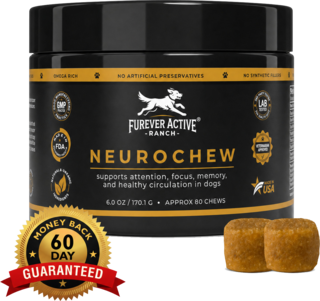
Support your dog's brain health with NeuroChew
NeuroChew is our daily soft chew for dogs, made fresh in the USA. See the ingredients and how it fits into a healthy daily routine.
Learn more about NeuroChew