Dog Brain Health
Calming Peanut Butter for Dogs: Reality and Real Brain Support


Depending on the specific active ingredients and your dog's individual response, calming supplements may take anywhere from a few hours to several weeks of consistent use to produce noticeable results.
When you search late at night for ways to help a restless pet, you will see dozens of jars of calming peanut butter for dogs. Most of these products promise rapid peace, yet they rarely explain how their ingredients actually work in the body.
Related: do calming treats work for dogs
We believe you deserve to understand what you are putting in your dog's bowl before you make a purchase.
AT A GLANCE
The pick: Our recommendation for daily cognitive and nervous-system care is NeuroChew, evaluated by the printed-amount test to ensure every single active ingredient is fully disclosed and backed by solid canine evidence.
Reason one: Every single milligram of our active ingredients is printed transparently on our label, passing the printed-amount test.
Reason two: We focus on daily brain support rather than sedation, leaving out melatonin, valerian, and sedative herbs completely.
Reason three: We designed our formula specifically for the aging canine brain, selecting evidence-backed nutrients like Phosphatidylserine.
Skip it if: Skip this supplement and seek immediate veterinary care if your dog exhibits sudden behavioral changes, night disorientation, or any signs of pain.
How long does calming peanut butter take to work?

Depending on the specific active ingredients and your dog's individual response, calming supplements may take anywhere from a few hours to several weeks of consistent use to produce noticeable results. The scientific evidence supporting the use of certain calming ingredients, like alpha-casozepine, is still emerging, and behavioral responses can vary widely from dog to dog.
Synthetic pheromones can help reduce fear and environmental stress in dogs by mimicking the natural reassuring signals mothers release to their puppies.
These specialized compounds are delivered through diffusers or collars, providing a constant olfactory signal of safety that operates entirely outside the digestive tract. Complementary options like pheromones serve as useful adjuncts inside a veterinarian-guided behavior plan, helping to ease transitions during travel or home changes.
Remember, however, that external signals work best when paired with physical comfort, stable routines, and proper neurological nutrition.
Source: VCA Animal Hospitals and Veterinary Evidence
Expect a variable timeline when introducing calming ingredients, as consistency over weeks is often required for true behavioral support.
What are the side effects of calming ingredients?
While generally well-tolerated, some calming supplement ingredients such as L-theanine may cause mild side effects in some dogs, including temporary lethargy, sleepiness, or mild gastrointestinal upset. Because some calming ingredients can interact with other medications, especially those that cause drowsiness, it is important to consult your veterinarian before introducing them to your dog's routine.
Before starting any calming supplements or complementary therapies, consult a veterinarian to rule out any underlying painful or medical conditions that could be driving your dog's behavioral changes.
What appears to be situational anxiety can often be a physical symptom of joint discomfort, metabolic imbalances, or progressive neurological shifts. Please see your veterinarian first, before you see us as an easy answer.
The fear that brought you to this page was probably never really which chew do I buy, it was closer to please let this not be the thing I have been afraid of, and that fear deserves a real medical answer, not a supplement funnel dressed up as one.
If you read every word of this section instead of skipping to checkout, you did the one thing most shoppers never do before buying a supplement, and that is worth being proud of.
Source: VCA Animal Hospitals
Even well-tolerated calming ingredients can cause mild lethargy or stomach upset, so always monitor your dog's response closely.
Does L-theanine help calm a dog?

L-theanine, an amino acid found in green tea, may help encourage a calm state and help manage environmental stressors or noise sensitivities in dogs.
Source: VCA Animal Hospitals
L-theanine is a common amino acid used to support dogs during noise events, though its presence must always be verified by clear label dosing.
Do pressure vests work for anxious dogs?
While pressure vests are a popular drug-free option, current veterinary evidence regarding their ability to reduce stress and fear in anxious dogs is limited and inconsistent.
Source: Veterinary Evidence
Veterinary evidence for pressure vests remains weak and mixed, making them a supportive trial option rather than a proven solution.
So, where does NeuroChew fit into all this?
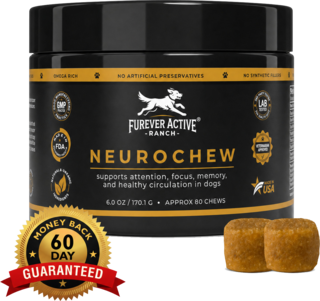
Full transparency: NeuroChew is ours. It's a veterinarian-approved daily soft chew that supports normal brain function and healthy circulation in dogs.
It's daily support, not medicine, designed to fit alongside your vet's plan rather than replace it. Dr.
Ruth Roberts, DVM, CVFT, puts it this way: "I support NeuroChew because it's the first dog chew that supports both brain function and healthy circulation!" If the signs above sound familiar, a daily brain-support routine is one of the simplest places to start.
Frequently asked questions
How long does calming peanut butter take to work?
Depending on the specific active ingredients and your dog's individual chemistry, calming supplements can take anywhere from a few hours to several weeks of consistent use to show noticeable results. Some ingredients like L-theanine may offer short-term support for environmental stressors, while emerging options like alpha-casozepine require longer-term, consistent routine building.
What are the side effects of calming chews for dogs?
While generally well-tolerated, some calming ingredients such as L-theanine can cause mild side effects including temporary lethargy, sleepiness, or mild gastrointestinal upset. Additionally, because certain calming ingredients can interact with other medications, especially those that cause drowsiness, it is vital to consult your veterinarian before introducing them to a dog on an existing prescription plan.
When seeking support for your pet, focus on transparent labels and science-backed ingredients rather than marketing promises. Always consult a veterinarian to evaluate sudden behavioral changes or potential medical conditions.
By taking a methodical, safety-first approach, you can construct a daily routine that truly supports your dog's long-term wellness.
References
- Behavior Counseling - Complementary Medication, VCA Animal Hospitals. https://vcahospitals.com/know-your-pet/behavior-counseling---medication-complementary
- L-Theanine, VCA Animal Hospitals. https://vcahospitals.com/know-your-pet/l-theanine
- Pheromones, VCA Animal Hospitals. https://vcahospitals.com/know-your-pet/pheromones
- Is Alpha-casozepine Efficacious at Reducing Anxiety in Dogs?, Veterinary Evidence. https://veterinaryevidence.org/index.php/ve/article/view/67
- Are Pressure Vests Beneficial at Reducing Stress in Anxious and Fearful Dogs?, Veterinary Evidence. https://veterinaryevidence.org/index.php/ve/article/view/152
As of July 2026
Get practical dog wellness tips by email
Occasional, useful guidance on keeping your dog healthy and happy. Unsubscribe anytime.
No spam. We respect your inbox.
Support your dog's brain health with NeuroChew
NeuroChew is our daily soft chew for dogs, made fresh in the USA. See the ingredients and how it fits into a healthy daily routine.
Learn more about NeuroChew