Senior Dog Care
Best Cognitive Supplements for Dogs: If the Label Won't Print the Amount, It Doesn't Count


The best cognitive supplement for a dog is the one whose maker will print the exact milligram or microgram of every active ingredient, say plainly which ones are proven in dogs and which are borrowed from other species, and admit in writing where the formula runs thin.
Judged against that standard, our own pick is NeuroChew, the daily brain-health soft chew we formulate as Furever Active Ranch, and we're telling you that in paragraph one instead of paragraph twelve.
That's the deal on this page: we teach the standard first, hold our own product to it in public, and link the sources behind every claim so you can check our arithmetic yourself.
AT A GLANCE
**The pick:** NeuroChew, our own daily brain-health soft chew, judged against the standard this article teaches.
**Reason one:** every active carries its own printed amount, never a "proprietary blend" figure.
**Reason two:** every ingredient carries an honest evidence tier, not one blanket "clinically proven" claim.
**Reason three:** no melatonin, no sedative herbs, built for daily support rather than sedation.
**Skip it if:** new, sudden, or severe symptoms (see a vet first); pregnancy, nursing, puppyhood, medication, or an existing condition without your vet's input; you want a precisely dosed EPA/DHA concentrate; or you expect overnight results.
We Make NeuroChew. Here's Why We're Writing The Buying Guide Anyway
We started this company because we read supplement labels and got angry.
We are Furever Active Ranch, we formulate NeuroChew, and we're writing this under our own name because the "neutral" alternative, a site with no product and no accountability, is worse. We started reading proprietary blend labels one by one, watching good ingredient names hide behind a single combined milligram figure.
The typical "best cognitive supplements for dogs" list earns an affiliate commission on whichever bag you click, so it's paid by everyone. This page is written by people who earn nothing from any product on it except the one we make, and we tell you that in paragraph one.
We set every number on our own label, and we'll defend each one out loud, by name. We're a small, family-and-friend owned company, not a faceless lab.
The industry spends its engineering budget on puppies and healthy adults, and aging dogs get whatever formula is left over; we think a ten-year-old dog deserves the same rigor a two-year-old gets.

Bottom line: we're not neutral, we never claimed to be, and this page is us proving bias doesn't have to mean dishonesty.
People Search This At Eleven At Night, Not On A Lazy Afternoon
People don't often type "best cognitive supplements for dogs" into a search bar on a lazy Tuesday afternoon.
They type it at eleven at night, phone lit in a dark kitchen, because the dog who used to sleep through until sunrise is pacing the hallway for the third time this week, or stood in a doorway like he'd forgotten what doorways are for, or looked at you for half a second like you were a stranger. Some part of you is scared to finish the sentence that starts with "what if this is the beginning of."
Veterinarians watch for a cluster of age-related signs: disorientation, interaction changes, sleep-wake changes, house-soiling, activity changes, and anxiety, and owners typically notice it long before a formal exam does (Cognitive Dysfunction Syndrome in Dogs, VCA Animal Hospitals). Noticing early isn't paranoia; sudden or severe versions still need a vet, not a chew.
This article is built around the ordinary slowing down, not the emergency.
Bottom line: gradual means you have time to research this properly, sudden means stop reading and call your vet.
You are not the only one who has stood in that hallway. One NeuroChew customer put it this way: "He was getting really disoriented, especially at night.
It made us so sad to see him like that. Now he seems steady and balanced at night."
That's one customer's experience, not a promise from us, and it's the same routine this whole page is built around.
What Matters When You're Choosing A Cognitive Supplement?
How much, not which names are on the bag, NeuroChew included.
The supplement industry has a name for hiding that answer: fairy-dusting, listing good-sounding ingredients under one combined figure, a "proprietary blend," so you can see the ingredient is present but never learn at what dose. A GeroScience systematic review of nutraceuticals for aging dogs and cats makes the scientific version of the same point: an ingredient's value cannot be separated from the dose it was studied at, in the species it was studied in (GeroScience systematic review, via PubMed Central).
Plenty of "best cognitive" roundups still rank ingredients by name recognition instead of dose.
THE PRINTED-AMOUNT TEST
Every active ingredient in NeuroChew earns its place with an exact amount we will defend in public.
If we cannot print the number, the ingredient does not go in the formula.
Our rule, and the rule we're handing you to hold every other bag up against.
Five things fall out of that rule. Call it the five-point test.
1. Real amounts, per ingredient, never split across nine others behind a blend.
2. Evidence tiers, not one flat "clinically proven" banner: direct-canine (tested in dogs for this use), canine-context (tested in dogs, different use), human-or-general (studied in people, not dogs), label-only (on the label, no research claim).
3. Cognition and circulation, considered together, two sections down. 4. Dosing that scales with your dog's actual weight. A 12-pound terrier and a 110-pound mastiff have no business on the same flat dose.
5. A clean inactive list, no artificial colors, preservatives, or filler behind a short active list.
Everything below maps to one of these five.
Bottom line: if a bag can't answer "how much" for every active ingredient, close the tab.
Why Is "Calm" The Most Dangerous Word On A Supplement Label?
Most calming chews aren't built to calm your dog.** **They're built to sedate him.
Melatonin is a sleep hormone, an ingredient-class fact, and it turns up often in calming chews, alongside sedative botanicals like valerian root and chamomile, both borrowed from human sleep aids. None of that makes those ingredients evil; it makes them the wrong tool for a dog who needs steady daily support instead of a dog sedated through a thunderstorm.
A sedated dog looks calm from across the room, but sedation can flatten the exact signs (restlessness, pacing, night waking) that would otherwise tell you and your vet something is changing. NeuroChew's label carries no melatonin and no sedative herbs; it supports steady daily brain health, not a knockout dose.
the printed-amount test applies here too: a "calming" chew that won't print which ingredient is doing the work, and at what dose, isn't telling you which one you're buying.
Bottom line: calm and sedated aren't the same thing, read the label to find out which one you're buying.
Why Does A Cognitive Supplement Need To Think About Blood Flow?
A dog's brain does not age apart from the rest of her body, the piece most cognitive-supplement pages leave out entirely.
Veterinary researchers who study the aging canine brain keep finding the same pattern: changes in small blood vessels and the blood-brain barrier show up together with cognitive changes (Vite and Head, Veterinary Clinics of North America, via PubMed Central). A 2025 clinical review in Today's Veterinary Practice describes that vascular-cognition link carefully, naming patterns like leukoaraiosis (white-matter changes tied to small vessels) without overselling it into a cure story (Updates on Cognitive Dysfunction Syndrome, Today's Veterinary Practice).
A pathology study of 37 aged dog brains documented amyloid inside the brain's blood vessel walls (cerebral amyloid angiopathy) as an age-related lesion, and its authors were skeptical about tying that lesion directly to canine cognitive change (Ozawa et al., Journal of Veterinary Medical Science, via PubMed Central). Heart and vessel disease is common in dogs too: Merck's veterinary manual states that slightly more than 10 percent of animals examined by a veterinarian show some form of cardiovascular disease (Heart Disease in Dogs, Merck Veterinary Manual).
That's the other half of the formula most roundups leave out, and why the veterinarian's quote later in this article pairs circulation with brain function too, not by accident.
Bottom line: a brain-health formula that ignores blood flow is only doing half the job.
What's In NeuroChew, Milligram By Milligram?
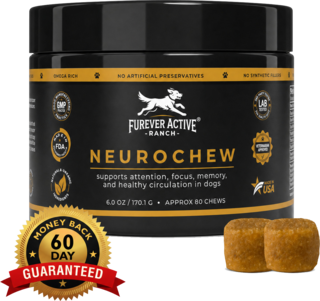
In NeuroChew, phosphatidylserine, huperzine-A, and alpha lipoic acid share one shelf because we can put an exact, defensible number next to each. One serving is 2 soft chews (4 g); the daily chew count scales with weight in the dosing table below.

Above is the real label; below is the same panel as text, so you can read it, compare it, and check our arithmetic. Every amount is per one serving of 2 soft chews (4 g); for your dog's daily intake, multiply by the servings column in the dosing table further down.
Evidence-tier key, so the table below makes sense at a glance: Direct-canine: tested in dogs for this kind of use.
Canine-context: tested in dogs, but not for this exact use. Human-or-general: research in people or general nutrition, not dogs.
Label-only: it's on the label; we make no research claim.
| Ingredient | Amount per serving (2 chews) | Evidence tier | What it's for |
|---|---|---|---|
| Phosphatidylserine (PS) | 5 mg | Direct-canine | Cell-membrane phospholipid, cognitive wellness support |
| Huperzine-A | 100 mcg | Canine-context | Acetylcholinesterase-inhibiting botanical, dose-sensitive |
| Alpha Lipoic Acid (ALA) | 25 mg | Canine-context | Antioxidant support |
| Norwegian Salmon Oil | 100 mg | Canine-context | Omega source, skin, coat, immune, and brain-health support |
| Vitamin B1 (Thiamine) | 15 mg | Direct-canine | Essential for normal nervous-system function |
| Organic Beet Root Powder | 20 mg | Human-or-general | Phytonutrient, modest dose |
| Organic Carrot Powder | 300 mg | Canine-context | Whole-food fiber and carotenoid nutrition |
| Organic Apple Powder | 300 mg | Human-or-general | Whole-food fiber and palatability |
| Organic Celery Leaf Powder | 300 mg | Human-or-general | Chew base |
| Organic Lemon Powder | 100 mg | Label-only | Flavor |
| Ginger Root Powder | 50 mg | Canine-context | Digestive-comfort context, secondary role |
NeuroChew's inactive list is short too: oat flour, hydrolyzed fish bioflavor, lecithin, glycerin, sunflower oil, natural flavor, and natural AOX. Nothing artificial, nothing hidden behind the actives above.
How Much Phosphatidylserine Does A Dog Need?
Buying back an ordinary Tuesday, not a smarter dog.
Here's what that 5 mg per serving is for (a 60-to-90-pound dog at 4 chews a day gets 10 mg): you're not trying to make your dog smarter, you're trying to protect the small daily moments, the one where he still lifts his head off the rug the second he hears your keys, instead of two seconds later. Underneath that, phosphatidylserine is a phospholipid, a structural building block of the membrane wrapped around every brain cell, where a neuron holds its shape, manages its signal receptors, and keeps cell-to-cell communication running.
Veterinary reviews of the aging canine brain describe membrane-level and vascular change as part of ordinary aging (Vite and Head, Veterinary Clinics of North America, via PubMed Central), and of everything on our label, PS carries the firmest direct-in-dogs footing, which is why it anchors the formula. The GeroScience systematic review shows aged-dog cognitive nutrition research is still maturing, so we dose PS at 5 mg and frame it as cognitive-wellness support, not a fix for anything (GeroScience systematic review, via PubMed Central).
Why Is Huperzine-A Measured In Micrograms, Not Milligrams?
The smallest number on our label is the one we're proudest of.
Huperzine-A is the smallest number on the NeuroChew label, a thousand times smaller than the milligram doses next to it. It's a plant compound studied as an acetylcholinesterase inhibitor, education about the compound class rather than a claim about our chew: it works by slowing how fast the brain clears a signaling chemical called acetylcholine, so each signal lasts a little longer.
A dog-specific pharmacokinetic study on huperzine-A's absorption and clearance in dogs tells us amount matters, which is why ours is 100 micrograms, not milligrams (Pharmacokinetics of huperzine A in dogs, PubMed). We chose a conservative, printed microgram dose over burying it in a blend, and a product listing huperzine-A with no microgram figure is worth a question before purchase.
Why Alpha Lipoic Acid Instead Of Vitamin E Or C?
Alpha lipoic acid earns its spot through a specific job: normal metabolism throws off free radicals, and antioxidant systems neutralize them before they damage cells, a balance studied directly in dogs and cats (Effect of dietary antioxidants on free radical damage in dogs and cats, via PubMed Central). Plenty of products check the antioxidant box with vitamin E or C; we chose ALA at 25 mg instead, backed by a long-term beagle feeding study on glutathione ratios (Long-term feeding of dl-alpha-lipoic acid in beagles, PubMed).
We tier ALA as canine-context: antioxidant support at a defensible dose, no disease claim.
What's The Trade-Off In Using Whole Salmon Oil Instead Of Isolated EPA/DHA?
The one place we chose accuracy over marketing shine.
NeuroChew uses 100 mg of Norwegian salmon oil as a whole-oil omega source, and here's where we chose plain accuracy over a flashier number. Much of the competitive set sells omega support as isolated fish oil measured in precise EPA and DHA milligrams, backed by veterinary writing on why those exact numbers matter, since fish-oil effects are dose- and context-dependent (Fish Oil Dosing in Pet Diets and Supplements, Today's Veterinary Practice; Therapeutic use of fish oils in companion animals, PubMed).
Until we have a supplier and lab spec that lets us print an exact EPA and DHA figure, we won't imply one: we frame our salmon oil as general omega support for skin, coat, immune, and brain health, not a standalone cognition dose. If a precisely dosed EPA/DHA number is your priority, say so: a dedicated concentrate may suit you better.
Why Does A Brain Chew Need Vitamin B1?
Basics before botanicals.
Thiamine isn't a trendy nootropic, and we like that about it: it's an essential nutrient a dog's body can't make enough of on its own, a coenzyme turning food into usable energy for metabolically demanding nervous-system tissue. That's established nutritional science, not marketing.
We tier it direct-canine and include 15 mg per serving accordingly.
What's In The Whole-Food Base?

Five ingredients make up NeuroChew's whole-food base and palatability layer, where the category's worst habit lives. Organic carrot powder (300 mg) contributes fiber and carotenoids, backed by canine-specific research (Carrot pomace digestibility in dogs, via PubMed Central; beta-carotene in dogs, Journal of Nutrition).
Organic apple powder (300 mg) contributes fiber and palatability too; that fiber claim is general nutrition science rather than a canine-specific study, so we tier it human-or-general like celery. Organic celery leaf powder (300 mg) and organic lemon powder (100 mg) round out the base and the flavor.
Organic beet root powder (20 mg) is a phytonutrient inclusion: the canine research on beets concerns beet pulp, not a blood-flow claim at 20 mg (sugar beet pulp and canine microbiota, PubMed). Ginger root (50 mg) sits here too, for digestive-comfort context.
We could have branded this base an "antioxidant superfood cognition complex," but broad pet-nutrition reviews keep carotenoid claims conservative, so we do too (Pet Wellness and Vitamin A overview, via PubMed Central).
Look at that table again: matching it ingredient for ingredient means a phosphatidylserine capsule, a hard-to-find botanical extract, a fish oil, and a B-complex, bought separately and split to your dog's weight by guesswork. We put it on one label, one chew, one weight-based chart instead.
That's arithmetic.
Bottom line: eleven ingredients, every one dosed, tiered, and honestly labeled.
See NeuroChew's full label and ingredient breakdown
How Much NeuroChew Does A Dog Get, By Weight?
NeuroChew is dosed daily by weight.


| Dog's Weight | Chews per day | Servings per day (1 serving = 2 chews) | Multiply label amounts by | Phosphatidylserine per day |
|---|---|---|---|---|
| Under 30 lbs | 2 chews | 1 | x1 | 5 mg |
| 30 to 60 lbs | 3 chews | 1.5 | x1.5 | 7.5 mg |
| 60 to 90 lbs | 4 chews | 2 | x2 | 10 mg |
| 90 to 120 lbs | 5 chews | 2.5 | x2.5 | 12.5 mg |
| 120 to 150 lbs | 6 chews | 3 | x3 | 15 mg |
| 150 to 180 lbs | 7 chews | 3.5 | x3.5 | 17.5 mg |
That same multiplier applies to every other active ingredient on the label, not just phosphatidylserine.
Here is the detail most labels never spell out and most owners never catch: the Product Facts panel prints its amounts per one serving of 2 chews, but the daily dose scales with weight. A 100-pound dog on 5 chews a day is getting 2.5 servings, so his actual daily phosphatidylserine is 12.5 mg, not the 5 mg printed per serving.
That multiplier column is how you read our label honestly for YOUR dog, and it is the same question you should ask of any label that prints per-serving numbers next to a weight-based feeding chart.
Bottom line: label amounts are per serving; your dog's daily intake is the label amount times the multiplier for his weight.
What's In The Guaranteed Analysis Panel?
Here is the guaranteed analysis printed on the NeuroChew label.
| Measure | Guarantee |
|---|---|
| Crude Protein | Not less than 11% |
| Crude Fat | Not less than 18% |
| Crude Fiber | Not more than 2% |
| Moisture | Not more than 13% |
| Calorie Content | 7.4 Kcal per chew |
Bottom line: standard feed-label numbers, printed in full.
What Did A Veterinarian Actually Say About NeuroChew?
Her exact words, and why diagnosis is the vet's job here, not our marketing.
Dr. Ruth Roberts, DVM, CVFT (Certified Veterinary Food Therapist), reviewed NeuroChew and approved it: a named veterinarian on record, not an anonymous "vets love it" claim, and here is what she told us, unedited.
"I support NeuroChew because it's the first dog chew that supports both brain function and healthy circulation!"
Source: Dr. Ruth Roberts, DVM, CVFT
We don't pay Dr. Roberts for her endorsement and she earns no percentage of our sales; she shares NeuroChew with her own audience, including through an affiliate link.
We're printing her exact words rather than paraphrasing them stronger than she said.
Veterinarian-approved means one named veterinarian reviewed the formula. It is not a category claim about the industry.
That echo is the vascular research above. A vet's job is diagnosis.
This article exists so you can read the label yourself, check the tiers, and know when to hand the question to your vet. Senior dogs benefit from regular checkups, where age-related changes get caught early (2023 AAHA Senior Care Guidelines for Dogs and Cats); a daily chew supports that routine, it doesn't replace the exam.
Bottom line: one named vet's exact words, plus a standing rule: research the label yourself, use your vet for diagnosis.
How Does NeuroChew Compare To The Common Alternatives?
Where each alternative wins.
NeuroChew leaves out several ingredient classes common in this category (SAMe, MCT oil, isolated EPA/DHA fish oil, and standalone antioxidant blends), and it's fairer to name them than pretend they don't exist.
| Ingredient Class | What It Offers | Our Trade-off | Who Should Choose It Instead |
|---|---|---|---|
| Isolated EPA/DHA fish oil concentrate | An exact, lab-verified omega dose (Fish Oil Dosing in Pet Diets, Today's Veterinary Practice) | We use whole salmon oil and won't print an EPA/DHA figure we can't verify yet | Owners who want a precisely dosed, lab-verified omega number |
| MCT oil | Appeared as part of a full therapeutic diet studied in dogs showing signs of cognitive dysfunction, not as a standalone ingredient (Efficacy of a Therapeutic Diet on Canine Cognitive Dysfunction, via PubMed Central; background at VCA Animal Hospitals: MCT Oil) | NeuroChew does not contain MCT oil | Owners working with their vet on a prescribed therapeutic diet |
| SAMe | Used in some cognitive and liver-support formulas | A formulation-philosophy choice, not a verdict on the ingredient; we kept our panel to compounds we could source transparently at conservative doses | Owners whose vet has specifically recommended SAMe |
| Antioxidant blends (vitamin E/C) | A studied, legitimate antioxidant role in dogs (dietary antioxidants in dogs and cats, via PubMed Central) | We cover that role with alpha lipoic acid at 25 mg instead | Owners who specifically want a recognizable vitamin E or C profile |
A therapeutic diet is not a chew, and a diet-level study doesn't prove one ingredient pulled from it works the same way alone. We didn't say every alternative is inferior, just where each one wins.
Bottom line: four ingredient classes we don't use, four honest reasons why, four kinds of owner who should choose them instead.
How Do You Read Any Dog Supplement Label In 30 Seconds?
Use this on the next bag you pick up, whichever brand it is.

One: is there a proprietary blend? Several ingredients under one combined figure means you can't know the working dose.
the printed-amount test fails here immediately.
Two: does every active carry its own milligram or microgram amount, not a vague "with"? No number means packaging without a dose.
Three: does the label name evidence tiers, or call everything "clinically proven"? Direct-canine, canine-context, human-or-general, and label-only are the four we use.
Four: if the product claims "calming," does it print which ingredient is doing that work, and is it a known sedative? Melatonin, valerian, and chamomile belong in that conversation.
Run those four checks on NeuroChew's own table above.
Bottom line: four questions, thirty seconds, and you'll know more than most owners learn before buying a bag.
Where Does NeuroChew Fall Short, And Who Should Skip It?
Honesty cuts both ways.
This standard applies to us too: here's where we'd point you elsewhere, or straight to your vet, before you order anything from us.
It is not a treatment for anything. NeuroChew supports brain health, cognition, nervous-system wellness, and healthy aging as part of a daily routine, and it is not intended to diagnose, treat, cure, or prevent any disease.
A dog with new or severe symptoms needs a veterinary workup, not a soft chew.
Sudden changes need a diagnosis, not a supplement. The very signs that send owners searching for a brain chew (nighttime restlessness, disorientation, getting stuck in corners) have several possible causes, and some are urgent.
Restlessness can be pain, and pain in dogs is easy to miss because they hide it well (Recognizing pain in dogs, Cornell Riney Canine Health Center; 2022 AAHA Pain Management Guidelines, PubMed). Sudden loss of balance, a head tilt, or circling can be vestibular disease (Vestibular Disease in Dogs, VCA Animal Hospitals).
Bumping into furniture and disorientation in the dark can be vision loss (Blindness in Dogs, VCA Animal Hospitals). Any of these, alongside the cluster of signs veterinarians group under cognitive dysfunction, deserves a professional workup, because a behavior change can have a medical cause a checklist will always miss (Diagnosis of Behavior Problems in Animals, Merck Veterinary Manual; Cognitive Dysfunction Syndrome in Dogs, VCA Animal Hospitals).
Please see your veterinarian first, before you see us as an answer. Underneath all of this: the fear that brought you to this page was probably never really "which chew do I buy," it was closer to "please let this not be the thing I've been afraid of," and that fear deserves a real medical answer.
It doesn't deserve a supplement funnel dressed up as one.
It is not for every dog without a vet's input. If your dog is pregnant, nursing, a young puppy, on medication, or managing an existing condition, talk to your veterinarian first.
Huperzine-A is dose-sensitive, and your vet is best positioned to weigh it against anything else your dog takes.
It is a daily routine product, not a fast fix. If you want something that works overnight, this isn't it.
We say so plainly instead of letting a five-star review imply otherwise. Picture next October: the porch light on, the leash coming off the hook, the same dog trotting out to it the way he always has.
That's what a daily routine is for, more ordinary days that look like the ones before, and we're not dressing that up as a promise, because it isn't one.
We've read enough of these label sheets to know exactly where a formula can quietly lie to you: a combined "proprietary blend" hiding the real number, a canine claim built on a mouse study, a five-star average with no ingredient panel anywhere near it. We just spent this whole page showing you every place ours could have done that, and didn't.
That's worth something, but we're not asking you to take it on faith: the real refund policy is a few lines down.
Bottom line: we'd rather lose a sale than let a symptom that needs a vet get treated like a supplement decision.
What Do The Reviews Prove, And What Does The Guarantee Cover?
A star rating tells you what other owners felt, not the label, the dosing chart, or your vet.
NeuroChew currently shows 14,871+ reviews averaging 4.8 out of 5 on our own store as of July 2026, where you can read customers' own words for yourself; weigh that however you like, then let the guarantee carry the risk: return the unused portion (or the empty container) within 60 days for a full refund, no questions asked.

Here's the part that protects your money: NeuroChew carries a 60-day money-back guarantee, and if you're not thrilled, you get a full refund, even on an empty bottle. That's a commercial policy; the chew's effects are a separate question.
Bottom line: the review count tells you what people felt, the guarantee tells you what happens if you're not one of them.
Frequently Asked Questions About NeuroChew
Why doesn't NeuroChew contain melatonin?
Melatonin is a sleep hormone, not a cognition ingredient, and it works by sedating. NeuroChew is built for steady daily brain support, so our label carries no melatonin and no sedative herbs.
Is huperzine-A safe, and why is the dose so small?
Huperzine-A is dose-sensitive, so NeuroChew includes it at a conservative 100 micrograms, a printed, defensible amount rather than a hidden one. If your dog takes other medication, talk to your veterinarian before adding any huperzine-A product, including this one.
Can adult dogs take NeuroChew, or is it only for seniors?
NeuroChew is a daily brain-health chew for cognition, nervous-system wellness, and healthy aging at any adult life stage. Puppies should see a veterinarian first before starting any supplement.
What if I want an exact EPA and DHA number instead of whole salmon oil?
NeuroChew uses 100 mg of whole Norwegian salmon oil as a general omega source and does not print a separate EPA/DHA figure, because we do not yet have a supplier and lab spec that lets us verify one. A dedicated EPA/DHA concentrate will suit you better if that precise number is what you need.
How soon will I notice a difference?
There is no fixed timeline: this is a daily nutritional support product, and it is not intended to diagnose, treat, cure, or prevent any disease. That is exactly why NeuroChew carries a 60-day money-back guarantee, so you can judge it for yourself without financial risk.
The Actual Bottom Line
All of it made in public, sources linked, so you can check it yourself. The only real reason to start today instead of next month: a routine only compounds if it's done daily, and every day you wait is a day that isn't in the bowl yet.
It's just how routines work.
Explore NeuroChew for your dog
S. If you remember one thing from this page, make it the printed-amount test: if a label will not print the exact amount of every active ingredient, assume the worst.
Ours passes it, because we built it to. The dog pacing the hallway tonight doesn't need a bigger promise.
He needs a routine that starts today, from a company willing to show its work.
NeuroChew is not intended to diagnose, treat, cure, or prevent any disease. These statements have not been evaluated by the Food and Drug Administration. Always consult your veterinarian regarding any change in your dog's care or supplementation.
References
- Cognitive Dysfunction Syndrome in Dogs, VCA Animal Hospitals. https://vcahospitals.com/know-your-pet/cognitive-dysfunction-syndrome-in-dogs
- Enhancing cognitive functions in aged dogs and cats: a systematic review of enriched diets and nutraceuticals, GeroScience, via PubMed Central. https://pmc.ncbi.nlm.nih.gov/articles/PMC12181554/
- Aging in the Canine and Feline Brain, Veterinary Clinics of North America: Small Animal Practice, via PubMed Central. https://pmc.ncbi.nlm.nih.gov/articles/PMC4254595/
- Updates on Cognitive Dysfunction Syndrome, Today's Veterinary Practice. https://todaysveterinarypractice.com/behavior/updates-on-cognitive-dysfunction-syndrome/
- The relation between canine cognitive dysfunction and age-related brain lesions, Journal of Veterinary Medical Science, via PubMed Central. https://pmc.ncbi.nlm.nih.gov/articles/PMC4937160/
- Heart Disease in Dogs, Merck Veterinary Manual (Dog Owners). https://www.merckvetmanual.com/dog-owners/heart-and-blood-vessel-disorders-of-dogs/heart-disease-in-dogs
- Pharmacokinetics of huperzine A in dogs following single intravenous and oral administrations, PubMed. https://pubmed.ncbi.nlm.nih.gov/16773540/
- Effect of dietary antioxidants on free radical damage in dogs and cats, PubMed Central. https://pmc.ncbi.nlm.nih.gov/articles/PMC11185959/
- Safety of long-term feeding of dl-alpha-lipoic acid and its effect on reduced glutathione:oxidized glutathione ratios in beagles, PubMed. https://pubmed.ncbi.nlm.nih.gov/19750748/
- Fish Oil Dosing in Pet Diets and Supplements, Today's Veterinary Practice. https://todaysveterinarypractice.com/nutrition/fish-oil-dosing-in-pet-diets-and-supplements/
- Therapeutic use of fish oils in companion animals, PubMed. https://pubmed.ncbi.nlm.nih.gov/22087720/
- Effects of Brewer's spent grain and carrot pomace on digestibility, fecal microbiota, and fecal and urinary metabolites in dogs fed low- or high-protein diets, PubMed Central. https://pmc.ncbi.nlm.nih.gov/articles/PMC6776304/
- Dietary beta-carotene stimulates cell-mediated and humoral immune response in dogs, Journal of Nutrition, via PubMed. https://pubmed.ncbi.nlm.nih.gov/10917901/
- Influence of lignocellulose and low or high levels of sugar beet pulp on nutrient digestibility and the fecal microbiota in dogs, PubMed. https://pubmed.ncbi.nlm.nih.gov/28464074/
- Pet Wellness and Vitamin A: A Narrative Overview, PubMed Central. https://pmc.ncbi.nlm.nih.gov/articles/PMC11010875/
- 2023 AAHA Senior Care Guidelines for Dogs and Cats, American Animal Hospital Association. https://www.aaha.org/resources/2023-aaha-senior-care-guidelines-for-dogs-and-cats/
- Efficacy of a Therapeutic Diet on Dogs With Signs of Cognitive Dysfunction Syndrome, PubMed Central. https://pmc.ncbi.nlm.nih.gov/articles/PMC6299068/
- Medium-chain triglycerides (MCT) oil, VCA Animal Hospitals. https://vcahospitals.com/know-your-pet/medium-chain-triglycerides-mct-oil
- Recognizing pain in dogs, Cornell Riney Canine Health Center. https://www.vet.cornell.edu/departments-centers-and-institutes/riney-canine-health-center/canine-health-topics/recognizing-pain-dogs
- 2022 AAHA Pain Management Guidelines for Dogs and Cats, PubMed. https://pubmed.ncbi.nlm.nih.gov/35195712/
- Vestibular Disease in Dogs, VCA Animal Hospitals. https://vcahospitals.com/know-your-pet/vestibular-disease-in-dogs
- Blindness in Dogs, VCA Animal Hospitals. https://vcahospitals.com/know-your-pet/blindness-in-dogs
- Diagnosis of Behavior Problems in Animals, Merck Veterinary Manual. https://www.merckvetmanual.com/behavior/behavioral-medicine-introduction/diagnosis-of-behavior-problems-in-animals
As of July 2026
Get practical dog wellness tips by email
Occasional, useful guidance on keeping your dog healthy and happy. Unsubscribe anytime.
No spam. We respect your inbox.
Support your dog's brain health with NeuroChew
NeuroChew is our daily soft chew for dogs, made fresh in the USA. See the ingredients and how it fits into a healthy daily routine.
Learn more about NeuroChew