Senior Dog Care
Best Dog Anxiety Supplements? An Honest Evidence Review


There is no single best dog anxiety supplement, and the honest reason is that individual responses vary widely. The options worth knowing include the emerging gut-brain research, where a placebo-controlled trial found a specific probiotic strain may help reduce behavioral signs of anxiety, alongside no-cost calming practices like a quiet safe haven and a food puzzle at departure. The right choice for your dog is a tailored plan made with your veterinarian, and the hardest cases belong with a veterinary behaviorist.
Search for the best anxiety supplement for your dog and you'll get a hundred confident answers, most of them selling something. This guide takes a slower path. It starts with what the worry actually looks like, walks through the calming steps that cost nothing, then spends real time on the gut-brain research everyone's suddenly citing, sorting what a study genuinely showed from what a label wants you to assume. If you leave with one thing, let it be this: the right choice is the one matched to your dog, not the one with the loudest reviews.
Related: what can i give my dog for anxiety
What the worry looks like when you leave

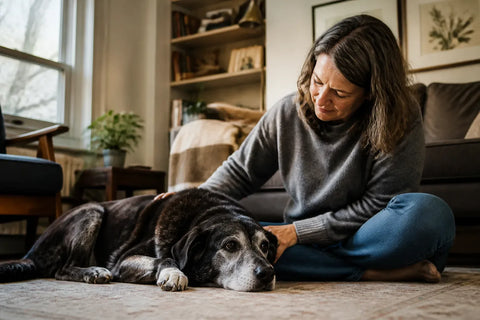
The clues tend to gather around the front door. Owners might observe signs of separation anxiety such as pacing, whining, destructive chewing, or accidents in the house when a dog is left alone or anticipates departure. The word anticipates is the one to sit with, because much of the distress starts before you've even reached for your keys, in the small rituals your dog has learned to read.
Watching for the pattern, and when it starts, tells you more than any single chewed shoe. Note what you see and the timing, since those notes turn a vague worry into something you can actually work on.
Source: VCA Animal Hospitals and ASPCA
What the worry looks like during storms

Weather brings its own version of the same problem. During storms, dogs experiencing fear or phobia may show physical and behavioral signs such as panting, trembling, hiding, or seeking close physical contact with their owners. These signs are easy to misread as simple clinginess, when they are closer to a genuine plea for safety.
The seeking-contact part matters most for what comes next, because a dog asking to be near you is telling you where comfort begins. The section on a safe haven builds directly on that instinct.
Source: Today's Veterinary Practice
The safe haven: cheap, quiet, and reliable
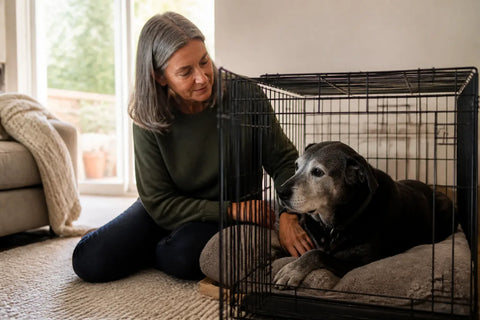
Every dog deserves one spot where the world goes quiet. Creating a quiet, safe haven or utilizing a cozy crate (if the dog is already comfortably crate-trained) can help soothe a dog's nervous system during frightening events like storms. The parenthetical is doing real work: a crate helps only for a dog who already finds it comforting, and forcing a frightened dog into a box she fears makes things worse, not better.
Related: can i give my dog benadryl for anxiety
Pick the corner she already retreats to, make it darker and softer, and let it be hers without conditions. This is the least glamorous item in the guide and one of the most dependable.
Source: Today's Veterinary Practice and Cornell Riney Canine Health Center
Give departures a job to do
Leaving gets easier when your dog has something better to do than miss you. Offering a high-value puzzle toy stuffed with food when leaving the house can help distract and soothe a dog experiencing mild separation distress. The trick is making the toy appear only at departures, so the thing she used to dread starts to predict something good.
Keep the word mild in view, though, because a food puzzle is a fine tool for the lighter end and not a fix for genuine panic. For that heavier end, the escalation section later is the honest answer.
Source: ASPCA
The one habit that backfires every time
Coming home to a wrecked cushion tests anyone's patience. Anxious behaviors are not acts of spite; punishing a dog for accidents or destruction when they are anxious can increase their stress and worsen the overall behavior. The reframe is the whole point: what looks like defiance is distress, and adding fear to distress compounds the original problem.
This is the cheapest improvement available, because it costs nothing to stop doing the thing that makes it worse. Everything else you try works better once punishment is off the table.
Related: what causes anxiety in dogs
Source: ASPCA and VCA Animal Hospitals
Why people keep bringing up the gut
Here the story takes an unexpected turn toward the digestive system. The gut-brain axis represents a bidirectional communication pathway, suggesting that maintaining a healthy gut microbiome may help support a calm and balanced nervous system in dogs. Bidirectional is the interesting word: the gut and the brain send signals both ways, which is why diet keeps entering conversations that used to be only about behavior.
This is the mechanism behind the probiotic products crowding the calming aisle. The next two sections look at what the research actually found, and where the honest line sits between mechanism and outcome.
Source: Veterinary Medicine International (Wiley, formerly Hindawi), via NCBI/PMC and Animals (MDPI)
The probiotic study worth reading closely
One study gets cited far more than it gets read. A placebo-controlled trial found that a specific probiotic strain, Lactiplantibacillus plantarum, may help reduce behavioral signs of anxiety and aggression in companion dogs. Two words carry the weight there.
Placebo-controlled means the result was measured against dogs given a dummy, which is the kind of design worth respecting. And specific strain means the finding belongs to that exact strain, not to probiotics in general and not to whatever unnamed blend a random calming chew contains. A result for one named strain is not a blanket endorsement of the shelf.
Source: Peer-reviewed article via PubMed Central
Anxious dogs, different gut bacteria
The pattern also shows up when researchers zoom out. Research indicates that differences in gut microbiota composition are associated with higher or lower anxiety and aggression scores in companion dogs. Associated is the load-bearing word, and it is not a synonym for caused.
Related: how to calm dog anxiety naturally
Calm dogs and worried dogs may differ in their gut bacteria without anyone yet showing that changing the bacteria changes the behavior. It is a genuinely intriguing clue and an honest reason to keep watching this research, not a reason to expect a supplement to rewrite your dog's temperament.
Source: Peer-reviewed article via PubMed Central and Animals (MDPI)
How new the science really is
Exciting research still deserves patient reading. While research into the canine gut-brain axis is promising, scientific findings are still emerging, and a dog's response to probiotic interventions can vary. That sentence is the whole category in miniature: real promise, real gaps, and no guarantees for your individual dog.
If you decide to try a gut-focused approach, treat your own dog as the only study that matters. Change one thing at a time, give it a few honest weeks, and trust your written notes over your memory of how last month went.
Source: Animals (MDPI) and Peer-reviewed article via PubMed Central
There is no best one, and here's why
The best-seller badge was not earned by your dog. Because individual responses to supplements and behavioral interventions vary widely, you should consult with your veterinarian to find the best tailored plan for your dog's specific anxiety. That is the actual answer to the question everyone types into the search bar, not an evasion of it.
The product that transformed a reviewer's dog was matched, by luck or by care, to that dog's situation. Yours has her own triggers and her own history, and the shortest route to the right choice runs through someone who can weigh both.
Related: anxiety meds for dogs
Source: Cornell Riney Canine Health Center and VCA Animal Hospitals
When it's time to bring in a specialist
Some cases outgrow the shelf entirely, and recognizing that is its own kind of care. For dogs experiencing severe anxiety or intense phobias, it is important to work directly with a veterinarian or a veterinary behaviorist to develop a specialized plan. Severe and intense are the signal words, and if that is your dog, no supplement comparison on the internet is the right starting point.
A specialist can draw on tools no aisle carries and build a plan around your specific dog. Reaching for that help sooner is not giving up on the gentler options, it is giving your dog the full toolkit.
Source: Today's Veterinary Practice and VCA Animal Hospitals
Our answer to the calming-aid question

From our family ranch, full disclosure: this one is ours
Since you're weighing calming options anyway, full disclosure: NeuroChew is ours, and it plays one specific position. It isn't a sedative, and the training and routines above still do the behavior work. What it covers is the daily foundation: a veterinarian-approved soft chew with phosphatidylserine, Norwegian salmon oil, and beet root with ginger that supports normal brain function and healthy circulation while you work the rest of the plan.
- ✓ 60-day guarantee: not thrilled? Even the empty bottle gets a full refund
- ✓ Free shipping on every order
- ✓ Multi-bottle packs save up to 40%
"I support NeuroChew because it's the first dog chew that supports both brain function and healthy circulation!" Dr. Ruth Roberts, DVM, CVFT
See What's Inside NeuroChew →Daily support, not medicine. It fits alongside your vet's plan, never in place of it.
Frequently asked questions
What is the best anxiety supplement for dogs?
There isn't one that wins for every dog. Because individual responses to supplements and behavioral interventions vary widely, you should consult with your veterinarian to find the best tailored plan for your dog's specific anxiety. The gut-brain research is promising but still emerging.
What is the best thing to give a dog for anxiety?
Start with the free tools before the shelf. Creating a quiet, safe haven or a cozy crate for an already crate-comfortable dog can help soothe a dog's nervous system during storms, and offering a high-value puzzle toy stuffed with food when leaving the house can help distract and soothe a dog experiencing mild separation distress.
How can I calm my dog's anxiety naturally?
Lean on a quiet safe haven, a food-stuffed puzzle toy at departures, and never punishing anxious behavior, since punishment can increase stress and worsen the overall behavior. On the supplement side, a placebo-controlled trial found a specific probiotic strain may help reduce behavioral signs of anxiety, though responses vary.
How do I calm a dog's nervous system?
A quiet, safe haven or a cozy crate for a crate-comfortable dog can help soothe a dog's nervous system during frightening events like storms. Emerging gut-brain research also suggests maintaining a healthy gut microbiome may help support a calm and balanced nervous system, though findings are still early.
So there's no winner to crown, and that's the honest answer rather than a dodge. The gut-brain research is genuinely interesting and genuinely early, the free calming work is reliable and underrated, and the best single move is a plan built around your own dog instead of a stranger's five-star review. Start with the quiet room and the departure routine, ask your veterinarian before you spend on a bottle, and treat the shelf as a helper rather than a cure. A worried dog needs a steady owner more than a trending product.
Get practical dog wellness tips by email
Occasional, useful guidance on keeping your dog healthy and happy. Unsubscribe anytime.
No spam. We respect your inbox.
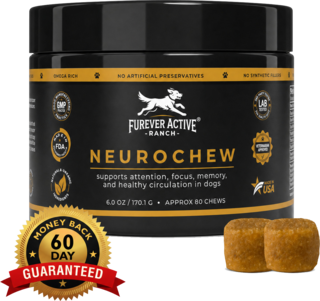
Support your dog's brain health with NeuroChew
NeuroChew is our daily soft chew for dogs, made fresh in the USA. See the ingredients and how it fits into a healthy daily routine.
Learn more about NeuroChew