Senior Dog Care
Dog Dementia Supplements: What the Evidence Actually Shows


Supplement ingredients studied in aging dogs include MCTs, omega-3 fatty acids (EPA and DHA), antioxidants such as vitamins E and C, and phosphatidylserine. Each may help support cognitive health, none is a cure, and individual responses vary widely. A predictable daily routine, nightlights in dark hallways, regular mental stimulation, and gentle exercise may help as well.
If you're reading this after finding your old dog staring at a wall, or standing in the wrong corner of a room she's lived in for a decade, you're in the right place. The supplement aisle has plenty of promises for dogs like her. The research has fewer, quieter answers. This guide walks through what dog dementia actually is, which supplement ingredients have real studies behind them, what those studies can and can't tell you, and the free changes at home that often matter as much as anything you can buy.
Related: what causes dementia in dogs
What dog dementia actually is
The name sounds scarier than the explanation. Cognitive Dysfunction Syndrome (CDS), which pet owners often refer to as canine cognitive dysfunction or dog dementia, is a neurodegenerative condition associated with brain aging in dogs. In plain terms, some brains age faster than the bodies around them, and the changes show up as behavior.
Researchers describe a cluster of age-related changes in these brains, including white-matter findings on imaging that have been attributed to small blood vessel abnormalities, and decreased blood flow appears among the general changes of an aging brain. One caution worth keeping: imaging findings do not always line up with how a dog actually behaves, so a scan result is one piece of the picture rather than the whole story.
Source: Cornell Riney Canine Health Center and Today's Veterinary Practice
The five changes veterinarians look for
You usually know something's off before you can name it. Veterinarians use the acronym DISHA (Disorientation, Interactions, Sleep-wake cycles, Housetraining, and Activity changes) to help identify early behavioral changes associated with cognitive dysfunction. Disorientation is the confused, lost-in-a-familiar-place behavior that owners describe as their dog acting strange or disoriented.
Interaction changes mean shifts in how she engages with the people and animals she lives with. Sleep-wake changes often show up as night waking. Housetraining changes mean accidents from a dog who was reliably trained.
And activity changes include aimless pacing or walking in circles. One sign alone proves nothing. A pattern across these five is worth writing down, with dates.
Source: Cornell Riney Canine Health Center and Today's Veterinary Practice
Why evenings are often the hardest part
Daylight hides what dusk gives away. A pattern of worsening clinical signs in the late afternoon or evening, sometimes called sundowning, can occur in dogs experiencing cognitive decline. For many owners the day looks ordinary, and the confusion and night waking arrive after the light fades.
If your evenings feel like a different dog lives in your house, that pattern itself is useful information. Note what time it starts and what you see, because those notes turn a vague worry into something concrete, and they connect directly to the routine and lighting changes covered later in this guide.
Related: dog dementia stages
Source: Cornell Riney Canine Health Center and Today's Veterinary Practice
When circling means more than restlessness
Some laps around the kitchen are just a dog being a dog. Pacing, walking in circles, or getting trapped in corners are recognized signs of cognitive decline, but they must be evaluated by a veterinarian to check for other potential underlying medical or neurological conditions. That second half of the sentence is the part that matters most.
Several very different problems can produce the same slow circles and stuck-in-the-corner moments, and they are handled in very different ways. Skipping that check to go straight to a supplement means treating a guess. The circling itself is not an emergency in most cases, but it is a clear signal that it's time for a real workup instead of watchful waiting.
Source: Cornell Riney Canine Health Center and Frontiers in Veterinary Science, 2025 and Today's Veterinary Practice
MCTs: a second fuel line for an aging brain
Old engines sometimes run better on a different fuel. Medium-chain triglycerides (MCTs) may help support cognitive health by providing ketone bodies as an alternative energy source for the aging canine brain. The logic is straightforward: aging brains can become less efficient at using their usual fuel, and ketones offer a second energy pathway.
Here's the honest boundary, though. Much of the MCT research in dogs comes from complete therapeutic diets tested in clinical settings, where MCTs were one ingredient among many. A positive diet study is not the same thing as proof for a single supplement on its own.
MCTs have earned a place in the conversation. They have not earned the word cure, and nothing in this category has.
Source: Today's Veterinary Practice and Peer-reviewed article via PubMed Central
Antioxidants, minus the hype
Every supplement label in the store loves this word. Antioxidants such as vitamins E and C, selenium, and beta-carotene may help reduce oxidative damage in the brains of senior dogs. Oxidative damage is real chemistry, not marketing: it's wear and tear at the cellular level that accumulates with age.
Antioxidant approaches have been studied in aged dogs as part of nutritional intervention research, which is more than most label ingredients can say. The same research tradition also teaches the caveat: these studies inform the category, and they don't guarantee an outcome for the specific bottle in your hand. When a label leans hard on the word antioxidant, check whether it names the actual ingredients and amounts.
Related: dog dementia
The studied ones are the four listed above.
Source: AGE via Springer and Today's Veterinary Practice and GeroScience via PubMed Central
Omega-3s: the familiar one, for good reason
Fish oil is the supplement most owners already have in the cupboard. Omega-3 fatty acids (including EPA and DHA) may help support brain health in senior dogs due to their role in cell membrane health and natural anti-inflammatory pathways. Cell membrane health and the body's natural anti-inflammatory pathways are the two jobs the research keeps pointing at, which is why these fats show up in nearly every serious discussion of cognitive nutrition for aging dogs.
EPA and DHA are the two names worth looking for on a label. As with everything in this guide, the hedge is doing honest work in that sentence: may help support is what the evidence carries, and no more.
Source: Today's Veterinary Practice and GeroScience via PubMed Central
Phosphatidylserine, apoaequorin, and ginkgo
Supplements containing ingredients like phosphatidylserine, apoaequorin, or Ginkgo biloba may support cognitive function in aging dogs, but owners should consult a veterinarian to determine the best approach. These three show up constantly on cognitive-support labels, and they sit at different heights on the evidence ladder. Systematic reviews of nutrition for aged dogs exist precisely to grade which ingredients carry stronger support and which are running mostly on momentum.
The practical takeaway: an ingredient appearing on a label is easy, and an ingredient appearing in graded evidence is the bar worth caring about.
Source: GeroScience via PubMed Central and Peer-reviewed article via PubMed Central
How to read the evidence like a skeptic

Promising results and settled science are two different things. While nutritional interventions show promise in clinical settings, individual responses vary widely, and more research is needed to determine long-term outcomes for every dog. That's not a reason for despair.
It's a reason to hold every bottle to the same three questions. How many dogs were in the study? Was it run in homes or in a research facility?
Related: dog dementia when to put down
And who paid for it? A label that survives those three questions has earned a spot in the conversation. One that dodges them is asking you to buy certainty the research doesn't contain.
Source: Peer-reviewed article via PubMed Central and GeroScience via PubMed Central
Why lab results don't always show up at home
The kitchen floor is not a laboratory, and that gap matters. Because many cognitive studies in dogs involve small study populations or laboratory-specific tasks, clinical outcomes in household pets can be highly variable. A memory task a research dog performs under controlled conditions is a long way from finding the water bowl at midnight in a dark house.
This is why two owners can try the same ingredient and tell you opposite stories, and both be telling the truth. The practical move is to pick one change at a time, give it an honest window of several weeks, and keep the notes you started earlier so you're judging your own dog's results instead of the label's promises.
Source: Peer-reviewed article via PubMed Central and GeroScience via PubMed Central
What helps beyond the supplement aisle
The cheapest tool in the house is your attention. Providing regular mental stimulation, gentle exercise, and interactive play may help support cognitive function in aging dogs. This is the part of the plan nobody profits from, which is exactly why it's underrated.
Mental stimulation can be as simple as letting a walk be slow and sniff-led instead of brisk and efficient, since sniffing is genuine work for a dog's brain. Gentle exercise means matching the outing to the dog she is now, not the dog she was at four. Interactive play counts even when it's shorter and softer than it used to be.
Ten engaged minutes beat an hour of ignoring each other in the same room.
Source: Cornell Riney Canine Health Center and Today's Veterinary Practice
Routine and light: engineering calmer nights

An aging brain leans on the schedule more than ever. Maintaining a predictable daily routine and placing nightlights in dark hallways may help ease confusion and support better sleep-wake patterns in dogs with cognitive changes. Keep wake time, meals, walks, and bedtime at the same hours every day, weekends included, because the routine itself becomes a handrail when memory gets unreliable.
Related: does my dog have dementia quiz
The nightlight advice is smaller and works for the same reason: a dog who wakes disoriented at 3 a.m. does better in a hallway she can see than one she has to remember. These changes cost almost nothing and stack cleanly with anything else you decide to try, including everything in the sections above.
Source: Cornell Riney Canine Health Center and Today's Veterinary Practice
The ingredients above are why NeuroChew exists

From our family ranch, full disclosure: this one is ours
Cards on the table: NeuroChew is ours, and the research you just read is why it exists. The same ingredient families covered above, phosphatidylserine and omega-3s from Norwegian salmon oil, plus beet root and ginger, are what our veterinarian-approved daily chew is built around to support normal brain function and healthy circulation. Air-dried, so processing doesn't cook the nutrients away.
- ✓ 60-day guarantee: not thrilled? Even the empty bottle gets a full refund
- ✓ Free shipping on every order
- ✓ Multi-bottle packs save up to 40%
"I support NeuroChew because it's the first dog chew that supports both brain function and healthy circulation!" Dr. Ruth Roberts, DVM, CVFT
See What's Inside NeuroChew →Daily support, not medicine. It fits alongside your vet's plan, never in place of it.
Frequently asked questions
What supplements are good for dogs with dementia?
Ingredients studied in aging dogs include MCTs, which may help support cognitive health by providing ketone bodies as an alternative energy source, omega-3 fatty acids including EPA and DHA, antioxidants such as vitamins E and C, selenium, and beta-carotene, and phosphatidylserine. Individual responses vary widely, and more research is needed on long-term outcomes.
What are the early signs of dementia in dogs?
Veterinarians use the acronym DISHA to identify early behavioral changes associated with cognitive dysfunction: Disorientation, Interaction changes, Sleep-wake cycle changes, Housetraining lapses, and Activity changes. Signs like pacing, circling, or getting stuck in corners are recognized, and they need veterinary evaluation because other conditions can look the same.
What helps old dogs with dementia?
Maintaining a predictable daily routine and placing nightlights in dark hallways may help ease confusion and support better sleep-wake patterns in dogs with cognitive changes. Providing regular mental stimulation, gentle exercise, and interactive play may help support cognitive function as well.
Why is my senior dog suddenly walking in circles?
Circling, pacing, and getting stuck in corners are recognized signs of cognitive decline in senior dogs, but the same behaviors can come from other medical and neurological conditions. That overlap is why sudden circling deserves a proper workup rather than a wait-and-see approach.
Here's the honest summary: a handful of ingredients have real research in aging dogs, none of them rewrites the story, and the daily things you control still carry serious weight. Keep the routine steady, keep her mind busy in small ways, keep the hallway lit, and read every label with the same skepticism you'd want a friend to bring to yours. Old dogs don't need miracles. They need the people who love them making calm, informed choices, one evening at a time.
Get practical dog wellness tips by email
Occasional, useful guidance on keeping your dog healthy and happy. Unsubscribe anytime.
No spam. We respect your inbox.
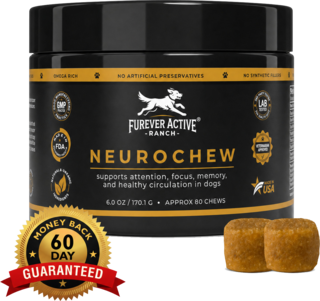
Support your dog's brain health with NeuroChew
NeuroChew is our daily soft chew for dogs, made fresh in the USA. See the ingredients and how it fits into a healthy daily routine.
Learn more about NeuroChew