Dog Brain Health
4health Calming Aid Supplement Bars for Dogs: Reality Check


The honest answer for any branded calming bar, this one included: individual responses to complementary calming supplements vary, and the science behind many options is still developing. The two ingredient names with the most research attention are L-theanine and alpha-casozepine, so the ingredient panel matters more than the front of the box. Results tend to be better when a calming bar is paired with behavior training and environmental management, and a veterinarian should weigh in first, especially if your dog takes other medications.
This page treats your search like the buying decision it is. Rather than scoring one product against another, it hands you the checklist that decides whether any calming bar deserves cart space: which ingredients carry real research, what generally considered safe actually obligates you to do, why the same bar succeeds in one home and flops in the next, and the one interaction question that outranks every review. Bring the 4health label to this checklist, or any label, and the decision mostly makes itself.
Related: what causes dementia in dogs
The frame every calming bar should be judged in

A specific product search deserves better than a shrug. Dog owners should understand that individual responses to complementary calming supplements vary, and scientific evidence for many options is still developing. That is the frame, and it holds for every brand in the aisle: the fair test of a calming bar is not the review average, it is what the ingredient panel contains and how your own dog responds over a fair trial.
Everything below turns that frame into a checklist you can hold in one hand at the store.
Source: VCA Animal Hospitals and Veterinary Evidence
The two studied names to scan the panel for

Start where the research starts. When looking for supportive calming options, ingredients like L-theanine and alpha-casozepine are commonly utilized, though a veterinarian should guide you on the best approach for your dog's specific needs. Those two names are the shortlist, and the buying move is simple: flip the box, find the panel, and see whether the studied names are present in the bar you are holding.
A product built on named, researched ingredients gives you something to evaluate; a vague calming blend gives you adjectives.
Source: VCA Animal Hospitals and Veterinary Evidence
L-theanine: the green-tea amino acid
The first name on the shortlist has a familiar origin. L-theanine, an amino acid found in green tea, may help support relaxation in dogs and is thought to work by interacting with brain chemistry. May help and thought to are the honest verbs, and they are worth keeping: this is an ingredient with a plausible mechanism and real research interest, not a switch that flips every dog.
When it appears on a panel, you know what the product is leaning on and what standard to hold it to.
Source: VCA Animal Hospitals
What 'generally considered safe' asks of you
Safe is a word that still comes with homework. While L-theanine is generally considered safe for dogs, it is important to monitor for any side effects under the guidance of a veterinarian. The obligation hiding in that sentence is the monitoring: a short note after each dose day, anything unusual flagged to the clinic, and a real conversation before the first bar rather than after the tenth.
Generally considered safe describes the category's track record, not a promise about the dog on your couch.
Source: VCA Animal Hospitals
Alpha-casozepine: the milk-protein peptide
The second studied name comes from an unexpected source. Alpha-casozepine, a natural peptide derived from milk protein, may help manage situational stress or anxiety in some dogs, though more robust clinical research is needed. Both halves of that sentence deserve equal weight.
Some dogs is a real qualifier, and more research needed is the professional way of saying the early results are interesting rather than settled. Treat any bar carrying it as a reasonable experiment, not a sure thing.
Source: Veterinary Evidence
Why the same bar gets five stars and one star
No supplement carries a household routine on its own. Complementary calming options are typically best used in combination with behavior training and environmental management rather than as standalone solutions. That single sentence explains most of the rating spread under every calming product ever sold: the households doing the pairing and the households expecting the bar to do everything are reviewing two different experiments.
Related: what can i give my dog for anxiety
Decide which household yours will be before you decide which brand to buy.
Source: VCA Animal Hospitals
The interaction question that outranks every review
One safety question comes before all the shopping ones. Because certain calming ingredients may interact with other medications your dog is taking, veterinary guidance is essential to avoid adverse effects. If your dog takes anything else, that turns the vet call from a nice-to-have into the first step, full stop.
Bring the exact label, name everything else in the rotation, and let the professional who knows your dog's chart clear the combination before the first bar leaves the wrapper.
Source: VCA Animal Hospitals
The no-wrapper alternative worth knowing
Not everything supportive comes in a wrapper. Synthetic appeasing pheromones may help create a more comforting environment for stressed or fearful dogs during challenging situations. They work on the room rather than the dog's bowl, which makes them a useful companion piece or fallback when chewable options are not a fit.
For hard moments you can see coming, having an environmental option beside an edible one gives the plan a second lever to pull.
Source: VCA Animal Hospitals
So, where does NeuroChew fit into all this?

From our family ranch, full disclosure: this one is ours
Full transparency: NeuroChew is ours. It's a veterinarian-approved daily soft chew that supports normal brain function and healthy circulation in dogs, daily support, not medicine, designed to fit alongside your vet's plan.
- ✓ 60-day guarantee: not thrilled? Even the empty bottle gets a full refund
- ✓ Free shipping on every order
- ✓ Multi-bottle packs save up to 40%
"I support NeuroChew because it's the first dog chew that supports both brain function and healthy circulation!" Dr. Ruth Roberts, DVM, CVFT
See What's Inside NeuroChew →Daily support, not medicine. It fits alongside your vet's plan, never in place of it.
Frequently asked questions
What are the strongest calming treats for dogs?
Strongest is the wrong measuring stick for supplements. The research frame is this: ingredients like L-theanine and alpha-casozepine are the names commonly utilized for supportive calming, individual responses vary from dog to dog, and evidence for many options is still developing, so a veterinarian should guide the approach for your dog's specific needs rather than a strength label.
Is L-theanine safe for dogs?
L-theanine is generally considered safe for dogs, and the honest fine print is the second half of that sentence: monitor for any side effects under the guidance of a veterinarian. Safety at the category level never removes the need to watch your individual dog, especially in the first weeks of anything new.
Do calming bars work without training?
The evidence points the other way: complementary calming options are typically best used in combination with behavior training and environmental management rather than as standalone solutions. A bar on its own is the weakest version of the plan, and the same purchase tends to look much better when the routine around it does part of the work.
Can calming supplements interact with my dog's medications?
They can. Certain calming ingredients may interact with other medications your dog is taking, which is why veterinary guidance is essential to avoid adverse effects. If your dog takes anything else, bring the exact supplement label to your vet and clear the combination before starting.
The reality check, compressed: read the ingredient panel and look for the studied names rather than trusting the artwork. Expect a maybe, because honest evidence promises nothing more for any dog. Pair whatever you buy with training and a calmer environment, since bars audition best inside a routine. And put your veterinarian at the front of the process, both for fit and for the medication question, not at the end after something goes sideways. Judged on those terms, a calming bar becomes what it was always meant to be: one modest, testable piece of a bigger plan for a calmer dog.
Get practical dog wellness tips by email
Occasional, useful guidance on keeping your dog healthy and happy. Unsubscribe anytime.
No spam. We respect your inbox.
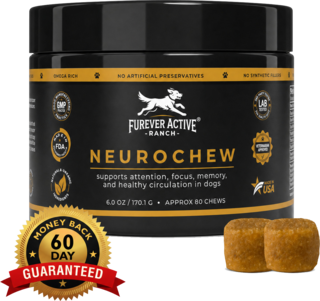
Support your dog's brain health with NeuroChew
NeuroChew is our daily soft chew for dogs, made fresh in the USA. See the ingredients and how it fits into a healthy daily routine.
Learn more about NeuroChew