Dog Brain Health
What Causes Dementia in Dogs, and What May Help


Dog dementia, canine cognitive dysfunction syndrome, is a progressive neurodegenerative condition. Brain aging in dogs is linked to biological factors such as beta-amyloid protein buildup and cellular damage from oxidative stress, and vascular events like restricted blood flow may be associated with signs of decline. Signs tend to worsen gradually at a rate that varies by dog. On the support side, research suggests certain diets and nutrients, mental stimulation, and moderate exercise may help support cognitive health, with responses varying dog to dog.
When the strange behaviors start, the first question is usually what is happening, and the second is whether anything could have been done. This guide takes both seriously. It walks through what actually drives cognitive decline in aging dogs, the protein buildup, the cellular wear, the blood-flow events most owners never hear about, how the condition tends to move once it starts, the early signs worth writing down, and then the support side: what the research honestly says about caring for an aging brain, and where the limits of that evidence sit. No miracle framing in either direction, just the mechanics and the levers.
Related: dog dementia
What the condition is
The long name comes with a short summary. Canine cognitive dysfunction syndrome (CDS) is a progressive neurodegenerative condition in senior dogs that shares characteristics with human dementia. The human comparison is not decoration: it gives families a familiar map for unfamiliar territory, and it sets expectations honestly, gradual change over time rather than a sudden switch.
Progressive is the other load-bearing word, and the rest of this guide is organized around it: first what starts the process, then how it moves, then what may slow the wear.
Source: Today's Veterinary Practice and Cornell Riney Canine Health Center
The biology: proteins and oxidative wear
Causes here are measured in molecules, not moments. Brain aging in dogs is linked to biological factors such as the buildup of specific proteins (beta-amyloid) and cellular damage from oxidative stress. Neither is anyone's fault, and neither comes from a single event: both are forms of accumulation, deposits collecting and cellular wear compounding across years.
That accumulation picture matters for expectations, because it explains why the condition announces itself gradually, and it matters for the support half of this guide, because the supports with research behind them aim at exactly these two processes.
Source: AGE via Springer and Today's Veterinary Practice and GeroScience via PubMed Central
The vascular storyline: blood flow and the brain
There is a second storyline most owners never hear about. Vascular events, like restricted blood flow or strokes in the brain, can occur in senior dogs and may be associated with signs of cognitive decline. This is worth knowing for one practical reason: a brain-aging picture is not always a single smooth process.
Vessel-level events can sit alongside the slower protein-and-wear story, and they are part of why a sudden change in behavior reads differently from a gradual drift. Sudden shifts deserve prompt professional attention rather than a wait-and-watch approach.
Related: dog dementia when to put down
Source: Frontiers in Veterinary Science, 2025
How fast it moves
Families always ask how fast this goes. Canine cognitive dysfunction is a progressive condition, meaning behavioral signs tend to gradually worsen over time at a rate that varies from dog to dog. Both halves of that sentence are the honest answer: direction is predictable, speed is not.
Anyone quoting a universal timeline is guessing. The practical response to variable speed is measurement: dated notes of what you see and how often turn how fast is this going from a fear into a question your own records can begin to answer.
Source: Today's Veterinary Practice and Cornell Riney Canine Health Center
The early signs worth writing down

Most families remember the first strange moment vividly. Initial signs of cognitive decline in senior dogs may include episodes of spatial disorientation, like getting stuck behind furniture or appearing lost in familiar areas. What makes these moments meaningful is the word familiar: this is confusion in a space the dog has navigated for years, which separates it from ordinary caution somewhere new.
Single episodes prove nothing on their own. A repeating pattern, written down with dates and places, is what turns a moment into information.
Source: Cornell Riney Canine Health Center and Today's Veterinary Practice
Accidents from a previously trained dog
Then there are the mornings that start with paper towels. An increase in house-soiling accidents in a previously trained dog can be a sign of cognitive dysfunction, provided other medical conditions are ruled out by a veterinarian. The proviso is half the sentence for good reason: urinary and other medical issues produce the same puddles and have their own fixes, so the rule-out comes before any conclusion.
Once medical causes are cleared, treat the accidents as a symptom category to track like the others, not as a training failure to correct.
Related: dog dementia stages
Source: Cornell Riney Canine Health Center and Today's Veterinary Practice
Restless nights: the sleep connection

The house gets loud when it should be quiet. Dogs with cognitive decline may experience altered sleep patterns, which can cause them to become restless, pace, or vocalize during the night. Night behavior is often the sign that finally exhausts a household into action, and it is also one of the easiest to log: the clock does the note-taking for you.
Track which hours the restlessness fills, because a consistent nightly window is a far more useful clinical detail than a general sense that nights are bad.
Source: Today's Veterinary Practice and Cornell Riney Canine Health Center
What this means for daily comfort
Comfort is the quiet stake in all of this. Progressive cognitive decline can cause disorientation and anxiety in aging dogs, which may affect their daily comfort and well-being. That is the real reason the causes matter to anyone outside a laboratory: the endpoint of the biology is a dog's ordinary day feeling less safe from the inside.
It also reframes the goal of everything in the support half of this guide. The target is not a cured brain, it is a calmer, more comfortable daily experience for the dog living with the one she has.
Source: Today's Veterinary Practice and Cornell Riney Canine Health Center
When to get changes checked
If you notice behavioral changes or sleep disturbances in your senior dog, consult your veterinarian to rule out underlying medical issues or pain. Early is the operative idea: several of the conditions that imitate cognitive decline, including pain, have their own treatments, and the sooner they are found the less time a fixable problem spends being mistaken for an unfixable one. Bring the dated notes this guide keeps recommending.
A pattern on paper gets a sharper answer than a memory recalled under fluorescent lights.
Related: dog dementia symptoms
Source: Today's Veterinary Practice and Cornell Riney Canine Health Center
The nutrition evidence, honestly framed
Food is where hope and hype share a shelf. Research indicates that certain diets and nutrients may help support cognitive health in older pets, though individual results can vary and more studies are needed. That sentence carries the whole category: real research interest, real early signals, and honest uncertainty about any individual dog.
Read labels the way that sentence reads evidence, favor named ingredients over adjectives, and treat your own dog as the deciding study: one change, a few patient weeks, notes you can trust.
Source: Peer-reviewed article via PubMed Central and GeroScience via PubMed Central
MCTs: the alternative fuel idea
The kitchen conversation starts with energy. Medium-chain triglycerides (MCTs) can serve as an alternative energy source for aging brain cells, which may help support cognitive functions in senior dogs. This connects straight to the energy side of the biology: if aging brain cells handle their usual fuel less well, a second fuel source may carry part of the load.
That mechanism is the entire pitch, plainly stated. May help support is the honest weight it deserves, one thread of a plan rather than the plan itself.
Source: Peer-reviewed article via PubMed Central and Today's Veterinary Practice and AGE via Springer
Antioxidants and mitochondrial support
Protection is the other half of the nutrition story. Antioxidants and mitochondrial cofactors may help protect brain cells against oxidative damage, potentially supporting cognitive vitality in senior dogs. This thread answers the oxidative-wear cause directly: if slow cellular damage is part of what drives decline, nutrition aimed at limiting that damage is a rational response.
Rational, not magical, and the same label discipline applies here: specific named ingredients and amounts are worth attention, and a bare buzzword is not.
Related: does my dog have dementia quiz
Source: Today's Veterinary Practice and AGE via Springer and GeroScience via PubMed Central
The levers that cost nothing
Not everything useful comes from a bowl. Providing mental stimulation and moderate exercise, alongside nutritional support, may help maintain cognitive function in aging dogs. Alongside is the design principle: brain work, body work, and nutrition are meant to stack, not compete.
Mental stimulation can be as unglamorous as a slow, sniff-led walk or a food puzzle at dinner, and moderate means matched to the dog she is now rather than the athlete she was. These are the levers every household already owns, and none of them requires a purchase to begin.
Source: AGE via Springer and Today's Veterinary Practice
Where NeuroChew fits in all this

From our family ranch, full disclosure: this one is ours
Reading pages like this usually means you're worried about a dog you love, so let's be straight about who we are: NeuroChew is ours. It won't replace the veterinary workup this guide keeps pointing you toward, and it doesn't try to. It's a veterinarian-approved daily soft chew built on phosphatidylserine, Norwegian salmon oil, and beet root with ginger to support normal brain function and healthy circulation as your dog ages.
- ✓ 60-day guarantee: not thrilled? Even the empty bottle gets a full refund
- ✓ Free shipping on every order
- ✓ Multi-bottle packs save up to 40%
"I support NeuroChew because it's the first dog chew that supports both brain function and healthy circulation!" Dr. Ruth Roberts, DVM, CVFT
See What's Inside NeuroChew →Daily support, not medicine. It fits alongside your vet's plan, never in place of it.
Frequently asked questions
Are dogs suffering when they have dementia?
Progressive cognitive decline can cause disorientation and anxiety, which may affect a dog's daily comfort and well-being. Whether pain is also involved is a separate question that matters: behavioral changes and sleep disturbances warrant a veterinary check to rule out underlying medical issues or pain, since those are often manageable once found.
What can trigger dementia in dogs?
Brain aging in dogs is linked to biological factors such as beta-amyloid protein buildup and cellular damage from oxidative stress. Vascular events, like restricted blood flow or strokes in the brain, can also occur in senior dogs and may be associated with signs of cognitive decline.
How long can a dog live with dementia?
There is no universal timeline. The condition is progressive, meaning signs tend to gradually worsen, but the rate varies from dog to dog, and overall health shapes the picture. Dated notes about what you observe give your veterinary team the clearest basis for an individual answer.
What are the first signs of dog dementia?
Initial signs may include episodes of spatial disorientation, like getting stuck behind furniture or appearing lost in familiar areas. Other early categories worth tracking include altered sleep patterns with nighttime restlessness and an increase in house-soiling accidents in a previously trained dog, once medical causes are ruled out.
The causes live at a scale you cannot see: proteins accumulating, cells wearing, vessels narrowing. But the response lives at the scale of an ordinary week: a brain kept busy with sniffing and small challenges, a body kept moving gently, nutrition chosen with named ingredients instead of promises, and changes checked early instead of explained away. None of it rewrites biology, and the honest research says responses vary. What the levers reliably buy is a better-supported brain and earlier, clearer information when something shifts, and for an aging dog, both of those are worth having.
Get practical dog wellness tips by email
Occasional, useful guidance on keeping your dog healthy and happy. Unsubscribe anytime.
No spam. We respect your inbox.
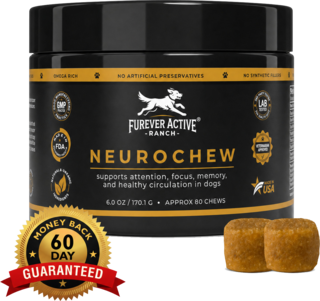
Support your dog's brain health with NeuroChew
NeuroChew is our daily soft chew for dogs, made fresh in the USA. See the ingredients and how it fits into a healthy daily routine.
Learn more about NeuroChew