Dog Brain Health
How to Manage Dog Kennel Anxiety: Step-by-Step Guide


Dogs facing unsettling situations may exhibit visible signs of anxiety, which can include pacing, panting, or vocalizing.
When a dog struggles with confinement, establishing safety and predictability is the primary goal for any household. This guide outlines the behavioral training steps, environmental risks, and underlying physiology that shape canine responses to being left alone.
By understanding both training principles and brain-gut science, you can make informed decisions for your dog.
AT A GLANCE
The pick: Our pick is NeuroChew, our own daily brain-health chew, held to the standard this guide teaches.
Reason one: Built for daily brain support, not sedation.
Reason two: Veterinarian-approved, with Dr. Ruth Roberts, DVM, CVFT as the named endorser.
Reason three: A 60-day guarantee, refunded even on an empty bottle.
Skip it if: Your dog has new, sudden, or severe symptoms, is pregnant, nursing, or a puppy, is on medication, or is managing an existing condition without your veterinarian's input.
Why Is My Dog So Anxious When Left in the Kennel?

Dogs facing unsettling situations may exhibit visible signs of anxiety, which can include pacing, panting, or vocalizing. Dogs with confinement or separation distress may try to escape from their kennels, posing a risk of physical injury to themselves.
Source: Cornell Riney Canine Health Center and VCA Animal Hospitals and ASPCA
Recognizing early physical signs of distress is the first step toward establishing a consistent, predictable routine.
How Should I Respond to Kennel Destruction or Vocalization?
Punishing a dog for anxiety-related behaviors when confined is counterproductive and may escalate their stress and fear. Because signs of pain can resemble behavioral anxiety, a professional veterinary evaluation is recommended if your dog shows sudden changes in comfort or behavior.
Source: VCA Animal Hospitals and ASPCA and Merck Veterinary Manual
Responding with punishment increases the dog's panic and delays their behavioral recovery.
Does the Gut Microbiome Influence Canine Stress and Behavior?

Emerging science suggests a connection between the gut microbiome and canine anxiety, but research is ongoing and individual responses are highly variable.
Source: Veterinary Medicine International (Wiley, formerly Hindawi), via NCBI/PMC and Animals (MDPI) and Peer-reviewed article via PubMed Central
While the gut-brain axis is a promising frontier of science, daily cognitive support relies on transparent, fully disclosed active ingredients rather than sedative knockout herbs.
How Do I Train My Dog to Love Their Kennel?
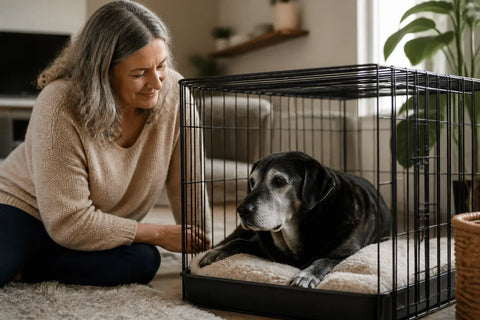
Creating positive associations with a confinement space through gradual training can help support a dog's comfort when they are left alone.
Source: Cornell Riney Canine Health Center and ASPCA
Slow, step-by-step training builds long-term confidence and helps dogs view confinement as a safe, predictable routine.
Our answer to the calming-aid question
Full transparency: NeuroChew is ours. It's a veterinarian-approved daily soft chew that supports normal brain function and healthy circulation in dogs.
It's daily support, not medicine, designed to fit alongside your vet's plan rather than replace it. Dr.
Ruth Roberts, DVM, CVFT, puts it this way: "I support NeuroChew because it's the first dog chew that supports both brain function and healthy circulation!" If the signs above sound familiar, a daily brain-support routine is one of the simplest places to start.
If your dog is struggling with kennel distress, always consult your veterinarian first to rule out underlying pain or medical issues. Developing a gradual behavioral retraining plan and maintaining a consistent daily routine are the most reliable pathways to long-term comfort.
Empower yourself with honest research, read every ingredient label carefully, and make decisions that support your dog's daily health.
References
- Anxious behavior: How to help your dog cope with unsettling situations, Cornell Riney Canine Health Center. https://www.vet.cornell.edu/departments-centers-and-institutes/riney-canine-health-center/canine-health-topics/anxious-behavior-how-help-your-dog-cope-unsettling-situations
- Gut microbiota composition is related to anxiety and aggression scores in companion dogs, Peer-reviewed article via PubMed Central. https://pmc.ncbi.nlm.nih.gov/articles/PMC12234828/
- Gut-Brain Axis Impact on Canine Anxiety Disorders: New Challenges for Behavioral Veterinary Medicine, Veterinary Medicine International (Wiley, formerly Hindawi), via NCBI/PMC. https://pmc.ncbi.nlm.nih.gov/articles/PMC10827376/
- The Relationship between Canine Behavioral Disorders and Gut Microbiome and Future Therapeutic Perspectives, Animals (MDPI). https://pmc.ncbi.nlm.nih.gov/articles/PMC11273744/
- Separation Anxiety in Dogs, VCA Animal Hospitals. https://vcahospitals.com/know-your-pet/separation-anxiety-in-dogs
- Separation Anxiety, ASPCA. https://www.aspca.org/pet-care/dog-care/common-dog-behavior-issues/separation-anxiety
- Recognizing and Assessing Pain in Animals, Merck Veterinary Manual. https://www.merckvetmanual.com/special-pet-topics/pain-management/recognizing-and-assessing-pain-in-animals
As of July 2026
Get practical dog wellness tips by email
Occasional, useful guidance on keeping your dog healthy and happy. Unsubscribe anytime.
No spam. We respect your inbox.
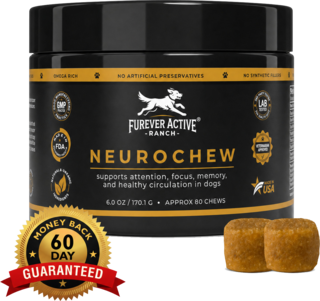
Support your dog's brain health with NeuroChew
NeuroChew is our daily soft chew for dogs, made fresh in the USA. See the ingredients and how it fits into a healthy daily routine.
Learn more about NeuroChew