Dog Brain Health
Can I Give My Dog Benadryl for Anxiety? A Vet-First Guide


Because canine anxiety is complex, only a veterinarian can determine the safest and most appropriate medication or intervention plan tailored to your individual dog. Substances that cause sleepiness or sedation should be used with caution and only under the direction of a veterinarian, as dogs can react differently to these compounds, and that caution applies here. Always seek direct guidance from a veterinarian regarding appropriate dosing for any substance intended to manage your dog's anxiety, rather than choosing an amount on your own.
If you've searched can I give my dog Benadryl for anxiety, you are probably watching your dog pace, whine, or tremble during something like a storm, and wondering whether something already in the medicine cabinet could help. This guide keeps the answer honest and vet-first: what the caution around sedating substances means for a case like Benadryl, why dosing is not something to guess at home, how to recognize what anxiety actually looks like, when the trigger is being left alone rather than a single scary moment, and what a veterinarian is likely to recommend instead, including training techniques and the gut-brain research still taking shape.
Related: what can i give my dog for anxiety
Does Benadryl Actually Help with Anxiety?

Substances that cause sleepiness or sedation should be used with caution and only under the direction of a veterinarian, as dogs can react differently to these compounds. That caution is exactly why the question behind Benadryl deserves a straight answer instead of a quick yes or no. Ask your veterinarian directly whether making your dog sleepy is the outcome you actually want, or whether the anxiety itself needs a different kind of help, before anything from the medicine cabinet becomes part of the plan.
Source: Today's Veterinary Practice and Cornell Riney Canine Health Center
Why Only Your Vet Can Choose the Right Medication
No two dogs respond to a stressful trigger in quite the same way. Because canine anxiety is complex, only a veterinarian can determine the safest and most appropriate medication or intervention plan tailored to your individual dog. That includes deciding whether something like Benadryl has any place in your dog's plan at all.
A conversation with your veterinarian is the only reliable way to find out.
Source: VCA Animal Hospitals and Today's Veterinary Practice
There's No Safe Dose to Guess at Home

It is tempting to eyeball an amount based on your dog's weight and call it done. Always seek direct guidance from a veterinarian regarding appropriate dosing for any substance intended to manage your dog's anxiety. That includes Benadryl.
This guide will not hand you a number to copy, because only your veterinarian can weigh what is right for your individual dog. Your veterinarian is the only source for that answer.
Source: Today's Veterinary Practice
What Anxiety Actually Looks Like in Dogs
Before reaching for anything, it helps to know exactly what you are looking at. Signs of situational anxiety in dogs can include panting, pacing, trembling, whining, or seeking out hiding spots. Watching for that pattern, especially around situations that seem to set it off, gives you something concrete to describe if you do call your veterinarian.
Source: Cornell Riney Canine Health Center
When the Trigger Is Being Left Alone
Some dogs only unravel once the door closes behind you. Separation anxiety in dogs may manifest as destructive behavior, vocalization, or accidents in the house when they are left by themselves. If that pattern matches what you see, it is worth naming specifically as separation anxiety when you talk to your veterinarian.
Source: VCA Animal Hospitals
Retraining the Response, Not Just Reaching for a Pill
Medication is not the only option on the table, and often is not the first one a professional reaches for. Desensitization and counter-conditioning are commonly utilized behavioral training techniques that may help dogs cope with being alone. Ask your veterinarian or a veterinary behaviorist whether this kind of training fits your dog's situation.
Source: VCA Animal Hospitals
A Calmer Environment Helps Too
Environment does some of the work before any training or medication decision even starts. Providing a quiet, secure space in your home may help your dog cope during stressful environmental events like storms. Ask your veterinarian how a setup like that might fit alongside whatever else ends up in your dog's plan.
Source: Cornell Riney Canine Health Center
When to Involve a Veterinarian or Behaviorist
There is a point where adjustments at home are not enough on their own. If your dog's anxiety is severe or ongoing, consult a veterinarian or veterinary behaviorist to develop a structured behavior modification plan. That is also the moment to ask directly whether Benadryl, or anything else, has an actual place in that plan, rather than deciding on your own.
Source: VCA Animal Hospitals and Cornell Riney Canine Health Center
The Gut-Brain Connection Researchers Are Studying
Some owners want to know if there is anything to look at beyond training and medication. The gut-brain axis is a communication pathway through which the balance of gut microbes can potentially influence your dog's mood and behavior. This is still an active area of research, and it sits alongside the training and environment approaches above rather than replacing a veterinarian's guidance.
Related: dog anxiety in crate
Source: Veterinary Medicine International (Wiley, formerly Hindawi), via NCBI/PMC
What the Studied Link Between Gut Bacteria and Anxiety Means
Researchers have also looked directly at the numbers instead of just the theory. Studies suggest a link exists between the types of bacteria in a dog's gut microbiome and behavioral measures of anxiety. That is a link observed in the research, not yet a plan on its own, which is exactly why it belongs in a conversation with your veterinarian rather than a decision you make alone.
Source: Peer-reviewed article via PubMed Central and Animals (MDPI)
One Ingredient Under the Microscope: Alpha-Casozepine
Not every ingredient under research works the same way. Alpha-casozepine may help promote calm behavior in some anxious dogs, although response levels vary. That variation is why it is worth raising as one option with your veterinarian, rather than trying on your own.
Source: Veterinary Evidence
A Specific Probiotic Strain Under Study
Probiotics are not one-size-fits-all either. Certain probiotic strains, including Lactiplantibacillus plantarum, are being studied for their potential to help support calmer behavior in companion dogs. Strain matters here, so this is worth mentioning by name if you bring up probiotics with your veterinarian, rather than assuming any probiotic product works the same way.
Source: Peer-reviewed article via PubMed Central
The Honest Limits of This Evidence
None of the research above is a finished story yet. While research is promising, evidence regarding dietary and microbiome-based support for canine anxiety is still emerging, and individual dog responses will vary. That honesty matters more than excitement about any single ingredient or study, and it is exactly why a veterinarian, not a product label, should have the final say in your dog's plan.
Source: Veterinary Medicine International (Wiley, formerly Hindawi), via NCBI/PMC and Animals (MDPI) and Peer-reviewed article via PubMed Central
Our answer to the calming-aid question

From our family ranch, full disclosure: this one is ours
Since you're weighing calming options anyway, full disclosure: NeuroChew is ours, and it plays one specific position. It isn't a sedative, and the training and routines above still do the behavior work. What it covers is the daily foundation: a veterinarian-approved soft chew with phosphatidylserine, Norwegian salmon oil, and beet root with ginger that supports normal brain function and healthy circulation while you work the rest of the plan.
- ✓ 60-day guarantee: not thrilled? Even the empty bottle gets a full refund
- ✓ Free shipping on every order
- ✓ Multi-bottle packs save up to 40%
"I support NeuroChew because it's the first dog chew that supports both brain function and healthy circulation!" Dr. Ruth Roberts, DVM, CVFT
See What's Inside NeuroChew →Daily support, not medicine. It fits alongside your vet's plan, never in place of it.
Frequently asked questions
Can I give my dog human Benadryl to calm him down?
Only under a veterinarian's direction. Substances that cause sleepiness or sedation should be used with caution and only under the direction of a veterinarian, since dogs can react differently to these compounds, and only a veterinarian can determine the safest and most appropriate medication or intervention plan for your individual dog.
What is the best anxiety medication for dogs?
There is no single best answer. Because canine anxiety is complex, only a veterinarian can determine the safest and most appropriate medication or intervention plan tailored to your individual dog, and if the anxiety is severe or ongoing, that conversation should include a veterinarian or veterinary behaviorist building a structured behavior modification plan.
How much Benadryl can a dog take for anxiety?
This guide will not give you a number to copy. Always seek direct guidance from a veterinarian regarding appropriate dosing for any substance intended to manage your dog's anxiety, since the right amount, and whether it makes sense at all, depends on your individual dog.
Will Benadryl make my dog sleepy?
Sleepiness is the effect many owners associate with Benadryl, which is exactly why the caution applies. Substances that cause sleepiness or sedation should be used with caution and only under the direction of a veterinarian, as dogs can react differently to these compounds, so ask your vet whether that drowsiness is actually the outcome you want.
What can I ask my vet instead of just giving my dog Benadryl?
Ask about the specific signs you are seeing, since signs of situational anxiety in dogs can include panting, pacing, trembling, whining, or seeking out hiding spots, and ask whether desensitization and counter-conditioning, a calmer environment, or a structured behavior modification plan fits your dog better than a sedating substance alone.
Benadryl is not an automatic yes for a dog's anxiety, and it is not a decision to make alone. Substances that cause sleepiness or sedation need a veterinarian's direction, dosing is never a guess, and the calmer, more settled dog you are looking for usually comes from a combination your vet helps you build: recognizing the real signs, working out whether the trigger is being left alone or something more situational, retraining the response with desensitization and counter-conditioning, a calmer environment, and an honest look at what the gut-brain research can and cannot yet promise. Ask your veterinarian before anything else, and let that conversation, not the medicine cabinet, set the plan.
Get practical dog wellness tips by email
Occasional, useful guidance on keeping your dog healthy and happy. Unsubscribe anytime.
No spam. We respect your inbox.
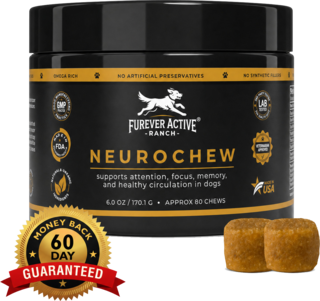
Support your dog's brain health with NeuroChew
NeuroChew is our daily soft chew for dogs, made fresh in the USA. See the ingredients and how it fits into a healthy daily routine.
Learn more about NeuroChew