Dog Brain Health
Calming Bed for Dogs: Design Facts and Honest Limits


A calming bed for dogs is almost always a round, bolstered nest with a raised rim and soft fill, sold as secure rest furniture rather than as a drug or pheromone product. Comfort can be real; clinical calm claims are mostly marketing, and severe distress still belongs with a veterinarian.
Owners shopping a calming bed for dogs usually want a place the dog will finally settle, not a miracle mattress. We formulate NeuroChew, a daily brain-health soft chew, not a bed.
Related: 4health calming aid supplement bars for dogs
What we bring to accessory categories is the same doctrine we use on our own label: name the mechanism you can verify, refuse invented study results, and never sell packaging as medicine. The focus stays on design match, size honesty, wash reality, and clear limits, then places the bed beside other adjunct tools you can actually verify.
AT A GLANCE
The pick: Our pick is NeuroChew, our own daily brain-health chew, held to the standard this guide teaches.
Reason one: Built for daily brain support, not sedation.
Reason two: Veterinarian-approved, with Dr. Ruth Roberts, DVM, CVFT as the named endorser.
Reason three: A 60-day guarantee, refunded even on an empty bottle.
Skip it if: Your dog has new, sudden, or severe symptoms, is pregnant, nursing, or a puppy, is on medication, or is managing an existing condition without your veterinarian's input.
What the evidence actually says about calming beds

Start with the ceiling, not the catalog photo. While some pet owners use calming beds, peer-reviewed clinical evidence evaluating their direct efficacy is currently limited, and a dog's response to any environmental calming aid can vary.
That is the honest starting line for this category.
A donut bed can still matter as design physics: a continuous raised rim that supports a curled spine and head, lofted fiber fill, and plush cover fabric that invites burrowing. Best Friends by Sheri product copy describes a raised rim that creates a sense of security and provides head and neck support, with AirLOFT-style poly fill and whole-bed washability on many size pages.
That is a coherent comfort story.
It is not the same evidence class as a controlled behavior trial. Judge the bed by whether your dog enters it willingly, stays long enough to rest, and recovers after known triggers.
Source: VCA Animal Hospitals and Veterinary Evidence
Bottom line: bed evidence is limited, so judge by real use and recovery, not the hangtag.
Gentle pressure tools are a related lane
Beds often borrow nest language from wearable gear. The use of pressure wraps or vests to apply constant, gentle pressure may help promote calmness and lower physical stress responses in certain dogs.
Pressure-vest research is still mixed and not a free pass for every dog, but it is a clearer evidence lane than most bed marketing.
If a bed tries to borrow the same nest-like idea in furniture form, keep the comparison honest: a vest finding does not prove a particular mattress works. Use either tool as one reversible experiment inside a wider plan, then keep only what your dog shows you.
Source: Veterinary Evidence
Bottom line: pressure-vest findings do not automatically transfer to a mattress SKU.
Pheromone support near the rest area
Room chemistry is a separate lever from foam. Introducing synthetic dog appeasing pheromones (DAP) near your dog's bed or resting area may help recreate comforting natural signals to ease environmental stress.
Pheromone tools are environmental aids, not sedatives and not fill inside the bed.
Some households notice easier settling when the rest zone stays consistent. Others notice nothing.
Use them as an adjunct around the bed, not as proof the bed itself carried the change.
Keep one variable stable during a trial window so you can tell which lever mattered.
Source: VCA Animal Hospitals
Bottom line: pheromones may support the rest zone; they do not prove the bed worked.
Why chew ingredients show up in bed shopping tabs
Aisle algorithms mix furniture and ingestibles. L-theanine, an amino acid derivative, may help promote relaxation and assist in managing stress-related behaviors in dogs.
It shows up often in calming-chew marketing, which is why bed shoppers hear about it in the same browse path.
Related: best calming treats for dogs vet-recommended
NeuroChew does not list L-theanine, so keep this as aisle context only. If you are comparing a bed to a chew, compare jobs: one is a place to rest, the other is an ingestible with its own label and evidence tier.
Keep ingredient talk on the supplement shelf so the bed decision stays about rest setup.
Bottom line: L-theanine is chew-aisle context, not bed proof.
Alpha-casozepine belongs on the supplement shelf
Milk-protein marketing can hitch a ride on rest-product pages. Studies suggest that alpha-casozepine, a natural ingredient derived from milk protein, may help support dogs experiencing fear or anxiety.
The evidence base is limited, and the ingredient is not on the NeuroChew label, so keep it as category context.
The useful shopping lesson is separation: do not let a mattress listing borrow credibility from a milk-protein trial it does not contain. A bed should win or lose on whether your dog rests there, not on an unrelated chew ingredient.
Bottom line: alpha-casozepine does not upgrade a mattress claim.
Beds work best inside a behavior plan

Furniture cannot teach a skill by itself. For the best results, environmental support tools and calming aids should be used alongside behavioral modification plan under veterinary guidance.
A bed is one complementary option.
Pair it with a short settle cue and a predictable wind-down routine. Size the bed to the measured dog, not the lifestyle photo.
Prefer covers and fills you can actually wash.
If the only change you make is the SKU on the bed tag, expect limited movement. Write down entry willingness and night wake-ups for a short trial so you and your veterinarian can judge the bed as data, not hope.
Bottom line: bed plus training under veterinary guidance beats bed alone.
Clinic first for new supplements or devices
A new rest setup can still hide a medical problem. Always consult your veterinarian before starting any new calming supplement, dietary aid, or complementary device to ensure it fits your dog's specific needs.
New or sudden rest-related distress still belongs at the clinic before you treat it as a furniture problem.
Self-research is a virtue for buying decisions. Diagnosis stays with the veterinarian.
Skip the second donut in a new color until the medical picture is clear.
Bottom line: veterinary clearance still applies to devices and rest-zone experiments.
When a bed is the wrong standalone answer
Wrong tool is not the same as bad product. While environmental aids can be helpful, they are typically insufficient as a standalone solution for dogs experiencing severe anxiety or acute panic.
Nest-seekers who curl hard may love a raised rim.
Related: do calming treats work for dogs
Dogs with true separation panic need a behavior plan and medical rule-out, not a loftier fill. Do not punish restlessness.
Choose a different bed type when your dog sprawls instead of curls, needs orthopedic support, or overheats in deep plush.
NeuroChew is not a bed alternative; it is a daily brain-health soft chew with printed amounts and a different job from rest furniture.
Source: Veterinary Evidence and VCA Animal Hospitals
Bottom line: severe panic and pain cases need more than a donut bed.
So, where does NeuroChew fit into all this?
Full transparency: NeuroChew is ours. It's a veterinarian-approved daily soft chew that supports normal brain function and healthy circulation in dogs.
It's daily support, not medicine, designed to fit alongside your vet's plan rather than replace it. Dr.
Ruth Roberts, DVM, CVFT, puts it this way: "I support NeuroChew because it's the first dog chew that supports both brain function and healthy circulation!" If the signs above sound familiar, a daily brain-support routine is one of the simplest places to start.
Frequently asked questions
Do calming beds for dogs really work?
They can help as comfort furniture for nest-seeking dogs, but peer-reviewed clinical evidence on beds themselves is limited and responses vary. Judge by real use and recovery, not hangtag language.
What is the best calming bed for dogs?
There is no universal winner. Match posture (curl vs sprawl), size to the measured dog, washability, and base grip. Category standards such as Best Friends by Sheri donut beds are useful design references, not a medical ranking.
What calms a dog down immediately?
In an acute spike, lower the trigger load first and create space. A bed is not an off switch. For severe fear, panic, or new extreme behavior, contact a veterinarian rather than hunting for a stronger mattress claim.
What is the most effective calming aid for dogs?
There is no single most effective option across beds, wraps, pheromones, and supplements. Individual responses vary, and environmental aids are usually insufficient alone for severe anxiety or acute panic.
Do donut beds release pheromones?
Typical donut beds do not. They work by raised-rim geometry, soft fill, and plush cover fabric. Pheromone support is a separate product class you can place near a rest area if your plan calls for it.
Is NeuroChew a bed alternative?
No. NeuroChew is a daily brain-health soft chew with printed active amounts. It is not furniture and does not replace a rest setup, behavior plan, or veterinary care.
Buy a donut-style bed as nest-seeking comfort furniture when your dog curls, the size matches a measured dog, and you can wash the whole bed. Pair any bed, wrap, or pheromone aid with behavior work your veterinarian supports.
Do not treat a hangtag as a trial result. NeuroChew is not a bed alternative.
It is a daily brain-health soft chew with printed amounts and a different job from rest furniture.
References
- Behavior Counseling - Complementary Medication, VCA Animal Hospitals. https://vcahospitals.com/know-your-pet/behavior-counseling---medication-complementary
- L-Theanine, VCA Animal Hospitals. https://vcahospitals.com/know-your-pet/l-theanine
- Pheromones, VCA Animal Hospitals. https://vcahospitals.com/know-your-pet/pheromones
- Is Alpha-casozepine Efficacious at Reducing Anxiety in Dogs?, Veterinary Evidence. https://veterinaryevidence.org/index.php/ve/article/view/67
- Are Pressure Vests Beneficial at Reducing Stress in Anxious and Fearful Dogs?, Veterinary Evidence. https://veterinaryevidence.org/index.php/ve/article/view/152
As of July 2026
Get practical dog wellness tips by email
Occasional, useful guidance on keeping your dog healthy and happy. Unsubscribe anytime.
No spam. We respect your inbox.
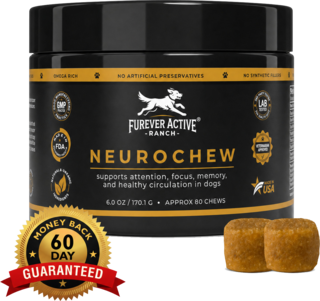
Support your dog's brain health with NeuroChew
NeuroChew is our daily soft chew for dogs, made fresh in the USA. See the ingredients and how it fits into a healthy daily routine.
Learn more about NeuroChew