Dog Brain Health
Dog Dementia Prognosis: A Practical Comparison


Canine Cognitive Dysfunction (CCD), often referred to colloquially as dog dementia, is an age-related decline in cognitive abilities similar to human dementias.
AT A GLANCE
The pick: Our pick is NeuroChew, our own daily brain-health chew, held to the standard this guide teaches.
Reason one: Built for daily brain support, not sedation.
Reason two: Veterinarian-approved, with Dr. Ruth Roberts, DVM, CVFT as the named endorser.
Reason three: A 60-day guarantee, refunded even on an empty bottle.
Skip it if: Your dog has new, sudden, or severe symptoms, is pregnant, nursing, or a puppy, is on medication, or is managing an existing condition without your veterinarian's input.
Canine Cognitive Dysfunction (CCD), often referred to colloquially as

Canine Cognitive Dysfunction (CCD), often referred to colloquially as dog dementia, is an age-related decline in cognitive abilities similar to human dementias. Current evidence suggests that while nutritional adjustments can support brain health, individual responses vary and findings are still emerging.
The primary clinical signs of dog dementia are categorized under the acronym "DISHA": disorientation, altered interactions, sleep-wake cycle disturbances, house soiling, and changes in activity levels.
Source: Cornell Riney Canine Health Center and Today's Veterinary Practice and GeroScience via PubMed Central and Peer-reviewed article via PubMed Central
Bottom line: Canine Cognitive Dysfunction (CCD), often referred to colloquially as dog dementia, is an age-related decline in cognitive abilities similar to human dementias.
Owners may observe a pattern known as "sundowning," where

Owners may observe a pattern known as "sundowning," where a dog's cognitive dysfunction symptoms become more pronounced or worsen during the evening and night. Aging dogs experiencing cognitive decline may have "good days and bad days" where their levels of confusion or alertness naturally fluctuate.
Sundowning in dogs with cognitive decline often looks like pacing, wandering, vocalizing, or general restlessness during the late afternoon, evening, or nighttime hours.
Source: Cornell Riney Canine Health Center and Today's Veterinary Practice
Bottom line: Owners may observe a pattern known as "sundowning," where a dog's cognitive dysfunction symptoms become more pronounced or worsen during the evening and night.
While cognitive dysfunction is typically a slowly progressive condition
While cognitive dysfunction is typically a slowly progressive condition, any sudden or rapid worsening of behaviors warrants a visit to your veterinarian to rule out underlying medical issues. If you are evaluating end-of-life options for a highly cognitively impaired senior dog, consult your veterinarian to discuss formal quality-of-life assessments and keeping your dog comfortable.
Source: Cornell Riney Canine Health Center and Today's Veterinary Practice
Bottom line: While cognitive dysfunction is typically a slowly progressive condition, any sudden or rapid worsening of behaviors warrants a visit to your veterinarian to rule out underlying medical issues.
Diets containing medium-chain triglycerides (MCTs) may help support brain
Diets containing medium-chain triglycerides (MCTs) may help support brain energy metabolism in aging dogs by providing ketones as an alternative energy source. Canine cognitive decline is associated with physiological changes in the brain, including increased oxidative damage and the accumulation of beta-amyloid plaques.
Providing a consistent daily routine and gentle environmental enrichment, like puzzle toys, may help support a stable routine for dogs experiencing cognitive dysfunction.
Source: Today's Veterinary Practice and Peer-reviewed article via PubMed Central and AGE via Springer and Cornell Riney Canine Health Center
Bottom line: Diets containing medium-chain triglycerides (MCTs) may help support brain energy metabolism in aging dogs by providing ketones as an alternative energy source.
Where NeuroChew fits in all this
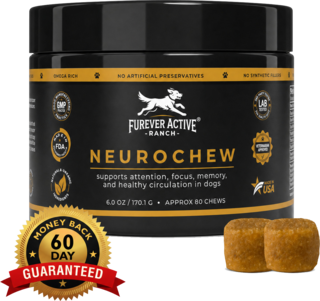
Full transparency: NeuroChew is ours. It's a veterinarian-approved daily soft chew that supports normal brain function and healthy circulation in dogs.
It's daily support, not medicine, designed to fit alongside your vet's plan rather than replace it. Dr.
Ruth Roberts, DVM, CVFT, puts it this way: "I support NeuroChew because it's the first dog chew that supports both brain function and healthy circulation!" If the signs above sound familiar, a daily brain-support routine is one of the simplest places to start.
Canine Cognitive Dysfunction (CCD), often referred to colloquially as dog dementia, is an age-related decline in cognitive abilities similar to human dementias. Diets containing medium-chain triglycerides (MCTs) may help support brain energy metabolism in aging dogs by providing ketones as an alternative energy source.
If these changes appear or continue, talk with your veterinarian about what you are seeing.
References
- Cognitive dysfunction syndrome, Cornell Riney Canine Health Center. https://www.vet.cornell.edu/departments-centers-and-institutes/riney-canine-health-center/canine-health-topics/cognitive-dysfunction-syndrome
- Enhancing cognitive functions in aged dogs and cats: a systematic review, Peer-reviewed article via PubMed Central. https://pmc.ncbi.nlm.nih.gov/articles/PMC12181554/
- Assessment of nutritional interventions for modification of age-associated cognitive decline using a canine model of human aging, AGE via Springer. https://link.springer.com/article/10.1007/s11357-005-4001-z
- Nutritional Intervention for Canine Cognitive Dysfunction, Today's Veterinary Practice. https://todaysveterinarypractice.com/nutrition/nutritional-intervention-for-canine-cognitive-dysfunction/
- Efficacy of a Therapeutic Diet on Dogs With Signs of Cognitive Dysfunction Syndrome, Peer-reviewed article via PubMed Central. https://pmc.ncbi.nlm.nih.gov/articles/PMC6299068/
- Enhancing cognitive functions in aged dogs and cats: a systematic review of enriched diets and nutraceuticals, GeroScience via PubMed Central. https://pmc.ncbi.nlm.nih.gov/articles/PMC12181554/
- Updates on Cognitive Dysfunction Syndrome, Today's Veterinary Practice. https://todaysveterinarypractice.com/behavior/updates-on-cognitive-dysfunction-syndrome/
As of July 2026
Get practical dog wellness tips by email
Occasional, useful guidance on keeping your dog healthy and happy. Unsubscribe anytime.
No spam. We respect your inbox.
Support your dog's brain health with NeuroChew
NeuroChew is our daily soft chew for dogs, made fresh in the USA. See the ingredients and how it fits into a healthy daily routine.
Learn more about NeuroChew