Dog Brain Health
Do Dogs Get Dementia or Alzheimer's? Clinical Realities


Do dogs get dementia or Alzheimer's? Yes, older dogs can develop cognitive dysfunction syndrome (CDS), which is often called canine dementia. This neurodegenerative condition shares key physical brain changes with human Alzheimer's, though veterinary care is needed to rule out other senior health issues.
As our canine family members live longer, we are witnessing aging-related changes that look remarkably similar to human cognitive decline. Understanding these behaviors helps us adapt our homes and routines to support them through their senior years.
Related: apple cider vinegar for dogs
This guide reviews the science behind senior dog brain aging and how nutritional choices fit into their daily care.
AT A GLANCE
The pick: We formulated NeuroChew to meet the strict standards of daily dog brain-health support, focusing on printed-amount transparency instead of mystery blends.
Reason one: Every active ingredient is printed with its exact milligram or microgram dose on the label.
Reason two: Contains zero sedative herbs or melatonin, prioritizing cognitive support over sedation.
Reason three: Utilizes direct-canine and canine-context evidence tiers for active ingredients like Phosphatidylserine.
Skip it if: Skip this supplement and consult your veterinarian immediately if your dog shows sudden neurological signs, severe disorientation, or signs of physical pain.
Do dogs experience cognitive decline like humans?
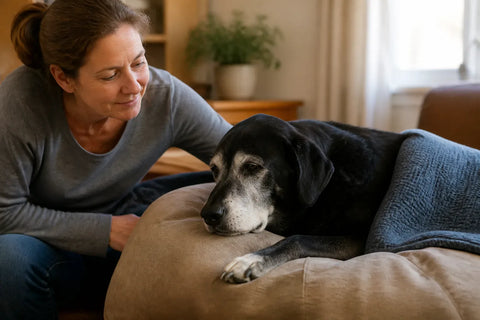
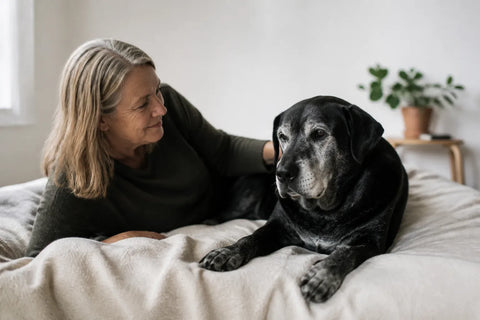
The evening routine used to be predictable, but lately your senior dog seems to hesitate at the doorway. Cognitive dysfunction syndrome (CDS), sometimes called canine cognitive dysfunction (CCD) or dog dementia, is a neurodegenerative condition in senior dogs that shares certain brain changes with human Alzheimer's disease.
When we talk about canine brain aging, CDS acts as the primary clinical differential for a senior dog acting weird or confused.
In veterinary medicine, this condition is recognized as a complex pathology where brain cells gradually lose function. While human Alzheimer's involves distinct genetic and physiological pathways, the parallel deterioration observed in aging canine brains is a subject of major study.
For owners watching their dogs navigate these changes, knowing the terminology is the first step of self-research.
Canine dementia is the lay term for this syndrome, and acknowledging it as a physical, neurodegenerative condition helps move past the assumption that a dog is simply being stubborn. Age-associated cognitive decline in dogs is typically classified into progressive stages, mild, moderate, and severe, marked by increasingly noticeable shifts in daily behavior and responsiveness.
Related: does gabapentin cause dementia in dogs
The evidence for nutritional support in senior dogs is promising, but research is ongoing, and how well an individual dog responds to dietary changes can vary.
Source: Cornell Riney Canine Health Center and Today's Veterinary Practice and Peer-reviewed article via PubMed Central and GeroScience via PubMed Central
Dogs can experience a physical neurodegenerative condition that closely mirrors the brain changes seen in human cognitive decline.
Why does my senior dog get restless at night?

Senior dogs with cognitive decline may exhibit increased pacing, agitation, or confusion during the evening hours, which is sometimes referred to as 'sundowning.' You might first notice your older dog standing in a corner, staring blankly at the wall.
Common signs of age-related cognitive decline in dogs include getting stuck behind furniture (disorientation), interacting differently with family members, waking up at night, losing house-training, and restlessness or decreased activity. In veterinary clinical practice, these signs are categorized using the DISHAA framework, which evaluates disorientation, social interactions, sleep-wake cycles, house-soiling, activity changes, and anxiety.
Disorientation often presents as a dog walking to the hinge side of a door instead of the opening, or aimlessly circling in the living room. Altered social interactions might show up as a dog withdrawing from family greeting routines, or conversely, developing sudden, intense clinginess.
Changes in house-training, such as urinating indoors shortly after a long walk, typically point to cognitive processing changes rather than a physical bladder issue, assuming medical causes have been ruled out.
Source: Cornell Riney Canine Health Center and Today's Veterinary Practice
Restlessness and confusion in the evening are recognized behavioral patterns associated with the canine brain's natural aging process.
How do medium-chain triglycerides support an aging brain?
Diets enriched with medium-chain triglycerides (MCTs) may help support brain function in aging dogs by providing ketones as an alternative fuel source for brain cells. Enriched diets containing antioxidants, essential fatty acids, and supportive nutrients may help maintain or support cognitive functions in senior dogs.
Related: herbsmith senior dog wisdom dog dementia supplement
The brains of dogs experiencing cognitive decline often show physical changes, such as the accumulation of beta-amyloid protein deposits, similar to the pathology found in human brain aging.
Source: Today's Veterinary Practice and Peer-reviewed article via PubMed Central and AGE via Springer and GeroScience via PubMed Central and Cornell Riney Canine Health Center
MCTs offer an alternative energy source to support aging brain cells when glucose metabolism becomes less efficient.
When should you consult a veterinarian about cognitive changes?
It is crucial to have a veterinarian evaluate your dog if you notice cognitive changes, as pain, vision or hearing loss, and other medical conditions can cause identical behavioral signs. If your older dog experiences a sudden or rapid onset of disorientation or neurological symptoms, contact your veterinarian immediately, as acute events like a stroke or brain infarction must be ruled out.
Source: Cornell Riney Canine Health Center and Today's Veterinary Practice and Frontiers in Veterinary Science, 2025
A professional veterinary evaluation is required to rule out physical pain or sensory loss before identifying cognitive decline.
How can you support your senior dog's daily routine?

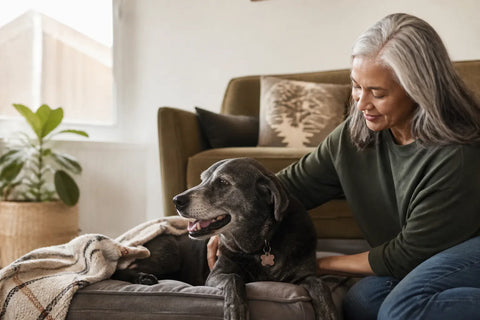
Keeping daily feeding, walking, and bedtime routines consistent, alongside gentle mental enrichment like food puzzles, may help support the well-being of dogs with cognitive changes. An older dog relies heavily on environmental memory to navigate their surroundings.
To help minimize distress and confusion for a dog experiencing cognitive decline, avoid making major or sudden changes to the layout of your home.
Rearranging sofas, moving their water bowl, or shifting their favorite dog bed can trigger intense disorientation. A dog with compromised spatial awareness may become frustrated or get stuck when their familiar pathways are suddenly altered.
Keeping the physical environment static provides them with a safe, predictable sensory map.
Related: dog cognitive supplements
If you must make modifications, such as adding non-slip rugs or ramps, introduce them slowly and guide your dog through the new setup.
Source: Cornell Riney Canine Health Center and Today's Veterinary Practice
A predictable daily schedule combined with low-stress mental stimulation helps support comfort and reduce anxiety.
Where NeuroChew fits in all this
Full transparency: NeuroChew is ours. It's a veterinarian-approved daily soft chew that supports normal brain function and healthy circulation in dogs.
It's daily support, not medicine, designed to fit alongside your vet's plan rather than replace it. Dr.
Ruth Roberts, DVM, CVFT, puts it this way: "I support NeuroChew because it's the first dog chew that supports both brain function and healthy circulation!" If the signs above sound familiar, a daily brain-support routine is one of the simplest places to start.
Supporting a senior dog through cognitive changes is a collaborative effort that requires patience and careful monitoring. Your family veterinarian is your best resource for physical diagnoses and personalized care plans.
By combining veterinary guidance with structured routines and targeted daily nutrition, you can help support your dog's comfort throughout their senior years.
References
- Cognitive dysfunction syndrome, Cornell Riney Canine Health Center. https://www.vet.cornell.edu/departments-centers-and-institutes/riney-canine-health-center/canine-health-topics/cognitive-dysfunction-syndrome
- Enhancing cognitive functions in aged dogs and cats: a systematic review, Peer-reviewed article via PubMed Central. https://pmc.ncbi.nlm.nih.gov/articles/PMC12181554/
- Assessment of nutritional interventions for modification of age-associated cognitive decline using a canine model of human aging, AGE via Springer. https://link.springer.com/article/10.1007/s11357-005-4001-z
- Nutritional Intervention for Canine Cognitive Dysfunction, Today's Veterinary Practice. https://todaysveterinarypractice.com/nutrition/nutritional-intervention-for-canine-cognitive-dysfunction/
- Efficacy of a Therapeutic Diet on Dogs With Signs of Cognitive Dysfunction Syndrome, Peer-reviewed article via PubMed Central. https://pmc.ncbi.nlm.nih.gov/articles/PMC6299068/
- Enhancing cognitive functions in aged dogs and cats: a systematic review of enriched diets and nutraceuticals, GeroScience via PubMed Central. https://pmc.ncbi.nlm.nih.gov/articles/PMC12181554/
- Case Report: Ischemic brain infarction and cognitive dysfunction syndrome in an aged dog, Frontiers in Veterinary Science, 2025. https://www.frontiersin.org/journals/veterinary-science/articles/10.3389/fvets.2025.1563798/full
- Updates on Cognitive Dysfunction Syndrome, Today's Veterinary Practice. https://todaysveterinarypractice.com/behavior/updates-on-cognitive-dysfunction-syndrome/
As of July 2026
Get practical dog wellness tips by email
Occasional, useful guidance on keeping your dog healthy and happy. Unsubscribe anytime.
No spam. We respect your inbox.
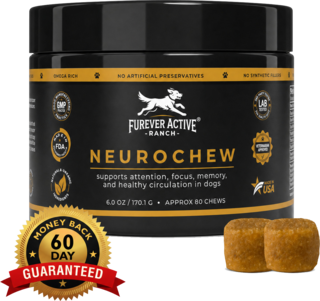
Support your dog's brain health with NeuroChew
NeuroChew is our daily soft chew for dogs, made fresh in the USA. See the ingredients and how it fits into a healthy daily routine.
Learn more about NeuroChew