Dog Brain Health
Herbsmith Senior Dog Wisdom: Fair Label Comparison


Herbsmith Senior Dog Wisdom is a senior cognitive-support product shoppers compare when aging signs look like dementia. Canine Cognitive Dysfunction (CDS) is a progressive age-related decline in dogs that is often compared to human dementia. No chew replaces a veterinary exam. Without dual-verified milligram sources on this page, judge the bag with a printed-amount test rather than invented specs.
A senior is pacing nights, staring at corners, or losing the old map of the house, and a senior brain bag is already open on the counter. The most useful sentence on this whole page says not to buy anything while the clinic work is still open.
Related: how to calm a dog with dementia at night
This comparison teaches the label test you should run on Senior Dog Wisdom and on every neighbor bag, without fairy-dusting.
AT A GLANCE
The pick: Our pick is NeuroChew, our own daily brain-health chew, held to the standard this guide teaches.
Reason one: Built for daily brain support, not sedation.
Reason two: Veterinarian-approved, with Dr. Ruth Roberts, DVM, CVFT as the named endorser.
Reason three: A 60-day guarantee, refunded even on an empty bottle.
Skip it if: Your dog has new, sudden, or severe symptoms, is pregnant, nursing, or a puppy, is on medication, or is managing an existing condition without your veterinarian's input.
What this comparison is actually about
Canine Cognitive Dysfunction (CDS) is a progressive age-related decline in dogs that is often compared to human dementia. Shoppers land on Herbsmith Senior Dog Wisdom and similar senior brain products because they want a practical bag comparison inside that CDS story, not another vague aging essay.
Hold the product question and the disease question side by side.
The bag does not settle the clinical picture, and the disease label does not automatically pick the bag.
Source: Cornell Riney Canine Health Center and Today's Veterinary Practice
Bottom line: CDS is the clinical frame; the bag is a secondary shopping question.
Night restlessness is a core CDS pattern

Disruption of the sleep-wake cycle, such as nighttime restlessness or pacing, is a common sign associated with Canine Cognitive Dysfunction. A pacing senior dog needs a veterinary exam first, before any supplement decision.
Bottom line: night pacing is a CDS-linked pattern and a clinic cue first.
Sundowning is a timing pattern, not a brand feature
Some dogs experience 'sundowning,' where signs of confusion, anxiety, or restlessness appear to worsen during the late afternoon or evening hours. Marketing pages love that word because it is searchable.
Useful comparison work still asks whether a product is promising sedation, daytime brain support, or nothing more than a blend name.
Bottom line: sundowning describes timing, not a brand victory.
Wall-staring and lost corners are common owner reports
An owner might observe a senior dog staring at walls or struggling to navigate familiar corners, which are common signs of cognitive changes. Those scenes drive product tabs open.
Related: what causes dementia in dogs
They are also why a thorough exam matters before you stack two senior formulas because a search result said dementia.
Bottom line: orientation changes are owner-visible cues, not a shopping list.
Clingy or withdrawn shifts still count
A sudden shift in how your senior dog interacts with you, such as becoming unusually clingy or unusually withdrawn, can be an indicator of cognitive decline. Interaction change is easy to miss when you are busy comparing ingredient panels.
Put it on the clinic list with sleep and orientation notes.
Bottom line: social shifts belong in the clinic notes, not only in a bag comparison.
Rule out look-alikes before you crown a supplement
Because signs of cognitive dysfunction can overlap with other health issues, a thorough veterinary exam is essential to rule out underlying medical conditions. The same owner story that opens a Senior Dog Wisdom tab can still be another senior health issue.
The fairest product comparison starts after that exam is on the calendar.
Source: Cornell Riney Canine Health Center and Frontiers in Veterinary Science, 2025
Bottom line: rule-outs first, label shopping second.
Build the support plan with a veterinarian
Consulting a veterinarian can help you build a personalized support plan, which may include dietary adjustments and environmental modifications. That plan is the spine.
Supplements, including Senior Dog Wisdom or any house chew, are optional layers after the spine exists.
Bottom line: the clinic plan is primary; chews stay optional layers.
Printed-amount test without invented competitor specs
Scientific evidence for individual supplements continues to emerge, and what helps support one dog's cognitive health may vary for another. That variance is why comparison pages that invent milligram tables without dual-verified sources are selling comfort, not evidence.
Related: what can i give my dog for anxiety
On this page we do not print competitor active amounts unless two independent sources confirm them.
If a label will not print every active amount, score transparency low even when the front panel sounds clinical.
Source: Peer-reviewed article via PubMed Central
Bottom line: dual-verified printed amounts beat marketing paragraphs.
MCT language you can actually defend
Medium-chain triglycerides (MCTs) may help support brain health in senior dogs by acting as an alternative energy source for aging brain cells. When a competitor or house label leans on MCT talk, ask for the printed amount and whether the claim stays in support language.
Alternative fuel is not a fix sentence.
Source: Today's Veterinary Practice
Bottom line: MCT support language still needs a printed amount.
Antioxidants and mitochondrial cofactors stay modest
Nutritional components like antioxidants and mitochondrial cofactors may help address oxidative stress in aging dogs. That is category science, not permission to over-claim dementia outcomes.
On a Herbsmith-versus-anyone scorecard, score transparency and ceiling honesty before brand loyalty.
Source: Today's Veterinary Practice and Peer-reviewed article via PubMed Central
Bottom line: antioxidant language stays support-level, not cure-level.
Routine still beats bag-only thinking

Maintaining a consistent daily schedule for meals, walks, and bedtime can help ease confusion and reduce anxiety in disoriented senior dogs. A fair Senior Dog Wisdom read puts schedule work above chew loyalty.
If the day is chaos, no label comparison will feel like a complete answer.
Related: 4health calming aid supplement bars for dogs
Bottom line: stable routines outrank bag-only shopping.
Enrichment is part of the same stack
Keeping senior dogs mentally active with puzzle toys and sensory enrichment may help support cognitive vitality as they age. Puzzle work is not a product attack.
It is a reminder that Senior Dog Wisdom, house brain chews, and every neighbor bag are incomplete if the dog never gets a simple job for their brain.
Bottom line: enrichment belongs beside nutrition, not under it.
Environment plus nutrition is a both-and
While cognitive decline is a progressive process, combining environmental adjustments with nutritional support may help support a senior dog's daily comfort. Progressive does not mean hopeless, and it also does not mean any single bag is the plan.
Use comfort language carefully and keep the clinic in the loop as needs shift.
Bottom line: environment plus nutrition is support, not a duel or a cure.
The ingredients above are why NeuroChew exists
Full transparency: NeuroChew is ours. It's a veterinarian-approved daily soft chew that supports normal brain function and healthy circulation in dogs.
It's daily support, not medicine, designed to fit alongside your vet's plan rather than replace it. Dr.
Ruth Roberts, DVM, CVFT, puts it this way: "I support NeuroChew because it's the first dog chew that supports both brain function and healthy circulation!" If the signs above sound familiar, a daily brain-support routine is one of the simplest places to start.
Frequently asked questions
What is the best supplement for dog dementia?
There is no single best bag for every senior. Scientific evidence for individual supplements continues to emerge, and what helps support one dog's cognitive health may vary for another. Start with a veterinary exam, then compare printed amounts and honest claim ceilings.
Related: can dogs get anxiety after pneumonia
What to give a senior dog with dementia?
Consulting a veterinarian can help you build a personalized support plan, which may include dietary adjustments and environmental modifications. Supplements are optional layers after that plan exists.
How do vets approach dementia-like aging in older dogs?
Because signs of cognitive dysfunction can overlap with other health issues, a thorough veterinary exam is essential to rule out underlying medical conditions. Clinical plans belong to the clinician, not to a shopping guide.
What is sundowning in dogs?
Some dogs experience 'sundowning,' where signs of confusion, anxiety, or restlessness appear to worsen during the late afternoon or evening hours. It is a timing pattern, not a brand feature.
Does Herbsmith Senior Dog Wisdom print every active amount?
This page does not invent competitor milligram tables without dual-verified sources. Open the physical label or manufacturer panel yourself and run the printed-amount test: if every active amount is not printed, score transparency low.
Where does NeuroChew fit in a senior comparison?
NeuroChew is our own daily soft chew, and its label prints every active's exact amount. Judge it by the same printed-amount test this page teaches; the appended product note below carries the rest.
Start with a veterinary exam that can separate CDS from look-alike senior issues. Use routine, enrichment, and nutrition as support layers after that plan is clear.
Compare any dementia-aisle bag with the printed-amount test and honest ceilings on MCT and antioxidant language. If you still want a daily brain-support chew later, keep it secondary to the clinic plan and refuse proprietary-blend fog on every label you open.
References
- Cognitive dysfunction syndrome, Cornell Riney Canine Health Center. https://www.vet.cornell.edu/departments-centers-and-institutes/riney-canine-health-center/canine-health-topics/cognitive-dysfunction-syndrome
- Enhancing cognitive functions in aged dogs and cats: a systematic review, Peer-reviewed article via PubMed Central. https://pmc.ncbi.nlm.nih.gov/articles/PMC12181554/
- Nutritional Intervention for Canine Cognitive Dysfunction, Today's Veterinary Practice. https://todaysveterinarypractice.com/nutrition/nutritional-intervention-for-canine-cognitive-dysfunction/
- Case Report: Ischemic brain infarction and cognitive dysfunction syndrome in an aged dog, Frontiers in Veterinary Science, 2025. https://www.frontiersin.org/journals/veterinary-science/articles/10.3389/fvets.2025.1563798/full
- Updates on Cognitive Dysfunction Syndrome, Today's Veterinary Practice. https://todaysveterinarypractice.com/behavior/updates-on-cognitive-dysfunction-syndrome/
As of July 2026
Get practical dog wellness tips by email
Occasional, useful guidance on keeping your dog healthy and happy. Unsubscribe anytime.
No spam. We respect your inbox.
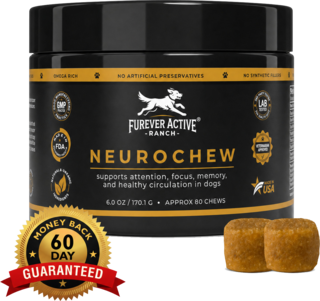
Support your dog's brain health with NeuroChew
NeuroChew is our daily soft chew for dogs, made fresh in the USA. See the ingredients and how it fits into a healthy daily routine.
Learn more about NeuroChew