Dog Brain Health
Does My Dog Have Dementia? A Simple At-Home Checklist


You cannot settle this question at home, but you can gather the observations that answer it. Veterinarians often assess age-related cognitive changes with the DISHA framework: disorientation, changes in social interactions, sleep-wake disturbances, house soiling, and altered activity. Watch for things like staring at walls, getting trapped in corners, interaction shifts in either direction, and nighttime pacing or vocalizing, and note dates and frequency. A veterinary evaluation stays essential, because arthritis pain, sensory loss, and metabolic diseases closely mimic cognitive decline.
If you typed this question into a search bar, something specific happened: a stare that lasted too long, a corner she could not solve, a 3-in-the-morning bark at nothing. This page will not hand you a diagnosis, because no honest page can. What it hands you instead is a working checklist: the exact sign categories veterinarians use, what each one looks like in a real house, how to record what you see so it becomes usable information, the look-alike conditions that make a professional evaluation non-negotiable, and the one situation that skips the checklist entirely. Fill it in over a week, and you will walk into the clinic with answers instead of anecdotes.
Related: dog dementia stages
What this checklist is actually for

The question in the search bar is usually asked at midnight. Canine cognitive dysfunction syndrome (CDS), sometimes referred to as 'dog dementia,' is a neurodegenerative condition that can affect senior dogs as their brains age. A checklist cannot confirm it, and this one does not pretend to.
What home observation genuinely can do is document the pattern: what you are seeing, how often, and since when. That record is the difference between a vague worry and a productive appointment, and building it is the whole job of this page.
Source: Cornell Riney Canine Health Center and Today's Veterinary Practice
DISHA: the five boxes on the list
A good checklist starts with the right categories. Veterinarians often assess age-related cognitive changes using the 'DISHA' framework: Disorientation, changes in social Interactions, Sleep-wake cycle disturbances, House soiling, and altered Activity levels. Those five categories are your checklist's structure, and they are worth using precisely because they are the same ones your veterinary team uses: notes organized by DISHA translate directly into a clinical conversation.
The next three sections walk the categories owners most often see first, with what each looks like at home.
Source: Cornell Riney Canine Health Center and Today's Veterinary Practice
Check one: the lost-at-home moments
The first check happens in the hallway. Disorientation may show up as your dog staring at walls, getting trapped in corners, or appearing confused in their own home. What you are checking for is not one strange moment but a repeating one: the same blank stare on multiple evenings, corners that keep defeating her, familiar rooms treated like new territory.
When it happens, jot the date, the place, and the time of day. Location and hour patterns are exactly the kind of detail that makes the record useful later.
Related: dog dementia
Source: Cornell Riney Canine Health Center and Today's Veterinary Practice
Check two: the greetings and the follows
The second check is about the hellos and the follows. A dog experiencing cognitive decline may show changes in how they interact with you, either seeking constant attention or withdrawing and ignoring family members. Both directions count, which surprises people: the dog who suddenly shadows you room to room belongs on the list just as much as the one who stops meeting you at the door.
The baseline is her own lifelong pattern, so the checklist question is simple: is this the same dog socially that she has always been?
Source: Cornell Riney Canine Health Center and Today's Veterinary Practice
Check three: what the nights look like
The third check belongs to the night. Disruptions in the normal sleep-wake cycle may cause senior dogs to pace, vocalize, or remain active at night when they would normally be sleeping. Nights are the easiest category to log because the clock does half the work: note which hours the pacing or barking fills and how many nights per week it happens.
A specific pattern, active from two to four for the last three weeks, is clinic-ready. A general sense that nights are bad is not.
Source: Cornell Riney Canine Health Center and Today's Veterinary Practice
How much: the mild to severe spectrum
Checks tell you what; the next question is how much. Cognitive decline in dogs typically progresses through stages, mild, moderate, and severe, with behavioral changes becoming more pronounced as the dog ages. For your checklist, that means frequency matters as much as presence: an occasional odd evening and a nightly ritual of confusion are different answers to the same checkbox.
Record how often, not just whether. The count is what lets a professional place your dog on that spectrum rather than guessing from a single story.
Related: what causes dementia in dogs
Source: Today's Veterinary Practice
The disclaimer that makes the list honest
Before any conclusion, the list has a disclaimer. Conditions like arthritis pain, vision or hearing loss, and internal metabolic diseases can cause behavioral changes that closely mimic cognitive decline, making a veterinary evaluation essential. This is why no home checklist can be a verdict: a dog in pain paces, a dog losing hearing stops responding, and from the couch those look identical to the signs above.
Each of those conditions is handled on its own terms, which is the best possible reason to get the real evaluation instead of settling for a guess.
Source: Cornell Riney Canine Health Center and Today's Veterinary Practice
The one situation that skips the checklist

In senior dogs, sudden or severe changes in behavior can sometimes be related to other serious neurological events, such as a brain stroke, which requires immediate veterinary attention. Sudden is the word that changes everything: this page is built for slow patterns tracked over weeks, and an abrupt overnight shift is a different situation entirely. If the change arrived fast and hard, close the checklist and make the call now.
Speed only costs you a phone call if it turns out to be nothing.
Source: Frontiers in Veterinary Science, 2025
While you watch: drop the scolding
Scolding feels like doing something. Punishing a senior dog for house-soiling or nighttime pacing should be avoided, as it can increase their stress and worsen their behavioral issues. If the signs on this list are present, they are symptoms, not choices, and correction lands on a dog who cannot connect it to anything she controls.
It also muddies your checklist, because a stressed dog shows more of everything you are trying to observe cleanly. Calm observation gives you better data and gives her better days.
Related: how to calm a dog with dementia at night
Source: Cornell Riney Canine Health Center
While you watch: keep the days boring
The cheapest item on this list is the calendar. Maintaining a stable home layout and keeping a predictable daily routine for feeding, walks, and sleep may help minimize confusion and anxiety in aging dogs. During your observation weeks this does double duty: it is kind to a dog whose memory may be strained, and it holds the household variables steady so the pattern you record reflects her, not a chaotic week.
Same meal times, same walk times, furniture where she left it.
Source: Cornell Riney Canine Health Center and Today's Veterinary Practice
The kitchen question: fuel
Fuel is the kitchen's angle on all this. Medium-chain triglycerides (MCTs) can serve as an alternative energy source for the brain, which may help support cognitive health in senior dogs. If your checklist ends up pointing toward cognitive changes, nutrition is one of the conversations that follows, and MCTs are the fuel side of it: a second energy pathway for a brain handling its usual one less well.
May help support is the honest strength of that sentence, and the specifics belong in the same appointment as your notes.
Source: Today's Veterinary Practice and AGE via Springer and Peer-reviewed article via PubMed Central
The kitchen question: protection
Defense is the other job food can apply for. Diets enriched with antioxidants and specific nutrients may help defend the aging canine brain against cellular oxidative damage. This is the protective half of the nutrition conversation, aimed at the slow wear that comes with brain aging rather than at daily fuel.
Label discipline applies as always: named nutrients and stated amounts are worth attention, and the bare word antioxidant on a bag is not evidence of anything.
Related: dog dementia diet
Source: Today's Veterinary Practice and AGE via Springer and Peer-reviewed article via PubMed Central and GeroScience via PubMed Central
The honest footer on the whole page
Every honest checklist ends with its limits. The effectiveness of nutritional interventions for supporting brain health can vary from dog to dog, and scientific findings in this area continue to develop. That applies to everything in the two sections above: real research interest, no guarantees for your individual dog, and a field still filling in its blanks.
The practical move never changes, one adjustment at a time, a few patient weeks, and the same dated notes this whole page is built on, so your dog's own record decides what is working.
Source: Today's Veterinary Practice and Peer-reviewed article via PubMed Central and GeroScience via PubMed Central
Where NeuroChew fits in all this

From our family ranch, full disclosure: this one is ours
Reading pages like this usually means you're worried about a dog you love, so let's be straight about who we are: NeuroChew is ours. It won't replace the veterinary workup this guide keeps pointing you toward, and it doesn't try to. It's a veterinarian-approved daily soft chew built on phosphatidylserine, Norwegian salmon oil, and beet root with ginger to support normal brain function and healthy circulation as your dog ages.
- ✓ 60-day guarantee: not thrilled? Even the empty bottle gets a full refund
- ✓ Free shipping on every order
- ✓ Multi-bottle packs save up to 40%
"I support NeuroChew because it's the first dog chew that supports both brain function and healthy circulation!" Dr. Ruth Roberts, DVM, CVFT
See What's Inside NeuroChew →Daily support, not medicine. It fits alongside your vet's plan, never in place of it.
Frequently asked questions
What are the first signs of dementia in a dog?
Veterinarians assess age-related cognitive changes using the DISHA categories: disorientation, interaction changes, sleep-wake disturbances, house soiling, and altered activity levels. Disorientation may show up as staring at walls, getting trapped in corners, or appearing confused in their own home.
Can a vet test a dog for dementia?
Veterinarians often assess age-related cognitive changes using the DISHA framework, and a veterinary evaluation is essential because conditions like arthritis pain, vision or hearing loss, and metabolic diseases can closely mimic cognitive decline. Your dated home observations are a key input to that assessment.
What can mimic dementia in dogs?
Conditions like arthritis pain, vision or hearing loss, and internal metabolic diseases can cause behavioral changes that closely mimic cognitive decline. That overlap is exactly why a veterinary evaluation is essential before drawing any conclusion at home.
What are the three stages of dog dementia?
Cognitive decline in dogs typically progresses through stages, mild, moderate, and severe, with behavioral changes becoming more pronounced as the dog ages. Frequency of signs matters as much as their presence, which is why a dated record of how often you see each change is so useful.
The checklist's real product is not a verdict, it is a record: which categories you observed, on which dates, how often. That record does what worry cannot, it turns a feeling that something is off into a pattern a professional can evaluate against everything else your dog's chart knows. So watch the hallway moments, the greetings, the nights. Write them down plainly. Skip the self-blame and the scolding, keep the days predictable, and bring the page with you. Whatever the answer turns out to be, you will have given your dog the fastest route to the right help.
Get practical dog wellness tips by email
Occasional, useful guidance on keeping your dog healthy and happy. Unsubscribe anytime.
No spam. We respect your inbox.
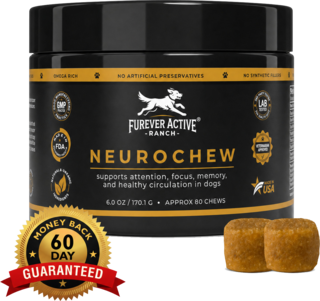
Support your dog's brain health with NeuroChew
NeuroChew is our daily soft chew for dogs, made fresh in the USA. See the ingredients and how it fits into a healthy daily routine.
Learn more about NeuroChew