Dog Brain Health
Diet and Nutrition for Dogs with Dementia


Nutrition for dogs with dementia centers on two research threads: diets supplemented with medium-chain triglycerides, which offer ketones as an alternative energy source for aging brain cells, and diets enriched with antioxidants, mitochondrial cofactors, and essential fatty acids. Research suggests pairing specialized nutrition with environmental enrichment supports cognitive health better than diet alone, individual responses vary, and dietary changes should be tailored with your veterinarian to the whole health picture.
When a dog's mind starts to slip, the food bowl is one of the few places an owner holds real influence every single day. This guide keeps that influence honest. It covers why aging brains develop an energy problem in the first place, the two nutrition strategies with actual research behind them, why food works better with company than alone, the daily structure that costs nothing, and the context every feeding decision sits inside: the signs, the stages, and the timeline question. No ingredient here is a rescue. Several are genuinely worth knowing about.
Related: what causes dementia in dogs
What dog dementia is
Owners meet this condition long before they meet its acronym. Canine Cognitive Dysfunction Syndrome (CDS) is a progressive neurodegenerative disorder in older dogs, often called dog dementia, that shares several pathological similarities with human Alzheimer's disease. The human parallel is why so much of the nutrition thinking in this space mirrors human brain-health research, and progressive is why diet gets discussed at all: when a condition unfolds over months and years, the daily inputs you control start to matter, meal by meal.
Source: Cornell Riney Canine Health Center and Today's Veterinary Practice
The energy problem inside an aging brain

Every kitchen decision starts with what the engine can burn. As dogs age, their brains may show a decreased capacity to metabolize glucose, creating an energy deficit that alternative dietary fuels like MCT-derived ketones are designed to support. This is the single most useful mechanism to understand before reading any senior-diet label, because it explains the logic instead of asking you to trust marketing: the usual fuel line weakens, so the strategy is to supply a second one.
Every MCT claim you will ever read traces back to this sentence.
Source: Today's Veterinary Practice and Peer-reviewed article via PubMed Central
MCT-supplemented diets: the fuel strategy
Start with the pantry's simplest idea. Feeding a diet supplemented with medium-chain triglycerides (MCTs) may help support brain health and cognitive function in older dogs by offering ketones as an alternative energy source for aging brain cells. This is the practical application of the energy deficit above, and it is the most direct nutrition idea in the whole space: not a mystery blend, a fuel substitution with a stated mechanism.
May help support is the honest strength of the evidence. Look for MCTs named explicitly on a label rather than implied by a buzzword.
Source: Today's Veterinary Practice and Peer-reviewed article via PubMed Central and GeroScience via PubMed Central
Antioxidants, cofactors, and fatty acids: the protection strategy
The second shelf of the strategy is protective. Diets enriched with antioxidants, mitochondrial cofactors, and essential fatty acids may support cognitive performance and help manage some signs of age-associated mental decline in older dogs. Where the MCT idea is about fuel, this trio plays a different position on the same field.
Related: dog dementia
Some signs is a phrase worth respecting, because it promises less than a headline and matches what studies actually measured. The reading discipline stays the same: named nutrients and amounts earn attention, adjectives do not.
Source: Peer-reviewed article via PubMed Central and AGE via Springer and GeroScience via PubMed Central
Why food works better with company
No bowl carries the whole job. Research suggests that combining specialized nutrition with environmental enrichment, such as regular play, interactive toys, and physical activity, may support cognitive health in senior dogs more effectively than diet alone. This is the most practical sentence in the research: the diet you choose and the ten-minute sniff walk you take are not separate projects, they are one project.
Enrichment costs almost nothing, scales to the dog she is now, and multiplies the investment you are already making at mealtime.
Source: AGE via Springer and GeroScience via PubMed Central and Today's Veterinary Practice
What the research honestly supports
Honest labels come from honest reading. While research supports the benefits of specific nutritional interventions for brain health, individual responses vary and some findings are still emerging. That sentence is the whole category in proportion: real support, real variation, real unknowns.
The practical translation never changes: one change at a time, a few patient weeks per change, and dated notes on what you actually observe, so the verdict on any diet comes from your dog rather than from the front of a bag.
Source: Peer-reviewed article via PubMed Central and GeroScience via PubMed Central
Talk to the vet before changing the menu
Owners should consult with their veterinarian before making significant dietary changes, as nutritional interventions should be tailored to the individual dog's overall health profile. The reason is bigger than politeness: senior dogs often carry more than one condition, and a diet that suits an aging brain must also suit the kidneys, the joints, and whatever else the chart says. Tailoring is where a promising idea becomes a safe plan, and it is also where the useful details get decided, amounts, transitions, and what to watch for.
Related: dog dementia stages
Source: Today's Veterinary Practice
Routines: the free half of the plan
Some help is architectural. Maintaining structured routines for feeding, exercise, and sleep, while avoiding unnecessary changes to the home layout, can help reduce anxiety and support dogs experiencing cognitive decline. Notice that feeding leads that list: mealtimes are already the anchor points of a dog's day, which makes the bowl a scheduling tool as much as a nutrition tool.
Same times, same places, and a home that stays where she left it. For a dog whose memory is less reliable, sameness is a kindness.
Source: Cornell Riney Canine Health Center and Today's Veterinary Practice
DISHA: how the changes get organized
Five letters give the changes a shared language. Veterinarians commonly assess cognitive decline using the DISHA framework, which evaluates changes in Disorientation, Social interactions, Sleep-wake cycles, House-soiling, and Activity levels. For a nutrition-focused owner, the framework is the measuring stick: if you are trying a dietary change, DISHA categories are what you take notes against, so improvement or drift gets recorded as something concrete instead of a feeling.
It is also the vocabulary your veterinary team already speaks.
Source: Today's Veterinary Practice
How the condition tends to progress
The road has recognizable mile markers. Cognitive dysfunction syndrome is progressive and usually develops in stages, starting with mild changes in interaction and gradually advancing to more severe impacts on daily routines, orientation, and house training. For feeding decisions, the staging matters because early is when habits are easiest to build: a dog still comfortable with her routine adapts to a new diet and schedule far more easily than one deep into disorientation.
Whatever you decide to try, earlier beats later for the trying.
Related: how to calm a dog with dementia at night
Source: Cornell Riney Canine Health Center and Today's Veterinary Practice
The sleep-wake flip at night

The clock tells on this condition. Altered sleep-wake cycles, including waking up and pacing or vocalizing at night and sleeping heavily during the day, are classic behavioral signs of canine cognitive dysfunction. Nights are usually what push a household from watching to acting, and they are worth tracking like data rather than surviving like weather.
Log the night hours you are seeing; the pattern is clinic-ready information.
Source: Cornell Riney Canine Health Center and Today's Veterinary Practice
Sundowning: the evening version
Late afternoon has its own weather in some houses. Dogs with cognitive decline may exhibit increased disorientation, pacing, or distress during the late afternoon or evening hours, a phenomenon commonly called 'sundowning.' If your dog shows this pattern, the day's schedule becomes a tool: an earlier dinner, an evening walk timed before the difficult window, calm hours planned where the hard hours land. The pattern's predictability is the one gift it gives, because a predictable problem can be planned around.
Source: Cornell Riney Canine Health Center and Today's Veterinary Practice
The timeline question, answered honestly
The timeline question deserves a grown-up answer. Cognitive Dysfunction Syndrome is a progressive condition, but a dog's life expectancy depends on overall physical health and the management of concurrent geriatric diseases in consultation with a veterinarian. In other words, the condition itself is not the whole clock: the rest of the body, and how well its other issues are managed, carry most of the timeline.
That is oddly hopeful, because it returns the question to things that can actually be tended, including the bowl this guide is about.
Source: Cornell Riney Canine Health Center and Today's Veterinary Practice and Frontiers in Veterinary Science, 2025
The ingredients above are why NeuroChew exists

From our family ranch, full disclosure: this one is ours
Cards on the table: NeuroChew is ours, and the research you just read is why it exists. The same ingredient families covered above, phosphatidylserine and omega-3s from Norwegian salmon oil, plus beet root and ginger, are what our veterinarian-approved daily chew is built around to support normal brain function and healthy circulation. Air-dried, so processing doesn't cook the nutrients away.
- ✓ 60-day guarantee: not thrilled? Even the empty bottle gets a full refund
- ✓ Free shipping on every order
- ✓ Multi-bottle packs save up to 40%
"I support NeuroChew because it's the first dog chew that supports both brain function and healthy circulation!" Dr. Ruth Roberts, DVM, CVFT
See What's Inside NeuroChew →Daily support, not medicine. It fits alongside your vet's plan, never in place of it.
Related: does my dog have dementia quiz
Frequently asked questions
What food is best for dogs with dementia?
No single food wins for every dog. The two approaches with research attention are diets supplemented with medium-chain triglycerides, which offer ketones as an alternative brain fuel, and diets enriched with antioxidants, mitochondrial cofactors, and essential fatty acids. Dietary changes should be tailored with a veterinarian to the dog's overall health profile.
What is the life expectancy of a dog with dementia?
Cognitive Dysfunction Syndrome is progressive, but life expectancy depends on the dog's overall physical health and how well concurrent geriatric diseases are managed in consultation with a veterinarian. The condition itself is not the whole clock, which is why whole-dog care matters more than any single number.
What helps dog dementia?
Research suggests combining specialized nutrition with environmental enrichment, such as regular play, interactive toys, and physical activity, may support cognitive health in senior dogs more effectively than diet alone. Structured routines for feeding, exercise, and sleep, with a stable home layout, can help reduce anxiety as well.
What are the stages of dog dementia?
The condition usually develops in stages, starting with mild changes in interaction and gradually advancing to more severe impacts on daily routines, orientation, and house training. Veterinarians commonly track the changes with the DISHA framework: disorientation, social interactions, sleep-wake cycles, house-soiling, and activity levels.
The bowl will not reverse what is happening, and anyone who says otherwise is selling something. What the bowl can honestly carry: a fuel strategy built for an aging brain, protective nutrients with research attention, and a twice-daily anchor in a routine that steadies the whole day. Add the enrichment that multiplies it, keep the home predictable, and let the veterinary team tailor the specifics to the dog in front of them. Small levers, pulled consistently, are still levers, and consistency is the one ingredient entirely in your hands.
Get practical dog wellness tips by email
Occasional, useful guidance on keeping your dog healthy and happy. Unsubscribe anytime.
No spam. We respect your inbox.
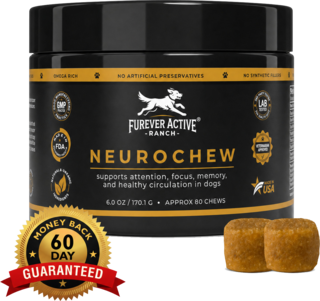
Support your dog's brain health with NeuroChew
NeuroChew is our daily soft chew for dogs, made fresh in the USA. See the ingredients and how it fits into a healthy daily routine.
Learn more about NeuroChew