Dog Brain Health
Dog Dementia: Quality of Life and the Hard Choice


Dog dementia itself is not thought to be a painful condition, so the decision about when to say goodbye is rarely about pain alone. It is a quality-of-life question you work through together with your veterinary team, weighing your individual dog's comfort and the ordinary pleasures that still fill their days, rather than following any fixed timeline or checklist. There is no universal answer, only the honest one that fits the dog in front of you.
If you are reading this after another restless night, you are probably not looking for a lecture. You want to understand what is happening to your dog and what the coming stretch might ask of you. This guide walks through what canine cognitive dysfunction is, the signs that tend to show up first, what quality of life really means as things progress, and the small, steady changes at home that can make your dog's days feel safer and calmer.
Related: dog dementia stages
What Dog Dementia Really Means
Your senior dog has been part of the family for a long time. Canine Cognitive Dysfunction (CCD), also known as Cognitive Dysfunction Syndrome (CDS), is a progressive brain condition in older dogs often described as dog dementia. The word progressive means it tends to develop gradually as your dog ages, and the everyday term dog dementia points at the same underlying condition a veterinarian would call CCD or CDS.
Understanding the name is the first step toward understanding what you are actually seeing at home, and it can take some of the fear out of a word that sounds frightening on its own.
Source: Cornell Riney Canine Health Center and Today's Veterinary Practice
The DISHA Signs Veterinarians Watch For

The acronym DISHA is widely used to help identify classic signs of canine cognitive dysfunction, representing changes in disorientation, social interactions, sleep, house training, and activity. Each letter stands for a familiar part of daily life: how oriented your dog seems, how they interact with the family, how they sleep, how house training holds up, and how active they are. Watching these five areas over time gives you a shared vocabulary for changes that are easy to miss one day at a time, and it turns a vague sense that something is off into specifics you can actually describe.
Source: Today's Veterinary Practice and Cornell Riney Canine Health Center
Why Sleep Changes Often Appear Early

Disrupted sleep cycles, such as waking up and pacing at night, are common early signs of cognitive decline in older dogs. Many owners first sense something is off not during the day but in the small hours, when a dog who once slept soundly is suddenly up and moving. Because these shifts arrive gradually, it is easy to write them off as ordinary aging at first.
Paying attention to when and how your dog's rest is changing gives you an early, honest picture of what might be developing, long before the daytime hours look any different.
Source: Cornell Riney Canine Health Center and Today's Veterinary Practice
Evening Restlessness and Sundowning
Dogs with CDS may display a pattern of evening or nighttime worsening of symptoms, sometimes called "sundowning," which can include pacing or restlessness. You might notice your dog settles fine in the morning yet grows unsettled as the light fades, circling the same room or struggling to get comfortable. The word "sundowning" simply names that evening-linked pattern, and it does not mean every hard night is a crisis.
Related: dog dementia
That small word, may, is doing real work here: not every senior dog follows this rhythm, and the intensity can vary from one evening to the next.
Source: Cornell Riney Canine Health Center and Today's Veterinary Practice
Why Dogs With Dementia Get Stuck in Corners
Disorientation from cognitive decline can cause dogs to get stuck in corners or behind furniture as they lose the spatial awareness needed to back up or turn around. To you it can look baffling: your dog walks into a corner, a closet, or the gap beside the couch, then stands there as if the way out has vanished. What has faded is the sense of space that once let them reverse or pivot without a thought.
It helps to gently guide them free rather than expect them to solve it alone, since the layout that feels obvious to you no longer reads the same way to them.
Source: Cornell Riney Canine Health Center and Today's Veterinary Practice
Are Dogs in Pain With Dementia?
Although dog dementia is not inherently a painful condition, underlying chronic pain from conditions like arthritis can exacerbate or resemble CDS behaviors, necessitating a veterinary evaluation. This is one of the most common worries owners carry, and the honest answer is reassuring on its own terms: the condition itself is not thought to hurt. What complicates the picture is that older dogs often live with other aches, and pain from something like arthritis can make confusion look worse or mimic it outright.
That overlap is why a full evaluation matters, so pain and confusion are not mistaken for each other.
Source: Today's Veterinary Practice and Cornell Riney Canine Health Center
Ruling Out Other Conditions First
Owners should consult a veterinarian to rule out other medical conditions, such as sensory loss or systemic disease, which can mimic the signs of CDS. A dog who bumps into things might be losing vision or hearing rather than memory, and problems elsewhere in the body can echo as changes in behavior. Because several very different issues can look almost identical from the couch, sorting out what is actually going on keeps your dog from being handled as if the wrong thing were to blame.
Related: what causes dementia in dogs
That first step turns a confusing set of signs into a clearer starting point for care.
Source: Cornell Riney Canine Health Center and Today's Veterinary Practice
When Vascular Events Look Like Dementia
Vascular events like brain infarctions can occur in aging dogs and may present with signs similar to cognitive dysfunction. An infarction is a disruption of blood flow in the brain, and in an older dog its aftermath can resemble the confusion of a slowly declining mind. The reason this matters for you is timing: a sudden change can have a very different cause than a gradual one, even when the two end up looking alike.
Noticing whether the signs crept in over months or arrived almost overnight gives useful context for what your dog is facing.
Source: Frontiers in Veterinary Science, 2025
Advanced Stages and Your Dog's Quality of Life
This is the part of the road that brings people to search for answers late at night. In severe or advanced stages of canine cognitive dysfunction, dogs may experience profound disorientation and loss of learned behaviors; owners should consult their veterinarian to evaluate overall quality of life. As the condition advances, a dog may seem to forget routines they knew by heart.
What comes next is not something you decide alone or by a checklist; it is a conversation with your veterinary team, centered on your own dog and the everyday comforts they can still enjoy.
Source: Cornell Riney Canine Health Center and Today's Veterinary Practice
Can Anything Support an Aging Brain?
While nutritional support shows promise for aging canine brains, research is still emerging and individual responses will vary from dog to dog. It is natural to want something you can do, and diet is one honest place to look. The careful wording matters here, because promise is not the same as a promise.
Related: dog dementia symptoms
Some dogs seem to respond to nutritional support and others show little change, and the science is still being written rather than settled. Consider any option a reasonable thing to discuss for your particular dog, not a switch that resets the clock.
Source: Peer-reviewed article via PubMed Central and GeroScience via PubMed Central and AGE via Springer
Keeping Daily Life Predictable
Maintaining a predictable daily schedule and keeping the home layout consistent can help ease anxiety for a dog dealing with spatial disorientation. When the world inside a dog's head feels less reliable, the world around them can pick up the slack. Feeding, walks, and bedtime that happen at roughly the same times give the day a shape your dog can lean on, and furniture that stays where it has always been means one less puzzle to solve.
You do not have to make the house perfect; you just make it steady, so the familiar does more of the work.
Source: Cornell Riney Canine Health Center and Today's Veterinary Practice
What Aging Does to the Canine Brain
Aging canine brains are highly susceptible to oxidative stress and cellular changes, such as mitochondrial dysfunction, which are associated with cognitive decline. In plain terms, the machinery inside brain cells grows less efficient with age, and the wear that builds up is linked to the slipping you notice in behavior. Oxidative stress is the strain that comes from that everyday wear, and mitochondria are the tiny power plants that keep cells running.
None of this is your fault or a sign you missed something; it is part of how bodies grow old, and knowing the biology can make the changes feel a little less bewildering.
Source: AGE via Springer and Today's Veterinary Practice
Making the Home Safer to Move Through
Modifying your home by blocking off hazards like stairs and tight corners can help keep a disoriented dog safe. A baby gate at the top of the stairs, soft barriers across the gaps where your dog tends to wedge, and clear, well-lit paths through the main rooms all lower the chance of a stumble or a stuck moment. Think of it as meeting your dog where they are now, adjusting the space so their confusion has fewer places to cause trouble.
Related: does my dog have dementia quiz
The goal is not to shrink their world but to make the parts they still use feel safe underfoot.
Source: Cornell Riney Canine Health Center and Today's Veterinary Practice
Where NeuroChew fits in all this

From our family ranch, full disclosure: this one is ours
Reading pages like this usually means you're worried about a dog you love, so let's be straight about who we are: NeuroChew is ours. It won't replace the veterinary workup this guide keeps pointing you toward, and it doesn't try to. It's a veterinarian-approved daily soft chew built on phosphatidylserine, Norwegian salmon oil, and beet root with ginger to support normal brain function and healthy circulation as your dog ages.
- ✓ 60-day guarantee: not thrilled? Even the empty bottle gets a full refund
- ✓ Free shipping on every order
- ✓ Multi-bottle packs save up to 40%
"I support NeuroChew because it's the first dog chew that supports both brain function and healthy circulation!" Dr. Ruth Roberts, DVM, CVFT
See What's Inside NeuroChew →Daily support, not medicine. It fits alongside your vet's plan, never in place of it.
Frequently asked questions
What is the final stage of dog dementia?
In severe or advanced stages, canine cognitive dysfunction can bring profound disorientation and the loss of learned behaviors your dog once knew well. Because these later stages affect each dog so individually, they are the point at which owners should consult their veterinarian to evaluate overall quality of life rather than measure progress against any fixed schedule.
Are dogs in pain with dementia?
Dog dementia is not inherently a painful condition. What can complicate the picture is that underlying chronic pain from conditions like arthritis can exacerbate or resemble CDS behaviors, which is why a veterinary evaluation matters when your senior dog's behavior changes.
Is doggy dementia a reason to put a dog down?
On its own, dog dementia is not considered a painful condition, and it is not a single reason to make that decision. In severe or advanced stages, though, dogs may experience profound disorientation and loss of learned behaviors, and that is when owners should consult their veterinarian to evaluate overall quality of life. The choice is always about your individual dog's comfort, made together with your veterinary team, not about the label alone.
Why do dogs with dementia get stuck in corners?
Disorientation from cognitive decline can cause dogs to get stuck in corners or behind furniture as they lose the spatial awareness needed to back up or turn around. To your dog, the way out has genuinely stopped being obvious, so gently guiding them free is kinder than waiting for them to work it out.
There is no tidy timeline for any of this, and there is no perfect owner. What you can offer is attention: noticing the changes, ruling out the things that mimic them, and keeping your dog's world steady and safe as it gets smaller. When the harder questions arrive, you will not face them alone or by a formula; you will work through them with people who know medicine and, above all, with what you know about the dog in front of you. That knowledge, more than any checklist, is what carries you both.
Get practical dog wellness tips by email
Occasional, useful guidance on keeping your dog healthy and happy. Unsubscribe anytime.
No spam. We respect your inbox.
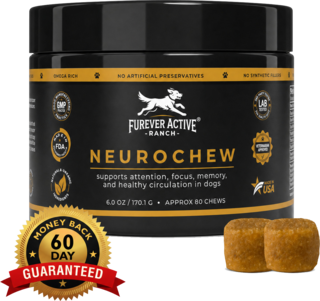
Support your dog's brain health with NeuroChew
NeuroChew is our daily soft chew for dogs, made fresh in the USA. See the ingredients and how it fits into a healthy daily routine.
Learn more about NeuroChew