Dog Brain Health
Adaptil Calming Collar for Dogs: An Honest Assessment


The honest expectation for any pheromone calming collar: synthetic dog appeasing pheromones may assist in soothing fearful or anxious dogs, individual responses vary widely, and the evidence is still emerging. Vets who suggest these collars frame them as a complementary aid beside a behavior program for mild stress, not a fix for severe fear. The safety conversation is short, with skin irritation from the collar itself the main thing to watch, and your dog's body language over a fair trial is the review that settles the question.
A calming collar is an easy thing to be cynical about and an easy thing to over-believe in, so this page does neither. One honest boundary up front: no outside page can verify what any specific collar releases or promise how your dog will respond, so everything here is the category-level research on dog appeasing pheromones, written so you can judge any collar's packaging for yourself.
Related: dog dementia
You will get what these pheromones are designed to do, where the evidence honestly stands, the short safety conversation, when veterinarians bring a collar into a plan, how to read your own dog's verdict, and the alternatives worth weighing beside it.
What a pheromone collar can honestly promise

Fair skepticism is the right starting point here. Pheromone-releasing collars utilizing synthetic dog appeasing pheromones (DAP) may assist in soothing fearful or anxious dogs, though individual responses can vary widely.
Both halves of that sentence are the review you came for: there is a real mechanism at work, and there is no promise your dog will be one of the dogs it helps.
Holding those two truths at once is what separates a fair trial from a disappointed return.
Source: VCA Animal Hospitals
The mechanism: borrowed from a mother dog
The mechanism story here starts at birth. Synthetic dog appeasing pheromones (DAP) are designed to mimic the natural comforting chemicals produced by a mother dog to help her puppies feel secure.
That is a more grounded origin than most calming products can claim, and it explains the delivery format: a signal the dog wears rather than an ingredient in the bowl.
Designed to mimic is the honest verb, and the sections below cover how well the design holds up.
Source: VCA Animal Hospitals
Where the evidence honestly stands
Enthusiasm and evidence move at different speeds. Scientific evidence for at-home calming aids like pressure vests and pheromone therapies is still emerging, and these tools may not produce the same results in every dog.
Emerging cuts both ways: enough signal to take the category seriously, not enough to guarantee anything about the dog on your leash.
Buy inside that reality and the purchase stays rational, whatever your dog ends up deciding about it.
Related: dog dementia when to put down
Source: Veterinary Evidence and VCA Animal Hospitals
Side effects: a short and specific list
The safety conversation for this category is refreshingly brief. While synthetic dog pheromones have no known systemic or toxic side effects, owners should monitor for potential physical skin irritation from the collar itself.
Note what moved there: the concern on record is not the pheromone, it is the hardware, and monitoring is the whole job.
Anything you notice on the skin is worth a photo and a message to your clinic rather than a wait-and-see.
Source: VCA Animal Hospitals
When veterinarians reach for a collar
The professional endorsement comes with fine print worth reading. Veterinarians may recommend using synthetic pheromone collars as a complementary aid alongside a professional behavior modification program for managing mild stress.
Every qualifier in that sentence is load-bearing: complementary, alongside a program, mild.
A vet reaching for this tool is adding a supporting layer to a plan, and a buyer who mirrors that framing, collar plus plan rather than collar instead of plan, is using it the way the profession does.
Source: VCA Animal Hospitals
How to read your dog's verdict

Your dog files the only review that counts. When using pheromone-releasing collars, owners should closely monitor their dog's body language and behavior to assess if the calming aid is providing a noticeable benefit.
Decide in advance what you are watching for during the household's hard moments, take short notes, and compare weeks rather than moments.
A collar is easy to forget you are testing, which is exactly why the notes matter: they turn a vague impression into an answer.
Source: VCA Animal Hospitals
The boundary: what a collar must not replace
Every honest product category needs a boundary line. Complementary calming options like pheromones should not replace a proper veterinary evaluation or professional behavior modification when addressing severe anxiety or fear.
Related: what can i give my dog for anxiety
If the hard moments in your house are big, frequent, or getting worse, the collar conversation waits behind the clinic conversation.
Nothing about a wearable aid should delay the evaluation that tells you what you are dealing with in the first place.
Source: VCA Animal Hospitals
The chewable alternative: L-theanine
Collars are not the only aisle worth a look. L-theanine, an amino acid found in green tea, may help support calm behavior by acting on brain neurotransmitters, and should be used under veterinary guidance.
This is a named, studied option on the supplement side of the calming shelf, and it works through the body rather than the air, which suits some dogs and households better.
The under veterinary guidance clause is standard for anything swallowed, and it is the difference between adding an ingredient and adding a plan.
Source: VCA Animal Hospitals
Alpha-casozepine rounds out the field
A second supplement name deserves a mention before you decide. Alpha-casozepine, an ingredient derived from milk protein, is sometimes suggested as a complementary option for mild canine anxiety, though research regarding its efficacy is still emerging.
The pattern by now should look familiar: a named ingredient, a mild-cases framing, and an evidence base described honestly as early.
Comparing a collar against options like this is less about picking a winner and more about picking the format your dog will accept and your routine will sustain.
Source: Veterinary Evidence and VCA Animal Hospitals
Pressure vests: the other wearable
The closest comparison might be another wearable. Although pressure vests are popular at-home options, current veterinary evidence remains inconclusive regarding their ability to consistently reduce stress in anxious dogs.
Collar and vest sit in the same honest bucket: plausible, popular, gentle, and unproven for any individual dog until tried.
Related: what causes anxiety in dogs
If your dog tolerates wearing things well, testing one at a time with notes gives each a clean verdict, and the loser costs you an experiment rather than a habit.
Source: Veterinary Evidence
So, where does NeuroChew fit into all this?
Full transparency: NeuroChew is ours. It's a veterinarian-approved daily soft chew that supports normal brain function and healthy circulation in dogs.
It's daily support, not medicine, designed to fit alongside your vet's plan rather than replace it. Dr.
Ruth Roberts, DVM, CVFT, puts it this way: "I support NeuroChew because it's the first dog chew that supports both brain function and healthy circulation!" If the signs above sound familiar, a daily brain-support routine is one of the simplest places to start.
Frequently asked questions
Do ADAPTIL calming collars work?
No page can promise a result for your dog. What the veterinary sources support: collars in this category release synthetic dog appeasing pheromones, they may assist in soothing fearful or anxious dogs, and responses vary widely from dog to dog. Treat the first weeks as a structured test with notes, and let what you record decide.
What are the side effects of ADAPTIL for dogs?
The published safety picture for synthetic dog pheromones lists no known systemic or toxic side effects. The watch item is local: potential physical skin irritation where the collar sits. If anything shows up on the skin, involve your veterinarian rather than waiting it out.
Do vets recommend calming collars?
Yes, in a specific role: as a complementary aid alongside a professional behavior modification program, typically for managing mild stress. The flip side is just as professional: for severe anxiety or fear, pheromones are not a substitute for a proper veterinary evaluation and behavior work.
What is the best calming dog collar?
There is no research-backed ranking of collar brands, so best has to be earned in your house. Run one collar at a time as a fair test, watch body language and behavior closely enough to notice a real difference, and ask your veterinarian to help interpret what you saw before buying twice.
Set beside its own marketing, a pheromone collar is a modest tool with a real mechanism story and an evidence base still filling in. Set beside your dog, it is a simple experiment: pair it with the behavior work, watch the body language, respect the mild-stress boundary, and let a veterinarian steer anything bigger.
That is the honest way to buy one, and the honest way to decide whether it stays on. Whatever you choose, the collar was never the whole plan, and the dogs who do best are the ones whose households remember that.
Get practical dog wellness tips by email
Occasional, useful guidance on keeping your dog healthy and happy. Unsubscribe anytime.
No spam. We respect your inbox.
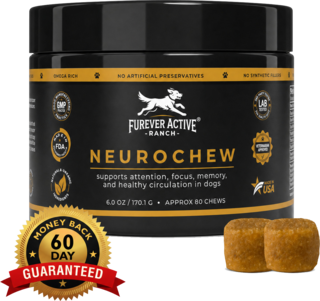
Support your dog's brain health with NeuroChew
NeuroChew is our daily soft chew for dogs, made fresh in the USA. See the ingredients and how it fits into a healthy daily routine.
Learn more about NeuroChew