Dog Brain Health
What Causes Anxiety in Dogs? Triggers, Signs, and Support


Anxiety in dogs rarely has a single cause. Studies show fear and anxiety levels vary among dogs, with individual history and daily environment as critical factors alongside potential breed predispositions, and research indicates the balance of gut microbes is closely related to anxiety and behavior scores. Early cues like yawning, lip-licking, or avoidance signal building stress, and supports include a quiet safe haven, gradual desensitization, and a consistent routine, with severe or ongoing cases belonging with a veterinarian.
The barking neighbor dog, the shredded doorframe, the shaking during storms: every anxious behavior has a backstory, and understanding it changes what you do about it. This guide walks the full chain. It starts with the quiet signals that come before the obvious ones, the pattern that shows up when you leave, and what actually drives an anxious temperament, where breed fits, where history and environment weigh in, and the newer gut-brain thread researchers keep pulling. Then it turns practical: the home supports that lower the temperature, the training approach that builds tolerance, and the line where professional help becomes the right call.
Related: what can i give my dog for anxiety
The early signals most owners miss

The earliest signals are small enough to miss from the couch. Observing subtle behavioral cues like yawning, lip-licking, or avoidance can help you recognize early signs of canine stress before anxiety escalates. A yawn from a dog who just woke up means nothing; a yawn in a tense room is a message.
The value of learning these cues is timing: stress caught at the flicker stage gives you options that a full escalation does not. Watch for the small stuff in the situations you already suspect, and note what sets it off.
Source: Animals (MDPI), via PubMed Central and Cornell Riney Canine Health Center
The pattern that shows up when you leave
The front door keeps its own diary. Common signs of separation anxiety include distress behaviors like house-soiling, vocalization, or destructive chewing specifically when owners are away. Specifically is the diagnostic word: a dog who chews all the time has a chewing habit, while a dog who only destroys things in an empty house is telling you what the trigger is.
If your evidence all clusters around departures and absences, you are looking at a specific, well-mapped pattern, and the supports later in this guide apply directly to it.
Source: VCA Animal Hospitals
Breed, history, environment: what the studies say
Everyone wants to blame the breed chart. Studies show that fear and anxiety levels can vary among dogs, though individual history and daily environment are critical factors alongside potential breed predispositions. Read that carefully, because it dethrones the tidy answer: breed may load the dice, but what has happened to a dog and what her days look like now carry real weight.
That is better news than it sounds. You cannot change her breed or her past, but the daily environment, a third of the equation, is entirely in your hands.
Related: can i give my dog benadryl for anxiety
Source: Veterinary Research Communications (Springer), via PubMed Central
The gut-brain conversation
The next chapter surprises most owners. The gut-brain axis serves as a communication channel in dogs, meaning that gut health and emotional states like anxiety can actively influence one another. The traffic running both directions is the interesting part: this is not just nerves upsetting a stomach, it is a two-way channel where each side can move the other.
That framing explains why diet and digestion keep appearing in behavior conversations that used to be about training alone, and the next two sections cover what researchers have actually measured.
Source: Veterinary Medicine International (Wiley, formerly Hindawi), via NCBI/PMC and Animals (MDPI)
What the microbiome studies found
Researchers keep counting things most of us never see. Research indicates that the specific balance of microbes in a dog's gut is closely related to their overall anxiety and behavior scores. Related is the honest verb: the studies measured association, a pattern where gut makeup and behavior scores move together, not proof that one causes the other.
As evidence goes, that is a genuine clue rather than a conclusion, and it is the reason gut-supportive approaches have earned a place in the conversation without earning the right to overpromise.
Source: Peer-reviewed article via PubMed Central
How young this science is
Every young field owes its readers a caveat. Research into the canine gut microbiome and anxiety is an emerging field, and because every dog is unique, individual behavioral responses to gut-supportive approaches can vary. Emerging means the honest posture is curiosity without certainty: promising threads, small studies, and plenty left to learn.
If you experiment in this area, run it like an experiment, one change, a few patient weeks, and notes you can reread, so your own dog's response is the evidence you act on.
Related: anxiety supplements for dogs
Source: Animals (MDPI) and Veterinary Medicine International (Wiley, formerly Hindawi), via NCBI/PMC
Where probiotics fit, honestly
This is where the research meets the shelf. Certain beneficial probiotic strains may help encourage balanced behavior in dogs by supporting gut-brain communication, though they should not replace professional veterinary advice. Two disciplines keep this honest.
Strains are specific: a result for one named strain says nothing about an unnamed blend, so labels that name their strains deserve more attention than labels that do not. And the second half of the sentence is not fine print, it is the design: gut support is an alongside, never an instead.
Source: Peer-reviewed article via PubMed Central and Animals (MDPI)
The safe haven: a room with the volume down
Every dog deserves a spot where the volume drops. Providing a designated, quiet 'safe haven' or den-like space in your home may help your dog cope during unsettling situations. The details are simple and worth doing properly: pick the place she already retreats to, make it softer and quieter, and let it stay hers unconditionally, no baths there, no nail trims, no surprises.
A retreat only works if it is reliable. It pairs with everything else in this guide and starts working the day you set it up.
Source: Cornell Riney Canine Health Center and VCA Animal Hospitals
Desensitization: building tolerance gradually
Courage gets built in small steps. Working to gradually and safely desensitize your dog to specific triggers can assist them in learning to cope with anxious situations. Gradually and safely are the two words that separate this from flooding a dog with what she fears: exposure so small it barely registers, repeated until boring, then one notch more.
It is slow by design, and the slowness is the mechanism. For triggers you can name, a doorbell, a departure routine, this is the training approach with the clearest logic behind it.
Related: how to calm dog anxiety naturally
Source: Cornell Riney Canine Health Center and VCA Animal Hospitals
Routine: predictability as a support

Sameness does quiet work around here. Maintaining a consistent daily schedule for your dog can provide a sense of predictability, which may help minimize overall environmental stress. Predictability is the cheapest lever on this entire page: meals, walks, and bedtime landing at the same hours turn the day into something a worried dog can rely on instead of brace against.
It also sharpens your observations, because behavior changes stand out cleanly against a steady background. Weekends included is what makes it real.
Source: VCA Animal Hospitals
The response that makes everything worse
The wrecked cushion will test you. Avoiding punishment for anxious behaviors, such as separation-induced destruction, is essential, as physical or verbal reprimands can heighten your dog's fear and distress. The mechanism is blunt: punishment adds fear to a problem made of fear.
The destruction you came home to was distress with nowhere to go, not defiance, and a dog cannot connect a scolding to something she did hours ago in a panic. Dropping punishment costs nothing and protects every other support you are building.
Source: VCA Animal Hospitals and Cornell Riney Canine Health Center
When it is time for professional help
Some situations outgrow home strategies. If your dog suffers from severe or ongoing anxiety, it is best to consult a veterinarian to rule out medical factors and discuss professional management options. Severe and ongoing are the two flags: intensity that frightens you, or persistence that has outlasted your patient weeks of home support.
The rule-out half matters as much as the management half, because medical factors can drive behavior that looks purely emotional. Reaching this step is not failure. It is the checklist working.
Related: anxiety meds for dogs
Source: VCA Animal Hospitals and Cornell Riney Canine Health Center
Our answer to the calming-aid question

From our family ranch, full disclosure: this one is ours
Since you're weighing calming options anyway, full disclosure: NeuroChew is ours, and it plays one specific position. It isn't a sedative, and the training and routines above still do the behavior work. What it covers is the daily foundation: a veterinarian-approved soft chew with phosphatidylserine, Norwegian salmon oil, and beet root with ginger that supports normal brain function and healthy circulation while you work the rest of the plan.
- ✓ 60-day guarantee: not thrilled? Even the empty bottle gets a full refund
- ✓ Free shipping on every order
- ✓ Multi-bottle packs save up to 40%
"I support NeuroChew because it's the first dog chew that supports both brain function and healthy circulation!" Dr. Ruth Roberts, DVM, CVFT
See What's Inside NeuroChew →Daily support, not medicine. It fits alongside your vet's plan, never in place of it.
Frequently asked questions
How do I calm my dog down during intense moments?
A designated, quiet safe haven or den-like space gives your dog somewhere to cope during unsettling situations, and your own calm matters because reprimands heighten fear and distress. If episodes are severe or ongoing, consult a veterinarian to rule out medical factors and discuss professional management options.
How do you manage anxiety in dogs?
The home-side supports are gradual, safe desensitization to specific triggers, a consistent daily schedule for predictability, a quiet safe haven, and never punishing anxious behaviors. For severe or ongoing anxiety, a veterinarian can rule out medical factors and discuss professional management options.
Which dog breed is most prone to anxiety?
Studies show fear and anxiety levels vary among dogs, but individual history and daily environment are critical factors alongside potential breed predispositions. In other words, breed may load the dice, while a dog's past and present circumstances carry real weight of their own.
How can I calm my dog's anxiety naturally?
Start with the no-cost supports: a quiet safe haven, gradual desensitization to known triggers, a consistent daily schedule, and dropping punishment entirely since reprimands heighten fear. Gut-supportive approaches are an emerging research area where individual responses vary.
Causes stack: a dog's history, her daily environment, whatever predispositions she carries, and, if the newer research holds, the state of her gut all feed the same nervous system. The response stacks too. Learn her early signals so you catch stress while it is still small, give her a quiet place to retreat, build tolerance in gradual steps, keep the days predictable, and never pay for a hard moment with punishment. Most of that costs nothing but consistency. And when the struggle is severe or will not loosen, the honest next step is professional, not another article.
Get practical dog wellness tips by email
Occasional, useful guidance on keeping your dog healthy and happy. Unsubscribe anytime.
No spam. We respect your inbox.
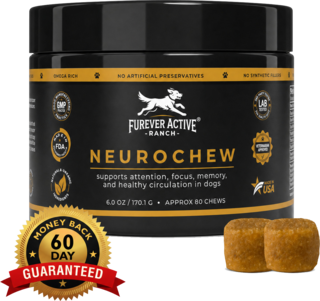
Support your dog's brain health with NeuroChew
NeuroChew is our daily soft chew for dogs, made fresh in the USA. See the ingredients and how it fits into a healthy daily routine.
Learn more about NeuroChew