Dog Brain Health
How Much Melatonin Can I Give My Dog for Anxiety?


There is no one safe at-home melatonin dose for every dog. How much melatonin you can give your dog for anxiety depends on weight, health history, other medications, and a veterinarian's judgment, not a blog chart or a human tablet bottle.
You are staring at a melatonin bottle at 11 p.m. because your dog will not settle, and every search result seems to toss out a milligram number like it is a recipe. Pause. How much melatonin can I give my dog for anxiety is a veterinary dosing question first, not a kitchen-table math problem. This guide explains why public milligram charts cannot answer the dose question, what a careful veterinarian actually weighs, and why night-time distress can be discomfort or separation work rather than a hormone gap. Later we also show where a daily brain-support chew like NeuroChew sits when you want routine support rather than a sedative stack.
Related: apple cider vinegar for dogs
AT A GLANCE
The pick: Our pick is NeuroChew, our own daily brain-health chew, held to the standard this guide teaches.
Reason one: Built for daily brain support, not sedation.
Reason two: Veterinarian-approved, with Dr. Ruth Roberts, DVM, CVFT as the named endorser.
Reason three: A 60-day guarantee, refunded even on an empty bottle.
Skip it if: Your dog has new, sudden, or severe symptoms, is pregnant, nursing, or a puppy, is on medication, or is managing an existing condition without your veterinarian's input.
Ask your veterinarian before any new sleep-supporting supplement

Always consult your veterinarian before administering any new calming or sleep-supporting supplement to your dog, as safety and suitability depend entirely on your dog's individual health history and weight. That rule is the only honest answer to how much melatonin can I give my dog for anxiety, because milligram charts on the internet cannot see liver values, heart meds, seizure history, pregnancy status, or drug interactions.
Owner-facing veterinary guidance on anxious behavior pushes you toward a real exam and a predictable routine when unsettled nights show up, not toward an open human bottle.
Bring the exact product label, your dog's current weight, a short list of recent night-time behaviors, and every other medication or supplement already in the house so the dosing conversation is specific. If your veterinarian prefers a prescription path or a structured behavior plan instead of an over-the-counter sleep hormone, that is a clinical decision, not a failure on your part.
A useful visit covers medical rule-outs first, then whether any sleep-supporting product belongs beside training, not a random milligram guess from a search result.
For related reading on other actives owners ask about, see ashwagandha for dogs dosage at /blogs/senior-dog-care/can-dogs-have-ashwagandha and collagen for senior dogs at /blogs/senior-dog-care/collagen-for-dogs.
Source: Cornell Riney Canine Health Center and VCA Animal Hospitals
Bottom line: Always consult your veterinarian before administering any new calming or sleep-supporting supplement to your dog, as safety and suitability depend entirely on your dog's individual health history and weight.
Why one melatonin dose will not fit every dog
Because research into canine behavioral pathways is ongoing, a dog's response to any calming intervention or supplement is highly individual and may vary. Canine-specific evidence on gut-brain links is still scarce and exploratory in the peer-reviewed reviews, so a quiet night after one pill is not proof you found a universal dose.
Two dogs of the same weight can land in different places because of age, gut environment, concurrent meds, and how strong the trigger is.
That is why copying a neighbor's milligram amount, or scaling a human gummy by body weight, is not a plan you should run at home. Keep expectations honest: if a product changes one dog's evening and does nothing for another, that individual pattern is exactly what the research posture already allows for.
Public charts collapse all of that into one number.
A veterinarian does not. Owners comparing joint-support marketing to sleep aids can also read does cosequin really work for dogs at /blogs/senior-dog-care/cosequin-for-dogs-review.
Source: Veterinary Medicine International (Wiley, formerly Hindawi), via NCBI/PMC and Animals (MDPI)
Bottom line: Because research into canine behavioral pathways is ongoing, a dog's response to any calming intervention or supplement is highly individual and may vary.
Rule out pain before you reach for a night-time aid

Signs of distress can sometimes be a manifestation of physical discomfort, so it is important to have a veterinarian evaluate your dog to rule out underlying pain. Restlessness at night and trouble getting comfortable can look like worry when discomfort is actually in the picture.
Owner triage starts with that possibility, then moves to the exam room before any sleep-supporting product.
A supplement trial is the wrong first step when pain has not been ruled out. If the pattern is new, sudden, or paired with trouble settling, book the veterinarian first.
Melatonin questions often arrive after weeks of pacing, and the kinder path is a medical read before another bottle enters the house.
Source: Merck Veterinary Manual
Bottom line: Signs of distress can sometimes be a manifestation of physical discomfort, so it is important to have a veterinarian evaluate your dog to rule out underlying pain.
When separation distress needs training, not only a pill
Addressing separation anxiety generally involves systematic desensitization and behavior modification protocols, as supplements are rarely a standalone solution. Owner-facing behavior guidance describes distress vocalization, destruction focused on exits, and house soiling when left alone, and it puts lasting improvement on graduated practice departures and counterconditioning.
The same education pattern is consistent: watch the triggers, then build a plan, instead of diagnosing from a checklist and shopping.
When a veterinarian adds medication, it is framed as adjunctive to the retraining program, not a cure by itself. If your dog only unravels when you leave, spend your energy on that departure plan and a veterinary behavior referral before you escalate milligrams of anything.
A sleep-supporting pill cannot replace mock departures, a safe room setup, or the slow work of teaching calm when you pick up keys.
If night-time irritability is the pattern you are seeing, also read our notes on dog sleep aggression at /blogs/senior-dog-care/dog-sleep-aggression.
Source: VCA Animal Hospitals and ASPCA
Bottom line: Addressing separation anxiety generally involves systematic desensitization and behavior modification protocols, as supplements are rarely a standalone solution.
What gut-brain research does and does not say
Emerging science suggests that the gut-brain axis plays a role in canine behavior, indicating that a dog's digestive environment may influence their anxiety levels. That sentence is education about a communication network among gut microbes, immune signals, and the nervous system, not a claim that any chew rewires temperament.
One companion-dog study reported associations between microbiota composition and owner-rated anxiety scores, and it did not test diet or any supplement as a behavior treatment.
Related: can dogs get anxiety after pneumonia
Recent reviews are just as careful: pathways are plausible, canine intervention proof is still thin, and no study yet shows that changing the microbiome fixes clinical behavior symptoms. Read that body of work as a reason to keep diet and stool health on the conversation list with your veterinarian, not as permission to skip a medical exam or invent a melatonin milligram chart from a gut paper.
For adjacent senior-care context, see how to calm a dog with dementia at /blogs/senior-dog-care/how-to-help-a-dog-with-dementia and senilife for dogs ingredients at /blogs/senior-dog-care/supplements-for-dog-dementia.
Source: Peer-reviewed article via PubMed Central and Veterinary Medicine International (Wiley, formerly Hindawi), via NCBI/PMC
Bottom line: Emerging science suggests that the gut-brain axis plays a role in canine behavior, indicating that a dog's digestive environment may influence their anxiety levels.
Skip unprescribed human melatonin and sedative stacks
Avoid giving your dog unprescribed calming aids or human-grade supplements without a veterinarian's approval, as improper usage can carry health risks or fail to address the root issue. Human sleep-supporting products are not automatically appropriate for dogs, and the safer path is a labeled product your veterinarian has reviewed.
University veterinary guidance on anxious behavior steers you toward a veterinary visit and a real plan, not an open bottle from the kitchen cabinet.
If the goal is night-time quiet, bring the exact product, the full ingredient list, and your dog's weight to the appointment before anyone swallows a tablet. Unprescribed use can also waste days you could have spent on pain checks or a separation-behavior plan, which is why the root-issue warning matters as much as the safety warning.
Melatonin is often sold as a gentle sleep aid for people; that marketing frame is not a veterinary dosing protocol for dogs, and it is not the same job as a daily brain-support routine with printed active amounts.
Life-stage supplement questions live elsewhere: dog pregnancy vitamins at /blogs/senior-dog-care/multivitamins-for-pregnant-dogs and puppy neurological issues at /blogs/senior-dog-care/signs-of-neurological-problems-in-puppies.
Source: Cornell Riney Canine Health Center
Bottom line: Avoid giving your dog unprescribed calming aids or human-grade supplements without a veterinarian's approval, as improper usage can carry health risks or fail to address the root issue.
Our answer to the calming-aid question
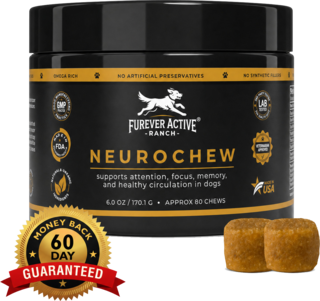
Full transparency: NeuroChew is ours. It's a veterinarian-approved daily soft chew that supports normal brain function and healthy circulation in dogs.
It's daily support, not medicine, designed to fit alongside your vet's plan rather than replace it. Dr.
Ruth Roberts, DVM, CVFT, puts it this way: "I support NeuroChew because it's the first dog chew that supports both brain function and healthy circulation!" If the signs above sound familiar, a daily brain-support routine is one of the simplest places to start.
Frequently asked questions
What would 10mg of melatonin do to a dog?
A public 10 mg figure cannot account for weight, health history, or other medications. The dose question belongs with your veterinarian after a real exam, not a blog chart.
What happens if a dog eats 5mg melatonin?
Call your veterinarian or an emergency clinic with the product label and your dog's weight rather than waiting on a blog chart to interpret a 5 mg exposure. Unprescribed human products are the wrong first move.
Can I give my dog 20 mg of melatonin?
A fixed 20 mg public answer is not a veterinary plan. Suitability depends on the individual dog, so the yes-or-no decision belongs in the clinic, not in a search result.
Does melatonin really calm dogs down?
Quiet after one pill is not proof of a reliable calm protocol. Lasting separation work still depends on training plans your clinician helps shape, and responses differ widely between dogs.
Why is there no safe public melatonin chart for dogs?
Public milligram tables cannot see labs, meds, pregnancy status, or the real trigger behind the night-time pacing. That is why the honest page refuses a kitchen-table chart.
What should I bring to the vet before trying a sleep aid?
Bring the product label, current weight, every other medication already in use, and a short log of night-time behaviors and triggers so the dosing conversation is specific.
If you take one thing from this page, let it be this: melatonin dosing is not a DIY project, and calm is not the same as knocked out. Start with your veterinarian, rule out physical discomfort, build a real behavior plan when separation is the issue, and only then decide whether a short-term sleep aid belongs in the plan at all.
When you want a daily brain-health routine you can audit in public instead of a sedative-style stack, NeuroChew prints every active amount and stays on the daily-support side of the line. We print no melatonin, no valerian, no chamomile, no L-theanine, no tryptophan, no hemp, and no CBD, because the chew is built for daily brain support, not sedation.
Phosphatidylserine appears at 5 mg per serving with direct-canine evidence framing for cognitive wellness support. Huperzine-A is listed at 100 mcg for nervous-system support on a canine-context tier.
Alpha lipoic acid is 25 mg as antioxidant support, Norwegian salmon oil is 100 mg for omega fatty acid support, and vitamin B1 is 15 mg for normal nervous-system function. A single serving is two soft chews at 4 g total, and the weight chart steps from two chews under 30 lbs through seven chews at 150-180 lbs.
That label is arithmetic you can check, not a substitute for the medical visit the dose question actually requires.
References
- Anxious behavior: How to help your dog cope with unsettling situations, Cornell Riney Canine Health Center. https://www.vet.cornell.edu/departments-centers-and-institutes/riney-canine-health-center/canine-health-topics/anxious-behavior-how-help-your-dog-cope-unsettling-situations
- Gut microbiota composition is related to anxiety and aggression scores in companion dogs, Peer-reviewed article via PubMed Central. https://pmc.ncbi.nlm.nih.gov/articles/PMC12234828/
- Gut-Brain Axis Impact on Canine Anxiety Disorders: New Challenges for Behavioral Veterinary Medicine, Veterinary Medicine International (Wiley, formerly Hindawi), via NCBI/PMC. https://pmc.ncbi.nlm.nih.gov/articles/PMC10827376/
- The Relationship between Canine Behavioral Disorders and Gut Microbiome and Future Therapeutic Perspectives, Animals (MDPI). https://pmc.ncbi.nlm.nih.gov/articles/PMC11273744/
- Separation Anxiety in Dogs, VCA Animal Hospitals. https://vcahospitals.com/know-your-pet/separation-anxiety-in-dogs
- Separation Anxiety, ASPCA. https://www.aspca.org/pet-care/dog-care/common-dog-behavior-issues/separation-anxiety
- Recognizing and Assessing Pain in Animals, Merck Veterinary Manual. https://www.merckvetmanual.com/special-pet-topics/pain-management/recognizing-and-assessing-pain-in-animals
As of July 2026
Get practical dog wellness tips by email
Occasional, useful guidance on keeping your dog healthy and happy. Unsubscribe anytime.
No spam. We respect your inbox.
Support your dog's brain health with NeuroChew
NeuroChew is our daily soft chew for dogs, made fresh in the USA. See the ingredients and how it fits into a healthy daily routine.
Learn more about NeuroChew