Dog Brain Health
High Anxiety Dog Crate: Safety First, Then Hardware


A high anxiety dog crate is heavy-duty confinement hardware for dogs who bend wire panels or panic at exits. It is not a behavior plan. Shop steel only after open-door comfort work, a quiet sanctuary option, and a vet screen when signs escalate.
If you are reading crate reviews at midnight, you are probably not comparing colors. You are trying to keep a distressed dog from wrecking a door frame, a wire panel, or their own mouth.
Related: can dogs get anxiety after pneumonia
This guide compares what impact-rated crates are built to do, where they fail, and what to put beside the hardware decision so steel does not become the whole plan. We stay honest about training limits and lookalikes that need a vet, then show where a daily brain-support chew like NeuroChew belongs in a calm routine without pretending a supplement replaces confinement training.
AT A GLANCE
The pick: Our pick is NeuroChew, our own daily brain-health chew, held to the standard this guide teaches.
Reason one: Built for daily brain support, not sedation.
Reason two: Veterinarian-approved, with Dr. Ruth Roberts, DVM, CVFT as the named endorser.
Reason three: A 60-day guarantee, refunded even on an empty bottle.
Skip it if: Your dog has new, sudden, or severe symptoms, is pregnant, nursing, or a puppy, is on medication, or is managing an existing condition without your veterinarian's input.
What heavy-duty confinement is actually selling

Crating or confining a dog with separation anxiety can sometimes worsen their distress and panic unless they have been carefully and gradually trained to feel safe in that space. That is the first filter before you spend on impact-rated steel.
These kennels are usually marketed as thicker panels, tougher latches, and fewer bend points than a basic wire crate.
Those features can reduce escape injuries for some dogs. They do not teach a dog that alone-time is safe.
If your dog already panics at closed doors, upgrading the box without a gradual crate-comfort plan can turn a hard night into a harder one.
Compare fit, ventilation, latch quality, and cleanability. Then ask whether confinement is even the right tool this week.
Bottom line: tougher steel is not the same as alone-time safety.
Early departure cues owners miss

Dogs with separation anxiety may show early signs of distress, such as pacing or excessive salivation, as they detect cues that their owner is preparing to depart. Watch the five minutes before keys, shoes, and the garage click.
Those micro-signals matter more than the brand badge on a crate wall.
If the spiral starts when you pick up a bag, a tougher kennel only contains the aftermath. Slow the departure ritual, shorten absences you practice, and log what fires first: pacing, drooling, whining, or door-focused scratching.
That log helps a veterinarian or behavior professional more than another midnight cart of hardware.
Bottom line: watch the five minutes before the keys move.
Sanctuary space versus forced confinement
Providing a quiet, designated sanctuary or safe zone in the house may help dogs cope with unsettling situations and manage their stress. For many households, that zone is a dim corner with a familiar bed, white noise, and no foot-traffic, not a locked box.
A heavy crate can become that sanctuary only after the dog chooses it with the door open and stays relaxed.
Related: what can i give my dog for anxiety
If the dog will not settle with the door open, locking it is not enrichment. Build the safe zone first, then decide whether denser hardware belongs inside that plan for travel or short supervised rests.
Source: Cornell Riney Canine Health Center
Bottom line: a chosen den beats a locked panic box.
Why scolding after a wrecked room fails
Scolding or punishing a dog for anxious habits, like destructive chewing when left alone, is ineffective and can inadvertently increase their fear and anxiety. Coming home to a shredded crate pad and raising your voice teaches the dog that your return predicts trouble.
It does not teach calm alone-time.
Clean up, protect the dog from injury, and change the setup: shorter practice absences, better enrichment before you leave, and a sanctuary the dog already likes. If you are shopping thicker steel because punishment failed, that is useful data.
Hardware is not a substitute for removing the fear loop.
Bottom line: raised voices after wreckage teach more threat.
When restlessness may be discomfort in disguise
Underlying physical discomfort or pain can sometimes trigger behavioral changes that mimic anxiety, making a veterinary evaluation essential. Dogs who suddenly hate a crate, pace at night, or act differently around the crate may be uncomfortable rather than acting out.
Before you upgrade to thicker steel, book a hands-on exam.
A medical rule-out changes whether denser hardware is a safety tool or an expensive wrong turn.
Bottom line: pain can wear an anxiety costume.
When the situation needs a veterinarian first
If a dog shows severe or worsening signs of anxiety, it is important to consult a veterinarian to rule out underlying medical issues or seek specialized behavioral guidance. Self-serve crate upgrades are not a triage plan for escalating panic, self-injury, or sudden personality change.
Ask about medical rule-outs, referral options, and whether a certified behavior professional should lead the training design.
Daily brain-support chews belong in the routine lane, not the emergency lane, and they never stand in for clinical care.
Bottom line: escalating panic is triage, not a cart checkout.
Crate comparison criteria that actually matter
Providing a quiet, designated sanctuary or safe zone in the house may help dogs cope with unsettling situations and manage their stress. After that sanctuary plan is in motion, compare options on practical rows rather than brand slogans.
Related: how much melatonin can i give my dog for anxiety
This article does not invent retail SKU specs.
Use criteria first: - Escape resistance: panel thickness, weld quality, bar spacing, and latch redundancy on every door. - Materials: powder-coated steel and aluminum frames usually outlast thin wire grids when a dog body-checks walls; plastic airline-style shells can feel cave-like but need strong metal doors and real airflow.
- Injury risk: rounded edges, paw-safe doors, covered feed openings, and no sharp mesh pinch points at latches. - Climate and air: ventilation on more than one side; dark den covers only after the dog is already calm.
- Size: stand, turn, and lie flat without forced crouching; too big can feel unstable for some dogs, too small raises injury risk.
- Use case: home alone practice, car travel, hotel stays, or post-op rest each stress different hardware points. - Training stage: door-open comfort first, closed-door only after calm reps; never buy steel to skip that sequence.
Who should choose a heavy crate anyway: a dog already relaxed in dens, a traveler who needs crash-minded hardware, or a household following a behaviorist's confinement plan.
Who should choose a sanctuary room instead: a dog who struggles hard against bars, freezes at closed latches, or has never had open-door success.
Bottom line: match hardware rows to training stage, not hype.
What microbiota studies can and cannot prove
Research indicates that the composition of a dog's gut microbiota may be linked to their anxiety and aggression scores through the gut-brain axis. Linked is the load-bearing word.
Association studies and reviews help explain why nutrition researchers care about the gut-brain conversation.
They do not prove that changing one product will rewrite a dog's alone-time behavior, and they do not rank crate brands. Keep hardware decisions on safety and training grounds, and keep gut talk in the interesting, still developing column.
Source: Peer-reviewed article via PubMed Central and Veterinary Medicine International (Wiley, formerly Hindawi), via NCBI/PMC
Bottom line: association is not a crate ranking.
Strain-specific probiotics are not a category blank check
Some controlled trials suggest that supplementing with specific probiotic strains, like Lactiplantibacillus plantarum, may help reduce signs of anxiety and aggressive behavior in dogs. Read that row twice if you skimmed it: a strain-level trial is not a free pass for every probiotic label.
Our chew is not documented as containing that strain, so the trial stays in the strain's lane.
Related: can i give my dog benadryl for anxiety
When a study is strain-specific, the honest move is to keep it there. Do not drag it into a hardware shopping cart as proof that gut support replaces training, and do not paste it onto a different active panel.
Source: Peer-reviewed article via PubMed Central
Bottom line: one strain trial is not every label.
Where NeuroChew fits beside the crate decision
Scientific understanding of the relationship between the gut microbiome and canine behavior is still emerging, and how an individual dog responds to gut-brain support can vary. With that ceiling named, here is the product case in plain label language for the routine lane beside crate training.
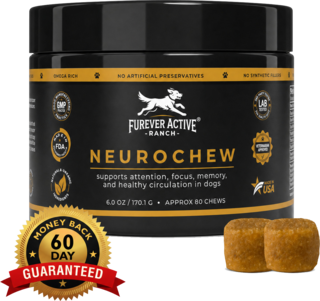
NeuroChew is a daily dog brain-health support chew from Furever Active, built for routine cognitive and nervous-system wellness support, not sedation.
Our label prints amounts you can check: phosphatidylserine (PS) 5 mg per serving, Huperzine-A 100 mcg per serving, alpha lipoic acid 25 mg per serving, Norwegian salmon oil 100 mg per serving, and Vitamin B1 15 mg per serving. Serving size is 2 soft chews (4g).
Dosing by weight: Under 30lbs = 2 soft chews; 30-60lbs = 3 soft chews; 60-90lbs = 4 soft chews; 90-120lbs = 5 soft chews; 120-150lbs = 6 soft chews; 150-180lbs = 7 soft chews.
The label carries no melatonin, valerian, chamomile, L-theanine, tryptophan, hemp, or CBD. Run the printed-amount test on our bag and every calming-category competitor: if an active is hiding inside a proprietary blend, assume the worst.
Skip NeuroChew when your dog needs urgent clinical care, when your veterinarian has not cleared a new supplement, or when you want a sedative effect the label does not offer.
Commercial policy only: 60-day guarantee; not thrilled, even the empty bottle gets a full refund.
Source: Animals (MDPI) and Veterinary Medicine International (Wiley, formerly Hindawi), via NCBI/PMC
Bottom line: daily brain support is not hardware.
Honest ceilings for hardware shopping
If a dog shows severe or worsening signs of anxiety, it is important to consult a veterinarian to rule out underlying medical issues or seek specialized behavioral guidance. Honesty cuts both ways on crates.
Skip denser steel as your first move when the dog already struggles hard against bars, has never accepted open-door den time, or needs a medical workup tonight.
Red-flag signs that mean see the vet first include sudden behavior change, night disorientation, and clear signs your dog hurts. Match materials and latches to the job only after those filters clear.
A denser steel frame can reduce bend points for a dog who already accepts a den.
Related: dog anxiety in crate
It cannot replace graduated alone-time practice, and it cannot diagnose pain wearing an anxiety mask.
Bottom line: a tougher latch is not triage.
Our answer to the calming-aid question
Full transparency: NeuroChew is ours. It's a veterinarian-approved daily soft chew that supports normal brain function and healthy circulation in dogs.
It's daily support, not medicine, designed to fit alongside your vet's plan rather than replace it. Dr.
Ruth Roberts, DVM, CVFT, puts it this way: "I support NeuroChew because it's the first dog chew that supports both brain function and healthy circulation!" If the signs above sound familiar, a daily brain-support routine is one of the simplest places to start.
Frequently asked questions
Can a heavy-duty crate make separation distress worse?
Crating or confining a dog with separation anxiety can sometimes worsen their distress and panic unless they have been carefully and gradually trained to feel safe in that space. Compare hardware only after open-door comfort work is going well.
What early signs show up before an owner leaves?
Dogs with separation anxiety may show early signs of distress, such as pacing or excessive salivation, as they detect cues that their owner is preparing to depart. Log those cues before you upgrade crate steel.
Is a quiet room better than a locked crate?
Providing a quiet, designated sanctuary or safe zone in the house may help dogs cope with unsettling situations and manage their stress. Many dogs do better with a chosen den than with forced confinement.
Should I punish chewing that happens while I am gone?
Scolding or punishing a dog for anxious habits, like destructive chewing when left alone, is ineffective and can inadvertently increase their fear and anxiety. Change the plan instead of raising your voice at the wreckage.
When is a veterinarian required before more crate shopping?
If a dog shows severe or worsening signs of anxiety, it is important to consult a veterinarian to rule out underlying medical issues or seek specialized behavioral guidance. Underlying physical discomfort or pain can sometimes trigger behavioral changes that mimic anxiety, making a veterinary evaluation essential.
What should I compare across heavy-duty crate options?
Start with whether confinement itself is safe for this dog, because forced confinement can worsen distress without gradual training. Then compare escape resistance, injury risk, ventilation, size, and training stage only after a quiet sanctuary plan exists.
A high anxiety dog crate can be the right hardware for travel, recovery, or a dog already comfortable in a den. It is the wrong first move when confinement itself is the panic trigger.
Start with a vet screen when something feels medical, build a quiet sanctuary, skip punishment, and only then compare steel, latches, ventilation, and size against your dog's real training stage. If you also want a daily brain-support chew with printed amounts, NeuroChew is a routine option, not a crate alternative and not a panic switch.
References
- Anxious behavior: How to help your dog cope with unsettling situations, Cornell Riney Canine Health Center. https://www.vet.cornell.edu/departments-centers-and-institutes/riney-canine-health-center/canine-health-topics/anxious-behavior-how-help-your-dog-cope-unsettling-situations
- Gut microbiota composition is related to anxiety and aggression scores in companion dogs, Peer-reviewed article via PubMed Central. https://pmc.ncbi.nlm.nih.gov/articles/PMC12234828/
- Efficacy of a Novel Lactiplantibacillus plantarum Strain in Reducing Canine Aggression and Anxiety: A Randomized Placebo-Controlled Trial, Peer-reviewed article via PubMed Central. https://pmc.ncbi.nlm.nih.gov/articles/PMC12345577/
- Gut-Brain Axis Impact on Canine Anxiety Disorders: New Challenges for Behavioral Veterinary Medicine, Veterinary Medicine International (Wiley, formerly Hindawi), via NCBI/PMC. https://pmc.ncbi.nlm.nih.gov/articles/PMC10827376/
- The Relationship between Canine Behavioral Disorders and Gut Microbiome and Future Therapeutic Perspectives, Animals (MDPI). https://pmc.ncbi.nlm.nih.gov/articles/PMC11273744/
As of July 2026
Get practical dog wellness tips by email
Occasional, useful guidance on keeping your dog healthy and happy. Unsubscribe anytime.
No spam. We respect your inbox.
Support your dog's brain health with NeuroChew
NeuroChew is our daily soft chew for dogs, made fresh in the USA. See the ingredients and how it fits into a healthy daily routine.
Learn more about NeuroChew