Dog Brain Health
How to Calm Dog Anxiety Naturally: An Honest Playbook


The natural toolkit starts free: a designated quiet safe haven may help your dog cope with unsettling situations, physical exercise and mental stimulation before departures may reduce mild anxiety, and practicing pre-departure routines without actually leaving may lower the charge those cues carry. On the diet side, gut-brain research is emerging and certain probiotic strains may help, though responses vary and severe signs like self-injury or extreme panic belong with a veterinarian or veterinary behaviorist.
Natural is a word that sells a lot of products, so let's define it honestly: most of what genuinely helps an anxious dog costs nothing and lives in how you run the house. This playbook goes in that order. First, how to read what your dog is actually doing when you are gone, then the three home practices with the clearest logic, a safe place, the hour before you leave, and rehearsing the leaving itself, then the gut-brain research everyone is suddenly quoting, kept at its honest size, and finally the line where home strategies stop being enough. No miracle products. A lot of usable moves.
Related: what can i give my dog for anxiety
What the worry looks like when you're gone

The evidence usually waits for you by the door. Anxious dogs may show distress through pacing, panting, vocalizing, or destructive behaviors when left alone. The when-left-alone part is what separates this pattern from general restlessness: the behaviors cluster around your absence, and the damage or the neighbor's noise report tells the story after the fact.
Before changing anything, get clear on which of these signs your dog actually shows and how often. The rest of this playbook works better aimed at a specific picture.
Source: ASPCA and VCA Animal Hospitals
Let the camera tell you the truth

Set the camera down before you change anything else. Using video recording to observe your dog's behavior when left alone can help you and your veterinarian track and evaluate their anxiety. A propped-up phone answers the questions guessing cannot: when the distress starts, how long it lasts, whether it eases or escalates.
It also gives you a baseline, so when you try the practices below you can see whether anything is actually changing instead of hoping. Ten minutes of honest footage beats a month of wondering.
Source: ASPCA and VCA Animal Hospitals
The safe haven: her spot, her rules
Every worried house needs one quiet corner. Creating a designated safe haven or quiet area in your home may help your dog cope with unsettling situations. The execution details carry the value: choose the spot she already retreats to, soften it, quiet it, and keep it unconditionally hers, no grooming ambushes, no surprises.
Related: what causes anxiety in dogs
Reliability is the whole mechanism, because a retreat only lowers the temperature if she trusts it completely. It costs one afternoon to set up and works alongside everything else on this page.
Source: Cornell Riney Canine Health Center
The hour before you leave
Think about the hour before you leave. Providing physical exercise and mental stimulation before departures may help reduce mild anxiety. The logic is plain: a dog who has walked, sniffed, and solved a food puzzle meets your departure with less unspent fuel than one who has been waiting on a couch all morning.
Mild is the honest boundary word, this is a lever for the lighter end of the spectrum, not a fix for full panic. Aim the effort at the timing: the walk that matters most is the one before the door closes.
Source: ASPCA
Rehearse the leaving without the leaving
Rehearsals are not just for stage actors. Accustoming your dog to departures by practicing pre-departure routines without leaving may help lower their anxiety. Pick up the keys and sit back down.
Put on shoes and make coffee. The cues that currently announce abandonment get repeated until they announce nothing at all, which drains the dread out of the routine itself. It is unglamorous and repetitive, and that is the point: it works on the trigger instead of the aftermath.
Related: can i give my dog benadryl for anxiety
Small doses, many repetitions, no drama.
Source: Veterinary Medicine: Research and Reports (Sargisson 2014), via PubMed Central and VCA Animal Hospitals
The gut-brain thread, at its honest size
One research thread starts somewhere unexpected. Scientific research suggests that the gut-brain axis and gut microbiome composition may be linked to anxiety and aggression in companion dogs. Linked is the honest verb: researchers found patterns worth studying, not a switch worth flipping.
This is why diet keeps entering conversations about behavior, and it earns the topic a place on a natural-calming page. What it does not earn is the miracle framing some labels borrow from it, and the next two sections keep the line clear.
Source: Peer-reviewed article via PubMed Central and Veterinary Medicine International (Wiley, formerly Hindawi), via NCBI/PMC
Probiotics: the specific-strain rule
Names this long usually stay in laboratories. Certain probiotic strains, like Lactiplantibacillus plantarum, may help reduce behaviors related to anxiety and aggression. The word strains is doing the heavy lifting: probiotic research is strain-specific, so a finding for one named organism says nothing about an unnamed blend in a bag.
That gives you a practical label test, products that name their strains are engaging with the research, and products that just say probiotic are borrowing its glow. May help remains the honest ceiling.
Related: anxiety supplements for dogs
Source: Peer-reviewed article via PubMed Central
Diet changes deserve a professional set of eyes
While dietary modifications and probiotics may support behavioral health, it is important to consult a veterinarian for professional guidance on managing canine anxiety. This is not a legal disclaimer, it is design: diet interacts with everything else in a dog's chart, and behavior problems have more moving parts than a food bowl can see. The productive version of this conversation is specific, bring your video footage, your notes on what you have tried, and the actual label of whatever you are considering.
Source: Animals (MDPI) and Veterinary Medicine International (Wiley, formerly Hindawi), via NCBI/PMC
Why your mileage will vary
Honesty is the best supplement on this page. Because behavioral disorders are complex, scientific findings are emerging and individual dog responses to anxiety management strategies will vary. That sentence is the fine print for everything above, and it is liberating rather than discouraging: your neighbor's success story and your slower results can both be true.
Run changes one at a time, give each a few patient weeks, and keep dated notes, so the strategy that stays is the one your own dog endorsed.
Source: Cornell Riney Canine Health Center and Animals (MDPI)
The line where natural stops being enough
There is a line, and it is worth knowing where it sits. If your dog shows severe symptoms of anxiety, such as self-injury or extreme panic, you should consult a veterinarian or a veterinary behaviorist. Self-injury and panic are not training problems, and no amount of safe-haven building or rehearsal fixes them alone.
Reaching for professional help at that point is not abandoning the natural playbook, it is what the playbook says to do on its last page. The earlier that call happens, the fewer hard nights she repeats.
Related: anxiety meds for dogs
Source: Veterinary Medicine: Research and Reports (Sargisson 2014), via PubMed Central and VCA Animal Hospitals
Our answer to the calming-aid question

From our family ranch, full disclosure: this one is ours
Since you're weighing calming options anyway, full disclosure: NeuroChew is ours, and it plays one specific position. It isn't a sedative, and the training and routines above still do the behavior work. What it covers is the daily foundation: a veterinarian-approved soft chew with phosphatidylserine, Norwegian salmon oil, and beet root with ginger that supports normal brain function and healthy circulation while you work the rest of the plan.
- ✓ 60-day guarantee: not thrilled? Even the empty bottle gets a full refund
- ✓ Free shipping on every order
- ✓ Multi-bottle packs save up to 40%
"I support NeuroChew because it's the first dog chew that supports both brain function and healthy circulation!" Dr. Ruth Roberts, DVM, CVFT
See What's Inside NeuroChew →Daily support, not medicine. It fits alongside your vet's plan, never in place of it.
Frequently asked questions
How can I tell if my dog has separation anxiety?
Anxious dogs may show distress through pacing, panting, vocalizing, or destructive behaviors specifically when left alone. Video recording your dog during absences is the clearest way to see what actually happens, and the footage helps you and your veterinarian track and evaluate the pattern.
What home remedy can I give my dog for anxiety?
The strongest home tools are practices, not products: a designated quiet safe haven, physical exercise and mental stimulation before departures for mild anxiety, and practicing pre-departure routines without leaving. Dietary approaches like probiotics are an emerging area best discussed with a veterinarian.
What should I do for a dog with anxiety?
Start by recording what happens when you are gone, set up a safe haven, use exercise and mental stimulation before departures, and rehearse departure cues without leaving. If signs are severe, such as self-injury or extreme panic, consult a veterinarian or a veterinary behaviorist.
How can you tell if a dog is stressed?
Common distress signals include pacing, panting, vocalizing, or destructive behaviors, especially clustered around being left alone. Tracking when the signs appear, and how often, turns a general worry into a specific pattern you can act on.
Run the playbook in order and it compounds: the camera tells you the truth, the safe haven gives her somewhere to take her worry, the pre-departure hour drains some of its fuel, and the rehearsals slowly teach her that keys and shoes are boring again. Add the diet thread carefully if you add it at all, one change, patient weeks, honest notes. And keep the line in view: home tools are for the mild and the moderate, and crossing into panic or self-injury means the next move is professional. Calm is built in ordinary weeks, not bought in a single afternoon.
Get practical dog wellness tips by email
Occasional, useful guidance on keeping your dog healthy and happy. Unsubscribe anytime.
No spam. We respect your inbox.
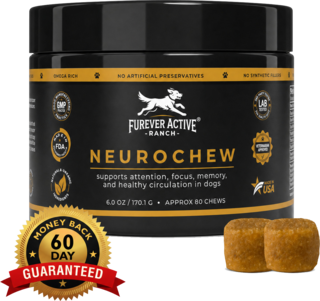
Support your dog's brain health with NeuroChew
NeuroChew is our daily soft chew for dogs, made fresh in the USA. See the ingredients and how it fits into a healthy daily routine.
Learn more about NeuroChew