Dog Brain Health
Do Dogs Have Anxiety Attacks? Signs and Calm Steps


Do dogs have anxiety attacks? Veterinary sources do not use "anxiety attack" as a formal canine diagnosis. Owners usually mean a sudden high-stress spike with pacing, heavy panting, trembling, whining, or hiding, and fear-related behaviors are widely reported in pet dogs.
You are watching your dog shake for no clear reason, and the first question that lands is blunt: do dogs have anxiety attacks, or is this something else? In clinic language, that episode is usually framed as an acute fear or panic-style response, not a separate disease code called an anxiety attack.
Related: apple cider vinegar for dogs
The useful work is naming the signs, checking medical lookalikes, and building a calm plan you can actually run at home.
AT A GLANCE
The pick: Our pick is NeuroChew, our own daily brain-health chew, held to the standard this guide teaches.
Reason one: Built for daily brain support, not sedation.
Reason two: Veterinarian-approved, with Dr. Ruth Roberts, DVM, CVFT as the named endorser.
Reason three: A 60-day guarantee, refunded even on an empty bottle.
Skip it if: Your dog has new, sudden, or severe symptoms, is pregnant, nursing, or a puppy, is on medication, or is managing an existing condition without your veterinarian's input.
What owners mean by an anxiety attack
Dogs experiencing high stress or anxiety may display observable signs like pacing, heavy panting, trembling, whining, or seeking out hiding spots. That cluster is what many guardians label an anxiety attack, even though veterinary behavior writing more often describes an acute fear response rather than a standalone attack diagnosis.
Cornell's owner guide on anxious behavior frames those signs as a practical checklist for unsettled situations and steers you toward a predictable routine plus a veterinarian or veterinary behaviorist when the pattern will not settle.
Note what happened right before the spike, how long it lasted, and how long recovery took. A single storm night is different from weekly episodes with no clear trigger, and that difference is what you bring to the clinic when you need a medical read rather than a product-aisle guess.
Source: Cornell Riney Canine Health Center and VCA Animal Hospitals
Bottom line: owner "attack" language usually points to a sudden fear spike you can log.
How common are these fear behaviors
Surveys of dog guardians indicate that fear and anxiety-related behaviors are widely observed and common in pet dogs. The Beaver Dog Aging Project analysis used owner questionnaire ratings on tens of thousands of dogs rather than clinical diagnoses, so hold the high prevalence as owner-reported context.
In that work, common trigger categories include unfamiliar dogs, grooming, novel situations, and unfamiliar people.
A later re-assessment has argued that moderate-to-severe rates look lower once scoring rules change, which is why you should hold the headline percentage lightly. Use prevalence to drop the shame, then still book a vet visit when the pattern is sudden, severe, or paired with pain signs.
Source: Veterinary Research Communications (Springer), via PubMed Central
Bottom line: owner-reported fear signs are common, not a personal diagnosis.
When separation turns the episode louder
When separated from their owners, dogs suffering from separation anxiety may exhibit destructive behaviors near doorways, distress vocalizations like howling, or lose bowel control. VCA's board-certified behaviorist guidance also flags destruction focused on owner possessions and exit doors, plus house soiling when alone, as separation-related distress signals.
Graduated mock departures with desensitization and counterconditioning are the retraining core; medication, when used, is adjunctive rather than a solo fix.
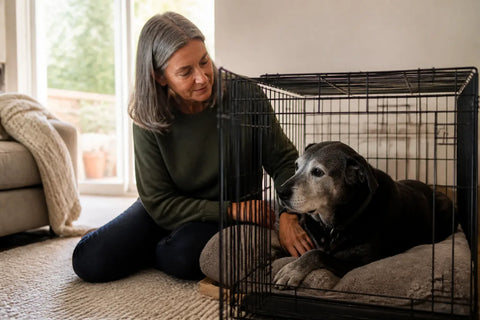
Crates can help some dogs and promote intense escape attempts in others, so handle the crate as a careful test rather than a default. For a related nighttime pattern that is easy to misread, see /blogs/senior-dog-care/dog-sleep-aggression and keep the two problems on separate tracks until a professional sorts them.
Source: VCA Animal Hospitals and ASPCA
Bottom line: alone-time wreckage is distress data, not spite.
New anxiety in an older dog needs a medical look
If an older dog suddenly begins showing new signs of anxiety, it may be due to age-associated cognitive changes or physical pain, which should be evaluated by a veterinarian. Cornell's anxious-behavior guidance is explicit that medical contributors belong in the first pass, not the last.
Nighttime restlessness, getting stuck, or a sharp personality shift are not a shrug-and-wait problem.
Ask for a senior workup before you stack training drills or chews on top of an undiagnosed issue. If cognitive aging is already on the table after that exam, our guide on /blogs/senior-dog-care/how-to-help-a-dog-with-dementia and the ingredient walkthrough at /blogs/senior-dog-care/supplements-for-dog-dementia can help you read labels with a cooler head.
Adjacent owner reading includes puppy nerve-system red flags at /blogs/senior-dog-care/signs-of-neurological-problems-in-puppies and dog pregnancy vitamins at /blogs/senior-dog-care/multivitamins-for-pregnant-dogs.
Source: Cornell Riney Canine Health Center
Bottom line: sudden senior fear is a vet-first problem.
Training that lowers fear without forcing it
Training techniques like systematic desensitization and counterconditioning may help reduce a dog's anxiety by gradually exposing them to their triggers in a positive, non-threatening way. Cornell and ASPCA owner guidance both center gradual work rather than flooding a dog until they shut down.
Start below the intensity that tips them into a full spike, then step up only when the old step looks easy.
Related: best over the counter anxiety meds for dogs
Keep sessions short. If progress stalls for weeks, a veterinary behaviorist can redesign the plan and decide whether prescription support belongs beside the training, not instead of it.
Cornell's guide notes that prescription options such as fluoxetine or clomipramine are clinic decisions, never aisle experiments.
Source: ASPCA and Cornell Riney Canine Health Center
Bottom line: gradual exposure beats flooding.
Why punishment makes the spike worse
Scolding or punishing an anxious dog for destructive chewing or house-soiling is counterproductive and may increase their fear and distress. ASPCA and VCA separation-anxiety education frame those messes as distress signals, not moral failures.
Yelling or crate punishment can pair your return with more threat, which is the opposite of the learning you want.
Clean up quietly, protect the house with management, and put the energy into the gradual plan instead. If a trainer leads with dominance or aversive gadgets as the main fix, walk away and find someone who can explain desensitization in plain English.
Source: ASPCA and VCA Animal Hospitals
Bottom line: scolding after a mess teaches more threat.
Routine and a safe retreat lower daily load

Providing a predictable daily schedule and a designated safe retreat in the home may help reduce day-to-day stress for an anxious dog. Cornell's anxious-behavior guidance puts consistency and routine next to desensitization for a reason: fewer surprises mean fewer spikes to recover from.
Same walk window, same quiet landing spot, same order of feeding and rest gives a nervous dog fewer problems to solve.
The retreat should be optional and free of kids barging through it. Routine is not a fix-everything story.
It is load management while you sort medical and training pieces.
Source: Cornell Riney Canine Health Center
Bottom line: predictable days cut spike recovery work.
Gut, behavior, and what the research actually says

While research indicates a connection between gut health and behavior, scientific understanding of the canine gut-brain axis is emerging, and response to dietary support varies between individual dogs. Scientific studies suggest there is a relationship between the diversity of a dog's gut microbiome and their overall behavioral scores for anxiety and aggression.
Those links are associations rather than proof that changing the microbiome rewrites temperament.
Reviews describe proposed pathways such as short-chain fatty acids, neurotransmitter signaling, and stress-axis crosstalk, while also stating that canine-specific intervention proof is still scarce. Keep gut talk in the interesting, still-developing column, not in the overnight-fix column.
Source: Veterinary Medicine International (Wiley, formerly Hindawi), via NCBI/PMC and Animals (MDPI) and Peer-reviewed article via PubMed Central
Bottom line: gut-behavior science is real and still incomplete.
Where a daily brain-support chew fits
Certain bacterial strains, like Lactiplantibacillus plantarum, have been studied in clinical trials for their potential to help manage anxiety and aggressive tendencies in companion dogs. That strain-level work does not transfer to every chew on the shelf, and NeuroChew is not documented as containing that probiotic strain.
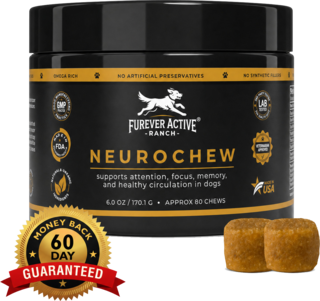
NeuroChew by Furever Active is one SKU with a serving size of 2 soft chews (4g), built for daily brain-health support rather than sedation, with no melatonin and no sedative herbs on the label.
Our label prints exact amounts: Phosphatidylserine (PS) 5 mg per serving, Huperzine-A 100 mcg per serving, Alpha Lipoic Acid Powder (ALA) 25 mg per serving, Norwegian Salmon Oil 100 mg per serving, and Vitamin B1 15 mg per serving. Dosing by weight: Under 30lbs = 2 soft chews; 30-60lbs = 3 soft chews; 60-90lbs = 4 soft chews; 90-120lbs = 5 soft chews; 120-150lbs = 6 soft chews; 150-180lbs = 7 soft chews.
Run the printed-amount test on any bag, ours included: if the label will not print the exact amount of every active ingredient, assume the worst.
Related: can dogs get anxiety after pneumonia
Fairy-dusting stacks impressive names under one combined figure so you never learn the milligrams. A daily chew only belongs after routine, training, and medical checks already have a lane.
Adjacent label-reading notes include ashwagandha for dogs dosage at /blogs/senior-dog-care/can-dogs-have-ashwagandha, collagen for senior dogs at /blogs/senior-dog-care/collagen-for-dogs, and does cosequin really work for dogs at /blogs/senior-dog-care/cosequin-for-dogs-review.
Source: Peer-reviewed article via PubMed Central
Bottom line: print the milligrams, then decide with your vet.
Who should pause before any daily chew
If an older dog suddenly begins showing new signs of anxiety, it may be due to age-associated cognitive changes or physical pain, which should be evaluated by a veterinarian before any supplement routine starts. Do not start NeuroChew until that workup is done and your veterinarian is comfortable with a daily brain-support chew.
If you want something that knocks a dog out for fireworks night, this label is the wrong tool, and we would rather say so before you buy.
Source: Cornell Riney Canine Health Center
Bottom line: new fear overnight means clinic before chew aisle.
Our answer to the calming-aid question
Full transparency: NeuroChew is ours. It's a veterinarian-approved daily soft chew that supports normal brain function and healthy circulation in dogs.
It's daily support, not medicine, designed to fit alongside your vet's plan rather than replace it. Dr.
Ruth Roberts, DVM, CVFT, puts it this way: "I support NeuroChew because it's the first dog chew that supports both brain function and healthy circulation!" If the signs above sound familiar, a daily brain-support routine is one of the simplest places to start.
Frequently asked questions
What does an anxiety attack look like in a dog?
Owners usually mean a sudden cluster of stress signs such as pacing, heavy panting, trembling, whining, or hiding. Log duration, trigger, and recovery time so your veterinarian can separate a one-off scare from a repeating pattern.
How can owners help a dog with anxiety?
After a veterinarian rules out pain and other medical causes, gradual desensitization and counterconditioning are the core owner tools. A predictable schedule and a quiet retreat lower daily load. Supplements, when used, sit beside that plan as structure-function support, never as a standalone fix story.
How do I know if my senior dog has anxiety?
If an older dog suddenly begins showing new signs of anxiety, it may be due to age-associated cognitive changes or physical pain, which should be evaluated by a veterinarian. That is a medical first pass, not a product-aisle guess.
How to train anxiety out of a dog?
Work below the intensity that tips your dog into a full spike, pair the trigger with good outcomes, and keep sessions short. Scolding after a mess usually raises fear. Bring in a veterinary behaviorist when progress stalls for weeks.
Is anxiety attack a real clinical label in dogs?
No. Sources in this packet describe acute fear, separation-related distress, and owner-reported anxiety signs rather than a formal "anxiety attack" clinical label. The phrase is useful owner shorthand for a sudden spike you can observe and log.
Can gut health supplements stop a dog's fear spike?
Gut-behavior research is still emerging, and individual response varies. Association studies and strain-specific trials are not the same as proof that a random chew will rewrite temperament or stop a panic episode on the spot.
So do dogs have anxiety attacks in the everyday sense owners mean? Dogs can show sudden, intense fear spikes, and those episodes deserve calm observation rather than guess-and-scold.
Map the signs, rule out age-associated change or pain with your veterinarian when something new appears overnight, train with gradual exposure instead of punishment, and keep the home routine predictable. If you want a daily brain-support chew built for cognition and nervous-system wellness rather than sedation, read the full NeuroChew label, run the printed-amount test yourself, and start only after the medical checks are done.
References
- Owner-reported prevalence and severity of fear and anxiety in dogs, Veterinary Research Communications (Springer), via PubMed Central. https://pmc.ncbi.nlm.nih.gov/articles/PMC13110192/
- Anxious behavior: How to help your dog cope with unsettling situations, Cornell Riney Canine Health Center. https://www.vet.cornell.edu/departments-centers-and-institutes/riney-canine-health-center/canine-health-topics/anxious-behavior-how-help-your-dog-cope-unsettling-situations
- Gut microbiota composition is related to anxiety and aggression scores in companion dogs, Peer-reviewed article via PubMed Central. https://pmc.ncbi.nlm.nih.gov/articles/PMC12234828/
- Efficacy of a Novel Lactiplantibacillus plantarum Strain in Reducing Canine Aggression and Anxiety: A Randomized Placebo-Controlled Trial, Peer-reviewed article via PubMed Central. https://pmc.ncbi.nlm.nih.gov/articles/PMC12345577/
- Gut-Brain Axis Impact on Canine Anxiety Disorders: New Challenges for Behavioral Veterinary Medicine, Veterinary Medicine International (Wiley, formerly Hindawi), via NCBI/PMC. https://pmc.ncbi.nlm.nih.gov/articles/PMC10827376/
- The Relationship between Canine Behavioral Disorders and Gut Microbiome and Future Therapeutic Perspectives, Animals (MDPI). https://pmc.ncbi.nlm.nih.gov/articles/PMC11273744/
- Separation Anxiety in Dogs, VCA Animal Hospitals. https://vcahospitals.com/know-your-pet/separation-anxiety-in-dogs
- Separation Anxiety, ASPCA. https://www.aspca.org/pet-care/dog-care/common-dog-behavior-issues/separation-anxiety
As of July 2026
Get practical dog wellness tips by email
Occasional, useful guidance on keeping your dog healthy and happy. Unsubscribe anytime.
No spam. We respect your inbox.
Support your dog's brain health with NeuroChew
NeuroChew is our daily soft chew for dogs, made fresh in the USA. See the ingredients and how it fits into a healthy daily routine.
Learn more about NeuroChew