Dog Brain Health
Best Over the Counter Anxiety Meds for Dogs


The best over the counter anxiety meds for dogs are the options your veterinarian clears first, then ranks inside a real behavior plan, using printed amounts rather than aisle hype. Structure-function products and supplements are not prescription sedatives, and human medicines are not a home pharmacy.
If you have been reading bottles at midnight, you want something safer than a random human pill without pretending a chew replaces training or a clinic visit. This guide keeps categories honest: what OTC options can and cannot do, which label tests matter, how alone-time distress shows up at home, where gut-brain research sits on the evidence ladder, why human medicines need a clinician, and where a daily brain-health chew like NeuroChew fits without sedation theater.
Related: what can i give my dog for anxiety
AT A GLANCE
The pick: Our pick is NeuroChew, our own daily brain-health chew, held to the standard this guide teaches.
Reason one: Built for daily brain support, not sedation.
Reason two: Veterinarian-approved, with Dr. Ruth Roberts, DVM, CVFT as the named endorser.
Reason three: A 60-day guarantee, refunded even on an empty bottle.
Skip it if: Your dog has new, sudden, or severe symptoms, is pregnant, nursing, or a puppy, is on medication, or is managing an existing condition without your veterinarian's input.
Start with safety before any OTC bottle
Always consult your veterinarian before giving your dog any over-the-counter calming aids or supplements to ensure they are safe and suitable for your dog's specific needs. Human antihistamines, leftover prescriptions, and random marketplace bottles are not a home pharmacy.
Your vet knows the medications, life stage, and medical history that change the risk picture, and that conversation belongs before the first dose.
Source: Cornell Riney Canine Health Center
Bottom line: vet clearance comes before any OTC bottle.
What separation-related distress can look like at home

Owners can look out for signs of separation anxiety such as whining, howling, destructive chewing, pacing, or accidents in the house when left alone. Those patterns usually show up soon after departure, not hours later as random mischief.
Video from a cheap camera is often more honest than memory.
Naming the pattern correctly keeps you from buying a bottle for the wrong problem.
Source: Today's Veterinary Practice
Bottom line: name alone-time distress patterns before you shop.
When OTC support is not enough
If your dog's anxiety leads to self-harm, extreme escape attempts, or intense panic, seek immediate professional help from a veterinarian or certified veterinary behaviorist. Broken teeth on crate bars, bloody paws, or full-body panic are not mild stress days.
An aisle product is the wrong tool in that moment.
Get hands-on help first, then rebuild the plan with people who can prescribe and coach safely.
Source: Today's Veterinary Practice and Veterinary Medicine: Research and Reports (Sargisson 2014), via PubMed Central
Bottom line: crisis signs are a clinic problem, not an aisle upgrade.
OTC products work best beside a behavior plan

Calming aids and dietary supplements are generally most effective when integrated into a broader behavioral modification plan rather than used as a sole solution. That is the quiet agreement across veterinary behavior writing: the retraining program drives lasting change, and products are optional adjuncts.
If a label implies the chew alone will rewrite your dog's emotional map, put it back.
Source: Veterinary Medicine: Research and Reports (Sargisson 2014), via PubMed Central
Bottom line: products are adjuncts; the plan does the heavy lifting.
Skip the scolding loop when you walk back in
Avoid punishing or scolding your dog for anxious behaviors when you return home, as this can increase their fear and worsen their overall anxiety. A shredded pillow is information, not a moral failure.
Calm re-entry keeps the emotional temperature down so training can stick.
Save your energy for the plan you run before the next departure.
Source: Today's Veterinary Practice and Veterinary Medicine: Research and Reports (Sargisson 2014), via PubMed Central and Cornell Riney Canine Health Center
Bottom line: scolding after panic makes the next departure harder.
Desensitization still does the heavy lifting
Gradual desensitization and counterconditioning techniques may help a dog learn to associate being alone with positive experiences rather than fear. Short, boring practice departures beat heroic all-day absences you hope they will suddenly tolerate.
Related: can dogs get anxiety after pneumonia
Food toys, predictable cues, and tiny time increases are the unglamorous core.
OTC support cannot replace those reps.
Source: Veterinary Medicine: Research and Reports (Sargisson 2014), via PubMed Central and Today's Veterinary Practice
Bottom line: graduated practice is still the core tool.
Build a quiet landing zone before you open a bottle
Setting up a quiet, comfortable sanctuary space and offering interactive food puzzles may help distract and calm a dog experiencing mild stress. Think dim light, a familiar bed, and a food puzzle that lasts longer than your shoe-tying routine.
Use that setup on ordinary days so it does not become a panic cue that only appears when you leave.
Bottom line: a practiced sanctuary beats a last-minute bottle grab.
A label-first map of common OTC aisles
Research into how the canine gut microbiome relates to anxiety is still emerging, and individual dog responses to gut-targeted supports may vary. Use that ceiling as your shopping filter.
Read each bottle the same way: Is this a supplement chew, a pheromone product, a probiotic, or a human drug redirected at dogs?
Does every active print a milligram amount, or is the panel a proprietary blend total? Does the formula lean on melatonin or sedative herbs that sell sleepiness as calm?
Fairy-dusting stacks impressive names under one combined figure so you never learn the milligrams.
Sedation is not the same thing as calm. Rank options by transparency and fit inside your vet's plan, not by front-of-bag adjectives.
This page does not invent product-specific doses without dual-verified label sources.
Source: Animals (MDPI) and Peer-reviewed article via PubMed Central
Bottom line: emerging gut-anxiety science is a filter, not a shopping free-for-all.
How the gut-brain conversation actually works
The gut-brain axis allows communication between a dog's digestive system and brain, meaning their gut microbiome composition may play a role in their emotional responses and stress levels. That is education about pathways, not a promise that any chew rewires mood on contact.
Reviews describe metabolic, neural, endocrine, and immune routes in the conversation.
Keep the wording at may play a role, because that is what the sources support.
Source: Veterinary Medicine International (Wiley, formerly Hindawi), via NCBI/PMC and Peer-reviewed article via PubMed Central
Bottom line: gut-brain talk is pathway education, not a product promise.
What the microbiome studies can and cannot say
Studies suggest that dogs experiencing high anxiety or aggression may have a different balance of gut bacteria compared to non-anxious dogs. Those findings are associations from owner-rated scores and fecal sequencing, not proof that changing the microbiome fixes behavior.
Related: how much melatonin can i give my dog for anxiety
Genus-level links such as Blautia show up in the research conversation, and overall group differences can still be small.
Do not stretch a correlation paper into a product pitch.
Source: Peer-reviewed article via PubMed Central and Animals (MDPI)
Bottom line: association studies are not causation or a dose chart.
Why probiotic headlines need a strain check
Some clinical trials have evaluated strains like Lactiplantibacillus plantarum to see how targeting the gut microbiome might help manage anxious behaviors in dogs. Strain-specific results stay with that strain.
NeuroChew is not documented as containing Lactiplantibacillus plantarum, so those trial headlines do not transfer onto our label.
If a competitor leans on a probiotic study, ask whether the exact strain and dose on their bag match the paper.
Source: Peer-reviewed article via PubMed Central
Bottom line: probiotic claims are strain-specific, not category-wide.
Probiotics as optional support, not a magic switch
Specific probiotics may help support a calm demeanor in dogs by interacting with the gut-brain axis, though you should consult your vet before starting any new supplement regimen. The honest ceiling is strain-specific and still early in dogs.
Run probiotics as one possible tool your vet may discuss, not as a substitute for behavior work.
Source: Peer-reviewed article via PubMed Central and Veterinary Medicine International (Wiley, formerly Hindawi), via NCBI/PMC
Bottom line: probiotics are optional, strain-bound, and vet-gated.
Human medicines still need a clinician first
Always consult your veterinarian before giving your dog any over-the-counter calming aids or supplements to ensure they are safe and suitable for your dog's specific needs. That rule is louder when the bottle was made for people rather than for dogs.
We will not invent a human-drug dose chart here.
If a clinician ever green-lights an OTC drug from the human cabinet, the dose, timing, and stop rules come from that clinician for that dog.
Bottom line: human OTC drugs are not a DIY dog pharmacy.
NeuroChew on a label-first OTC shortlist
Some clinical trials have evaluated strains like Lactiplantibacillus plantarum to see how targeting the gut microbiome might help manage anxious behaviors in dogs. Strain-specific probiotic headlines stay with those strains, which is one reason a daily brain-support chew is a different decision.
Full transparency: NeuroChew is ours.
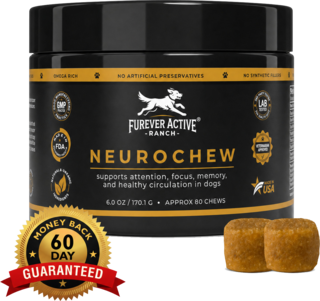
We make one SKU at Furever Active with a serving size of 2 soft chews (4g). Printed actives per serving include Phosphatidylserine (PS) 5 mg, Huperzine-A 100 mcg, Alpha Lipoic Acid Powder (ALA) 25 mg, Norwegian Salmon Oil 100 mg, and Vitamin B1 15 mg.
Dosing by weight runs from 2 soft chews under 30lbs up to 7 soft chews at 150-180lbs.
Related: can i give my dog benadryl for anxiety
The formula does not list melatonin, valerian, chamomile, L-theanine, tryptophan, hemp, or CBD. It is built for daily brain support and cognitive function.
Commercial policy only: 60-day guarantee, even on an empty bottle.
That is a refund policy, not a promise about what the chew will do.
Bottom line: NeuroChew is a transparent daily brain-support chew on a vet-first OTC shortlist, not a sedative med.
Our answer to the calming-aid question
Full transparency: NeuroChew is ours. It's a veterinarian-approved daily soft chew that supports normal brain function and healthy circulation in dogs.
It's daily support, not medicine, designed to fit alongside your vet's plan rather than replace it. Dr.
Ruth Roberts, DVM, CVFT, puts it this way: "I support NeuroChew because it's the first dog chew that supports both brain function and healthy circulation!" If the signs above sound familiar, a daily brain-support routine is one of the simplest places to start.
Frequently asked questions
What is the best thing to give a dog with anxiety?
There is no single answer for every dog. Calming aids and dietary supplements are generally most effective when integrated into a broader behavioral modification plan rather than used as a sole solution, and your veterinarian should clear anything that goes in the bowl.
What is the best over the counter calming aid for dogs?
Pick the option that passes a vet safety check, prints every active amount, and fits the trigger you actually have. Alone-time distress, noise fear, and mild situational stress are not interchangeable shopping jobs.
What human medicine can I give a dog for anxiety?
Do not invent a human-medicine plan from a search result. Always consult your veterinarian before giving your dog any over-the-counter calming aids or supplements to ensure they are safe and suitable for your dog's specific needs.
Can Benadryl calm a dog down?
Do not invent a human-medicine plan from a search result. If your dog's anxiety leads to self-harm, extreme escape attempts, or intense panic, seek immediate professional help from a veterinarian or certified veterinary behaviorist.
Do probiotics help dogs with anxiety?
Specific probiotics may help support a calm demeanor in dogs by interacting with the gut-brain axis, though you should consult your vet before starting any new supplement regimen. Research into how the canine gut microbiome relates to anxiety is still emerging.
Are OTC calming aids the same as prescription meds?
No. Structure-function supplements and other OTC tools are not interchangeable with veterinary-prescribed medication. Prescription decisions belong to a clinician who knows your dog.
Shop OTC options the same way you would read any label: printed amounts, a clear role for each active, no fairy-dust blends, and a plan that still includes training and veterinary judgment. Crisis signs need a clinician first.
Mild stress support sits beside behavior work. Gut-targeted ideas stay strain-specific and early.
NeuroChew is a daily brain-health chew with a public panel, not an aisle sedative, and it still waits its turn behind safety clearance.
References
- Canine Separation Anxiety (On Your Best Behavior), Today's Veterinary Practice. https://todaysveterinarypractice.com/behavior/on-your-best-behavior-canine-separation-anxiety/
- Canine separation anxiety: strategies for treatment and management, Veterinary Medicine: Research and Reports (Sargisson 2014), via PubMed Central. https://pmc.ncbi.nlm.nih.gov/articles/PMC7521022/
- Anxious behavior: How to help your dog cope with unsettling situations, Cornell Riney Canine Health Center. https://www.vet.cornell.edu/departments-centers-and-institutes/riney-canine-health-center/canine-health-topics/anxious-behavior-how-help-your-dog-cope-unsettling-situations
- Gut microbiota composition is related to anxiety and aggression scores in companion dogs, Peer-reviewed article via PubMed Central. https://pmc.ncbi.nlm.nih.gov/articles/PMC12234828/
- Efficacy of a Novel Lactiplantibacillus plantarum Strain in Reducing Canine Aggression and Anxiety: A Randomized Placebo-Controlled Trial, Peer-reviewed article via PubMed Central. https://pmc.ncbi.nlm.nih.gov/articles/PMC12345577/
- Gut-Brain Axis Impact on Canine Anxiety Disorders: New Challenges for Behavioral Veterinary Medicine, Veterinary Medicine International (Wiley, formerly Hindawi), via NCBI/PMC. https://pmc.ncbi.nlm.nih.gov/articles/PMC10827376/
- The Relationship between Canine Behavioral Disorders and Gut Microbiome and Future Therapeutic Perspectives, Animals (MDPI). https://pmc.ncbi.nlm.nih.gov/articles/PMC11273744/
As of July 2026
Get practical dog wellness tips by email
Occasional, useful guidance on keeping your dog healthy and happy. Unsubscribe anytime.
No spam. We respect your inbox.
Support your dog's brain health with NeuroChew
NeuroChew is our daily soft chew for dogs, made fresh in the USA. See the ingredients and how it fits into a healthy daily routine.
Learn more about NeuroChew