Dog Brain Health
Dog Anxiety Medication: Rx, OTC, and Natural Options Compared


Anxiety medication for dogs comes in three lanes. Prescription options are chosen with a veterinarian and tailored to the dog's health profile and triggers. Over-the-counter calming support exists, and checking it with a veterinarian is still the recommended move. And the free lane, a quiet safe zone, structured training, and never punishing anxious behavior, carries real veterinary-behaviorist backing of its own.
Type this question into a search bar at midnight and you'll find two kinds of pages: ones that promise a pill fixes everything, and ones so cautious they never actually answer. This guide tries to be a third kind. It walks the three real lanes for an anxious dog: prescription medication and where it belongs, over-the-counter options and what to know before buying, and the behavioral and environmental work that costs nothing. You'll also find what the newest gut-brain research does and doesn't say, and the red flags that mean it's time to stop reading articles and get help.
Related: what can i give my dog for anxiety
What anxiety actually looks like in a dog

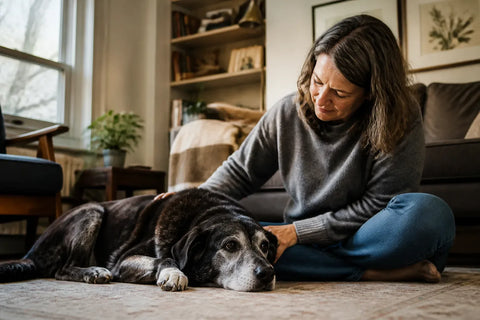
You've been watching her differently lately, and you know it. Signs of anxiety in dogs can range from subtle cues like lip licking, yawning, and panting to more obvious behaviors like pacing, constant vigilance, or destructive chewing. The subtle end of that range is the part most owners miss, because a yawn doesn't look like distress.
In separation-related cases, veterinary behaviorists describe distress vocalization like howling and whining, destruction focused on exit doors and the owner's possessions, and house soiling that happens specifically when the dog is left alone. The pattern and the timing tell you more than any single behavior does.
Source: Today's Veterinary Practice and Cornell Riney Canine Health Center and VCA Animal Hospitals
The prescription lane: where real medication belongs

The strongest options come with a prescription pad attached. Choosing the most appropriate prescription option for a dog's anxiety should be done under the guidance of a veterinarian, who can tailor the selection to the dog's unique health profile and the nature of their anxiety triggers. That tailoring is the entire point of the prescription lane: the same dog can respond very differently depending on health history and what actually sets the anxiety off.
Which specific option fits your dog is exactly the conversation to have at the clinic rather than to settle from an article. What a guide like this one can do is help you arrive at that conversation informed.
Source: VCA Animal Hospitals
Situational medication for events you can see coming
Some hard days are on the calendar in advance. Administering veterinarian-prescribed pre-visit medications ahead of appointments may help reduce acute fear, allowing for a calmer examination experience. The idea generalizes to a useful distinction: some dogs need daily support, while others mostly struggle with specific, predictable events.
Related: what causes anxiety in dogs
Naming which kind of dog you have, before the appointment, makes the whole medication conversation more productive. Bring your notes on when the fear shows up and how intense it gets, because the pattern is half the diagnosis.
Source: VCA Animal Hospitals
The over-the-counter shelf, read honestly
The store shelf has its own promises. Even when exploring non-prescription or over-the-counter calming support options, consulting with a veterinarian is highly recommended to ensure they are safe and appropriate for your dog. That advice isn't gatekeeping.
Calming products vary enormously in what they contain and how much evidence sits behind them, and appropriate for one dog is not appropriate for another. The two questions worth asking about anything on that shelf: what exactly is in it, and has that exact thing been studied in dogs? The rest of this guide walks through what the research actually covers.
Source: Cornell Riney Canine Health Center and VCA Animal Hospitals
The gut-brain thread: what's real so far
The gut keeps showing up in conversations about the brain. Certain probiotics, such as specific strains of Lactiplantibacillus plantarum, may support balanced behavior in dogs, reflecting the link between gut health and emotional well-being. The key word in that sentence is specific.
Probiotic research is strain-level research: a result for one named strain says nothing about the unnamed blend in a random calming chew. Reviews of the canine gut-brain axis describe real communication pathways between the gut microbiome, the immune system, and the nervous system, with short-chain fatty acids and neurotransmitter systems among the proposed links. Mechanism is not the same as outcome, and the next two sections stay honest about that line.
Related: can i give my dog benadryl for anxiety
Source: Peer-reviewed article via PubMed Central and Veterinary Medicine International (Wiley, formerly Hindawi), via NCBI/PMC and Animals (MDPI)
Anxious dogs, different gut bacteria: an association worth watching
The newest line of research looks somewhere unexpected. Studies suggest that dogs displaying signs of anxiety or aggression may have a different composition of gut bacteria compared to calmer, non-anxious companion dogs. In one peer-reviewed study of companion dogs, one bacterial genus, Blautia, was consistently linked to owner-rated anxiety.
The boundaries matter as much as the finding: this is observational research, the behavior ratings came from owners, and an association is not a cause. Nobody has shown that changing a dog's gut bacteria changes a dog's anxiety. What the finding earns is exactly what it says: an association worth watching as the research grows.
Source: Peer-reviewed article via PubMed Central and Animals (MDPI)
Why the honest answer is still: it varies
New science deserves old-fashioned patience. While the science surrounding the gut-brain axis in companion animals is growing, individual dogs may show varying behavioral responses to dietary and microbial supports. The researchers themselves say the canine-specific evidence is still scarce and exploratory, and that honesty is worth copying.
If you try a dietary approach, treat your own dog as the study that matters: one change at a time, a few weeks of honest observation, and notes you can trust more than your memory.
Source: Veterinary Medicine International (Wiley, formerly Hindawi), via NCBI/PMC and Animals (MDPI) and Peer-reviewed article via PubMed Central
The safe zone: cheap, boring, and backed
Every dog deserves one room where the world gets quiet. Providing a quiet, darkened sanctuary or comfortable safe zone within the home may help a dog feel more secure and cope with environmental stressors like thunderstorms. This is the least glamorous item in the entire guide and one of the most reliable.
Related: anxiety supplements for dogs
Pick the spot she already retreats to, make it darker and quieter, and let it be hers without conditions. A safe zone works alongside anything else you try, medication included, and it starts working the day you set it up.
Source: Today's Veterinary Practice and Cornell Riney Canine Health Center
The one thing that reliably makes it worse
Frustration in the middle of the night is deeply human. Punishing a dog for showing signs of anxiety, such as whimpering or destructive behavior, can increase their stress levels and may make the behavioral challenges worse. The behavior that's driving you to the edge is not disobedience, it's distress, and adding fear to distress compounds the original problem.
This is the cheapest fix on the page: stop doing the thing that makes it worse, and the rest of your plan gets easier.
Source: Cornell Riney Canine Health Center and VCA Animal Hospitals
Separation anxiety: the combined approach wins
The goodbye at the front door is its own skill. Managing long-term behavior issues like separation anxiety often yields the best results when combining structured training plans with professional veterinary guidance and behavior modification. In practice, the behaviorist playbook is built on graduated mock departures, where leaving is rehearsed in tiny, boring doses, paired with desensitization and counterconditioning so the triggers lose their charge.
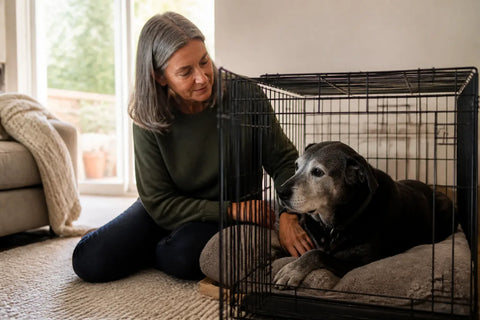
One caution from the same specialists: crating an anxious dog can backfire, since confinement may drive intense escape attempts. Separation anxiety is a marathon problem, and the combined approach exists because no single tool finishes it alone.
Related: dog anxiety in crate
Source: VCA Animal Hospitals
The red flags that end the research phase
Some nights cross a line you'll recognize when you see it. When a dog exhibits intense panic, destructive behavior, or signs of self-injury during stressful events, it is critical to consult a veterinarian or a veterinary behaviorist for specialized support. Self-injury is the brightest of those lines: a dog hurting herself during a stressful event means the problem has outgrown articles and store shelves.
There's no failure in that escalation. The specialists exist because some cases need them, and getting there sooner spares the dog repeats of her worst nights.
Source: VCA Animal Hospitals and Today's Veterinary Practice
Our answer to the calming-aid question

From our family ranch, full disclosure: this one is ours
Since you're weighing calming options anyway, full disclosure: NeuroChew is ours, and it plays one specific position. It isn't a sedative, and the training and routines above still do the behavior work. What it covers is the daily foundation: a veterinarian-approved soft chew with phosphatidylserine, Norwegian salmon oil, and beet root with ginger that supports normal brain function and healthy circulation while you work the rest of the plan.
- ✓ 60-day guarantee: not thrilled? Even the empty bottle gets a full refund
- ✓ Free shipping on every order
- ✓ Multi-bottle packs save up to 40%
"I support NeuroChew because it's the first dog chew that supports both brain function and healthy circulation!" Dr. Ruth Roberts, DVM, CVFT
See What's Inside NeuroChew →Daily support, not medicine. It fits alongside your vet's plan, never in place of it.
Frequently asked questions
What is the best drug for anxiety in dogs?
There is no universal best. Choosing the most appropriate prescription option should be done under the guidance of a veterinarian, who can tailor the selection to the dog's unique health profile and the nature of their anxiety triggers. What works for one dog can be wrong for another.
What can I give my dog for anxiety without a vet prescription?
Over-the-counter calming support options exist, and consulting a veterinarian about them is still recommended to confirm they're safe and appropriate for your dog. Alongside anything from the shelf, a quiet darkened safe zone at home may help a dog feel more secure during stressors like thunderstorms.
How do I calm dog anxiety naturally?
The approaches with veterinary-behaviorist backing are a quiet safe zone in the home, structured training combined with behavior modification for issues like separation anxiety, and never punishing anxious behavior, which can increase stress and make things worse. Gut-brain approaches are an emerging area where individual responses vary.
What human meds can I give my dog for anxiety?
Reaching for human medication on your own is the wrong turn here. Prescription choices for a dog's anxiety are tailored to that dog's health profile by a veterinarian, and even over-the-counter options are worth checking first. What's safe for you can be unsafe for her.
The honest map looks like this: real prescription options exist and belong in a tailored plan, the store shelf requires the same skepticism as any promise in a bottle, and the free work at home, the safe zone, the structure, the patience, is backed by the same specialists who write the prescriptions. Pick one lane to start. Watch what actually changes. An anxious dog doesn't need you to have every answer tonight. She needs you calm, consistent, and willing to get the right kind of help at the right time.
Get practical dog wellness tips by email
Occasional, useful guidance on keeping your dog healthy and happy. Unsubscribe anytime.
No spam. We respect your inbox.
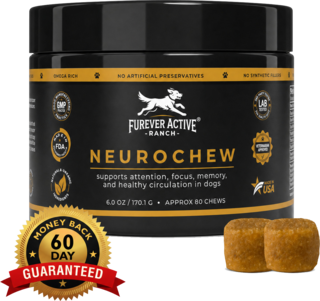
Support your dog's brain health with NeuroChew
NeuroChew is our daily soft chew for dogs, made fresh in the USA. See the ingredients and how it fits into a healthy daily routine.
Learn more about NeuroChew