Dog Brain Health
Calming Music for Dogs: Comparison and Label Test


Calming music for dogs is an environmental layer, not a stand-alone fix. Complementary therapies may assist in managing a dog's anxiety when combined with professional behavior modification plans. Rank music beside pheromones, pressure wraps, and transparent chews rather than treating a playlist as medicine.
If thunder or a late-night restlessness cycle has you searching playlists at midnight, you are not alone. Music is one of several non-pharmaceutical tools owners try before they open a pouch.
Related: calming pheromones for dogs
This comparison keeps the job honest: what an audio track can and cannot do, which neighboring tools share the same adjunct lane, and how to read any chew label with a printed-amount test. We sell NeuroChew for daily brain support, and we will say when a playlist, a diffuser, or a clinic visit is the better next move.
AT A GLANCE
The pick: Our pick is NeuroChew, our own daily brain-health chew, held to the standard this guide teaches.
Reason one: Built for daily brain support, not sedation.
Reason two: Veterinarian-approved, with Dr. Ruth Roberts, DVM, CVFT as the named endorser.
Reason three: A 60-day guarantee, refunded even on an empty bottle.
Skip it if: Your dog has new, sudden, or severe symptoms, is pregnant, nursing, or a puppy, is on medication, or is managing an existing condition without your veterinarian's input.
Where music sits in a real plan

Complementary therapies may assist in managing a dog's anxiety when combined with professional behavior modification plans. A playlist belongs in that same adjunct lane.
It can change the room sound, and it cannot diagnose the dog or replace a professional behavior plan when the problem is already serious.
If marketing sells music as the whole answer, read that as packaging, not proof.
Source: VCA Animal Hospitals
Bottom line: music is complementary support inside a plan, not the plan.
Pheromones as non-audio environment support

Synthetic pheromones may help reduce stress-related behaviors in dogs by mimicking natural comforting signals. Diffusers, collars, and sprays change the air, not the speaker.
Use them when the trigger is a room or a travel crate more than a need for new audio.
Some households notice easier settling. Others notice nothing.
Keep what your dog shows you and drop the rest.
Related: 4health calming aid supplement bars for dogs
Bottom line: pheromone tools are environment support, not a music substitute or proof of either.
L-theanine is an ingredient class, not a playlist
L-theanine may help promote calm behavior and reduce stress in dogs experiencing anxiety. That is consumer veterinary context about a green-tea amino acid, not a reason to treat music as a dose.
Many situational calm pouches lean on L-theanine.
Our label does not list it. If a bag leads with the name, demand a printed milligram line or assume the worst.
Bottom line: L-theanine is a chew-panel story, separate from audio tools.
Alpha-casozepine evidence stays limited
Alpha-casozepine may help support the management of anxiety and fear in dogs, though scientific evidence regarding its absolute efficacy is still emerging. Milk-peptide marketing loves clinical-sounding names.
Limited evidence is not a ban, and it is a hard ceiling.
NeuroChew does not list alpha-casozepine. Hold every competitor bag to the same emerging-evidence honesty you would want from us.
Source: Veterinary Evidence
Bottom line: emerging milk-peptide evidence is not a crown for any brand.
Pressure vests: mixed responses, clear limits
Deep-pressure vests may help reduce anxiety and stress-related behaviors in some dogs, but individual responses vary widely. A wrap is hardware, not a song and not a chew.
Some dogs look looser in one.
Related: adaptil calming collar for dogs
Others fight the fabric. Use a short trial next to training, and keep expectations modest when published support is mixed.
Bottom line: pressure tools are optional hardware with uneven dog-by-dog results.
Why results stay uneven across dogs
Scientific findings on non-pharmaceutical calming aids are still emerging, and how an individual dog responds to these tools can vary significantly. That ceiling covers playlists, pheromones, wraps, and pouches.
Track what you try in ordinary language: trigger, tool, minutes until settle or none.
Sparse notes beat another untested product stack.
Source: VCA Animal Hospitals and Veterinary Evidence
Bottom line: emerging science plus dog-by-dog variance is the honest default.
Vet first when the pattern is new or severe
Always consult a veterinarian before starting any new complementary therapies or supplements for your dog's anxiety. Sudden behavior change, night disorientation, or pain signs belong on the exam table before you add a second diffuser, a new playlist, or a daily chew.
Self-research helps you read labels.
It does not replace clinical oversight.
Bottom line: clinic clearance beats another late-night experiment.
Where NeuroChew sits beside audio tools
Scientific findings on non-pharmaceutical calming aids are still emerging, and how an individual dog responds to these tools can vary significantly. That is why we refuse to sell a chew as a playlist replacement.
Related: best calming treats for dogs vet-recommended
NeuroChew is built for daily brain support, not sedation.
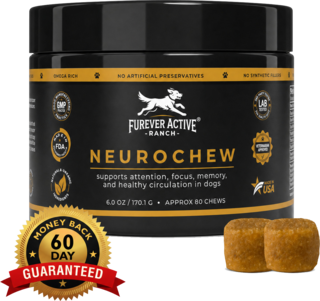
Serving size is 2 soft chews (4g). Printed actives per serving include Phosphatidylserine (PS) 5 mg, Huperzine-A 100 mcg, Alpha Lipoic Acid Powder (ALA) 25 mg, Norwegian Salmon Oil 100 mg, and Vitamin B1 15 mg.
The label does not list melatonin, valerian, chamomile, L-theanine, tryptophan, hemp, or CBD.
Weight-based dosing runs from 2 soft chews under 30lbs up to 7 soft chews at 150-180lbs. Commercial policy only: 60-day guarantee, even on an empty bottle.
Run the printed-amount test on our bag and every competitor bag the same way.
Bottom line: NeuroChew is a transparent daily brain-support chew, not an audio or sedative substitute.
Our answer to the calming-aid question
Full transparency: NeuroChew is ours. It's a veterinarian-approved daily soft chew that supports normal brain function and healthy circulation in dogs.
It's daily support, not medicine, designed to fit alongside your vet's plan rather than replace it. Dr.
Ruth Roberts, DVM, CVFT, puts it this way: "I support NeuroChew because it's the first dog chew that supports both brain function and healthy circulation!" If the signs above sound familiar, a daily brain-support routine is one of the simplest places to start.
Related: calming techniques for dogs
Frequently asked questions
Does calming music for dogs actually work?
Some dogs settle more easily with low-key audio, and individual responses vary. Complementary therapies may assist in managing a dog's anxiety when combined with professional behavior modification plans, so treat music as one layer beside training rather than as proof of a cure.
What music is backed by science for dogs?
Scientific findings on non-pharmaceutical calming aids are still emerging, and how an individual dog responds to these tools can vary significantly. No playlist earns a universal proof claim in the sources behind this page.
What is the most calming music for dogs?
There is no single winner track for every household. Start with quiet, steady audio at a modest volume, watch your dog's body language, and keep the rest of the behavior plan in charge.
Should I use music instead of a calming treat?
Music and chews do different jobs. Audio changes the room. An ingested product changes what goes in the bowl. Compare each on its own terms and keep both as optional adjuncts inside training and veterinary guidance.
When should I skip home tools and call the clinic?
Always consult a veterinarian before starting any new complementary therapies or supplements for your dog's anxiety, especially when behavior shifts suddenly, night disorientation appears, or pain is possible.
Do pheromones or pressure vests work better than music?
Synthetic pheromones may help reduce stress-related behaviors in dogs by mimicking natural comforting signals, and deep-pressure vests may help some dogs while responses vary widely. Neither is automatically better than audio. Match the tool to the trigger and the dog in front of you.
Treat audio support as one layer beside training, environment work, and veterinary judgment. Complementary therapies may assist in managing a dog's anxiety when combined with professional behavior modification plans, and the same adjunct rule applies to pheromones, pressure wraps, and chews.
Run the printed-amount test on every bag, including ours. NeuroChew is a daily brain-health soft chew with a public milligram panel, not a sedative stack and not a substitute for a behavior plan.
References
- Behavior Counseling - Complementary Medication, VCA Animal Hospitals. https://vcahospitals.com/know-your-pet/behavior-counseling---medication-complementary
- L-Theanine, VCA Animal Hospitals. https://vcahospitals.com/know-your-pet/l-theanine
- Pheromones, VCA Animal Hospitals. https://vcahospitals.com/know-your-pet/pheromones
- Is Alpha-casozepine Efficacious at Reducing Anxiety in Dogs?, Veterinary Evidence. https://veterinaryevidence.org/index.php/ve/article/view/67
- Are Pressure Vests Beneficial at Reducing Stress in Anxious and Fearful Dogs?, Veterinary Evidence. https://veterinaryevidence.org/index.php/ve/article/view/152
As of July 2026
Get practical dog wellness tips by email
Occasional, useful guidance on keeping your dog healthy and happy. Unsubscribe anytime.
No spam. We respect your inbox.
Support your dog's brain health with NeuroChew
NeuroChew is our daily soft chew for dogs, made fresh in the USA. See the ingredients and how it fits into a healthy daily routine.
Learn more about NeuroChew