Dog Brain Health
How to Prevent Separation Anxiety in Dogs (Not a Treatment)


How to prevent separation anxiety in dogs is not a treatment shortcut: start with a predictable rest space, physical activity before you leave, honest video for your veterinarian, and a structured desensitization plan when distress is already significant.
Most searches for alone-time help start after a chewed door frame or a neighbor note about barking. This guide stays practical and clinic-first.
Related: can dogs get anxiety after pneumonia
You will get an early habit stack: a secure rest area, movement before departures, camera logs you can show a vet, and a tailored plan when distress is already loud. Red-flag signs still go to your veterinarian before anyone talks about a bag.
AT A GLANCE
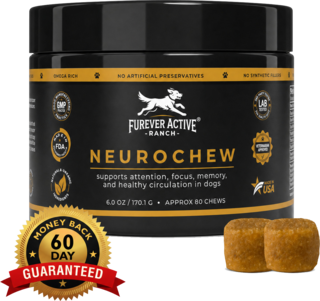
The pick: Our pick is NeuroChew, our own daily brain-health chew, held to the standard this guide teaches.
Reason one: Built for daily brain support, not sedation.
Reason two: Veterinarian-approved, with Dr. Ruth Roberts, DVM, CVFT as the named endorser.
Reason three: A 60-day guarantee, refunded even on an empty bottle.
Skip it if: Your dog has new, sudden, or severe symptoms, is pregnant, nursing, or a puppy, is on medication, or is managing an existing condition without your veterinarian's input.
Start early habits before the first long goodbye
For dogs experiencing significant distress when alone, a structured behavioral plan involving gradual desensitization and positive associations is often recommended. Veterinary behavior sources describe graduated mock departures and counterconditioning as the backbone, not a weekend crash course.
Peer-reviewed management writing also lists protective factors on the early-habit side of the line: varied experiences at roughly five to ten months of age, stable routines, and avoiding punishment after a messy return home.
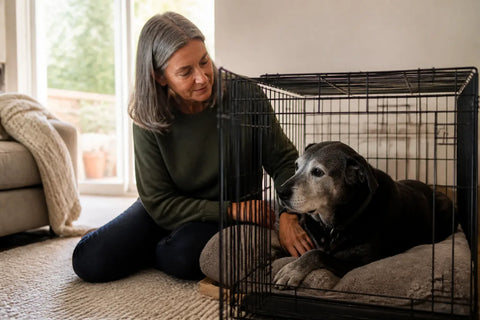
Leave for seconds, return before panic peaks, and stretch the timeline only when the dog stays loose. Those same sources caution that crating a frantic dog can drive injury during escape attempts, so the containment choice belongs inside the plan.
Source: VCA Animal Hospitals and Veterinary Medicine: Research and Reports (Sargisson 2014), via PubMed Central
Bottom line: early short absences and stable routines come first.
Build a predictable rest space before you leave
Setting up a predictable, secure area or quiet room where your dog can rest may support their ability to cope with temporary separation. Owner-facing separation guidance treats that safe area as part of a broader plan, not a standalone fix.
Keep the setup familiar and boring on purpose so the room cues rest.
Use the same bed, the same water bowl, and the same low-key settle cue on ordinary days, not only on work mornings. Board-certified veterinary behavior sources also caution that crates may promote intense escape attempts for some dogs, so containment belongs inside the plan rather than as a default.
Related: best over the counter anxiety meds for dogs
Source: ASPCA and VCA Animal Hospitals
Bottom line: a boring rest area supports temporary alone time; it is not a full plan.
Use movement and play before every departure

Providing physical activity or interactive play before departures may help your dog settle down more easily during your absence. Owner-facing separation guidance ties pre-departure activity to an easier settle once you are gone.
Use that window for ordinary movement or interactive play, then leave without turning the goodbye into a second event.
Pair the movement with the same rest-space cue you already practiced on quiet days so the body has somewhere to land.
Source: ASPCA
Bottom line: ordinary pre-departure movement is routine hygiene, not a complete plan.
Log the first thirty minutes on camera
Using a video camera to log your dog's behaviors during the initial period of your absence provides essential details for your veterinarian to evaluate. Clinical behavior writing notes that separation-related distress often shows within about the first half hour after you leave.
Film a few ordinary departures before you change the plan.
Note vocalizing, destruction focused on exits or owner possessions, or house soiling when separated, and bring the clip to the appointment instead of a vague story.
Source: Today's Veterinary Practice and VCA Animal Hospitals
Bottom line: film ordinary departures so your veterinarian sees facts.
Ask your veterinarian before you stack tools
Consult your veterinarian to determine if professional behavior plans, potentially supported by veterinary-prescribed medical management, are appropriate for your dog's distress. Peer-reviewed management reviews treat prescription adjuncts as tools directed by a veterinarian that may sit beside desensitization early on, never as a shopper substitute for a workup.
Related: do dogs have anxiety attacks
Sudden behavior change, night disorientation, or signs of pain are red flags that mean a medical exam first.
Bring your camera log, a timeline of departures, and a list of what you already tried so the visit is concrete.
Source: Veterinary Medicine: Research and Reports (Sargisson 2014), via PubMed Central and Today's Veterinary Practice and Veterinary Clinics of North America: Small Animal Practice (Elsevier), via PubMed
Bottom line: clinic-directed plans sit beside behavior work; they are not a DIY substitute.
Breed and genetics shape risk, not destiny
Studies on canine behavior suggest that genetic factors and breed differences can influence a dog's predisposition to various forms of anxiety. A large Finnish owner-questionnaire study in Scientific Reports (n=13,715 dogs across many breeds) found noise sensitivity was common and separation-related behavior less common in that cohort, with meaningful comorbidity across traits.
That population was self-selected and Finnish, so treat the percentages as one data set, not a universal ranking of breeds.
Use breed context as a planning hint, not as a verdict that your dog is doomed.
Source: Scientific Reports (Nature) - Salonen et al., 2020; via PubMed Central
Bottom line: breed context is a planning hint, not destiny.
Where a daily brain-health chew sits after the behavior standard

Because every dog responds uniquely to behavioral plans, management strategies should be tailored, keeping in mind that individual outcomes and responses can vary. Reviews of separation-related distress keep that hedge on purpose: what settles one dog can overwhelm another, and timelines are not interchangeable.
That is why we refuse to sell a chew as a fix for alone-time distress.
Related: high anxiety dog crate
NeuroChew is built for daily brain support, not sedation. The label does not list melatonin, valerian, chamomile, L-theanine, tryptophan, hemp, or CBD.
Serving size is 2 soft chews (4g), with a weight-based chart from 2 chews under 30lbs up to 7 chews at 150-180lbs.
Printed actives per serving include Phosphatidylserine (PS) 5 mg, Huperzine-A 100 mcg, Alpha Lipoic Acid Powder (ALA) 25 mg, Norwegian Salmon Oil 100 mg, and Vitamin B1 15 mg. Skip the bag if you need a clinic workup first, if you want a sedative-style product, or if the only goal is to mute a panic response during departures without a plan.
The commercial policy is separate from any outcome claim: 60-day guarantee, not thrilled, even the empty bottle gets a full refund.
Source: Veterinary Medicine: Research and Reports (Sargisson 2014), via PubMed Central and Veterinary Clinics of North America: Small Animal Practice (Elsevier), via PubMed
Bottom line: NeuroChew is a printed-amount daily brain-support chew, not a sedative and not a substitute for a vet plan.
Our answer to the calming-aid question
Full transparency: NeuroChew is ours. It's a veterinarian-approved daily soft chew that supports normal brain function and healthy circulation in dogs.
It's daily support, not medicine, designed to fit alongside your vet's plan rather than replace it. Dr.
Ruth Roberts, DVM, CVFT, puts it this way: "I support NeuroChew because it's the first dog chew that supports both brain function and healthy circulation!" If the signs above sound familiar, a daily brain-support routine is one of the simplest places to start.
Related: how much melatonin can i give my dog for anxiety
Frequently asked questions
How do you fix a dog with separation anxiety?
For dogs experiencing significant distress when alone, a structured behavioral plan involving gradual desensitization and positive associations is often recommended. Consult your veterinarian to determine if professional behavior plans, potentially supported by veterinary-prescribed medical management, are appropriate for your dog's distress.
What is the 7 7 7 rule for dogs?
That popular adoption shorthand is not covered by the veterinary sources on this page. Because every dog responds uniquely to behavioral plans, management strategies should be tailored, keeping in mind that individual outcomes and responses can vary.
What dog breed has the most separation anxiety?
Studies on canine behavior suggest that genetic factors and breed differences can influence a dog's predisposition to various forms of anxiety. That does not crown a single worst breed for every home.
Why do I miss my dog so much when I leave?
Owner guilt is common and is not a canine behavior diagnosis. Channel that energy into habits you can measure: a predictable rest space, physical activity before departures, and a camera check of the first half hour.
Does exercise before leaving help a dog left alone?
Providing physical activity or interactive play before departures may help your dog settle down more easily during your absence. Pair that movement with a predictable rest space rather than treating either step as a complete plan.
Should I record my dog when I leave the house?
Using a video camera to log your dog's behaviors during the initial period of your absence provides essential details for your veterinarian to evaluate. Clips from ordinary departures beat a vague verbal summary at the appointment.
Early alone-time work is a habit stack, not a treatment slogan. Use a secure rest area, movement before departures, video you can show a vet, and a tailored behavior plan when distress is already real.
Clinic language belongs to the veterinarian and the graduated plan. Judge any later bag with the printed-amount test: if the label will not print the exact amount of every active, assume the worst.
References
- Canine separation anxiety: strategies for treatment and management, Veterinary Medicine: Research and Reports (Sargisson 2014), via PubMed Central. https://pmc.ncbi.nlm.nih.gov/articles/PMC7521022/
- Separation Anxiety in Dogs, VCA Animal Hospitals. https://vcahospitals.com/know-your-pet/separation-anxiety-in-dogs
- Separation Anxiety, ASPCA. https://www.aspca.org/pet-care/dog-care/common-dog-behavior-issues/separation-anxiety
- Canine Separation Anxiety (On Your Best Behavior), Today's Veterinary Practice. https://todaysveterinarypractice.com/behavior/on-your-best-behavior-canine-separation-anxiety/
- Prevalence, comorbidity, and breed differences in canine anxiety in 13,700 Finnish pet dogs, Scientific Reports (Nature) - Salonen et al., 2020; via PubMed Central. https://pmc.ncbi.nlm.nih.gov/articles/PMC7058607/
- Canine anxieties and phobias: an update on separation anxiety and noise aversions, Veterinary Clinics of North America: Small Animal Practice (Elsevier), via PubMed. https://pubmed.ncbi.nlm.nih.gov/18672155/
As of July 2026
Get practical dog wellness tips by email
Occasional, useful guidance on keeping your dog healthy and happy. Unsubscribe anytime.
No spam. We respect your inbox.
Support your dog's brain health with NeuroChew
NeuroChew is our daily soft chew for dogs, made fresh in the USA. See the ingredients and how it fits into a healthy daily routine.
Learn more about NeuroChew